
Imagine standing on the deck of a ship, making a phone call. Now imagine lowering the phone into seawater. Why does a signal that can travel kilometers through the air become almost undetectable after passing through a relatively small amount of seawater?
The answer is a beautiful application of mathematics: exponential decay. The same mathematical idea that describes radioactive decay and cooling also helps explain what happens to electromagnetic waves in seawater.
This article is adapted from a presentation I gave at Rice University in November 2004.
A mathematical model for a fading signal
As a radio wave travels into a conducting material, its electric-field amplitude decreases. For a plane wave in a uniform medium, the model is
E(z)=E_0e^{-\alpha z}.Here E_0 is the initial field amplitude, z is distance traveled through the medium (in meters), and \alpha is the attenuation coefficient, measured in inverse meters. The larger \alpha is, the faster the wave fades.
This is the amplitude envelope, not the complete oscillating electric field. For our purposes, it is the part that tells us how much signal remains.
How quickly does the signal disappear?
Consider a radio wave with frequency 1 gigahertz (GHz), a representative cellular-radio frequency. Using a simple seawater model with conductivity \sigma=4\ \mathrm{S/m}, relative permittivity \varepsilon_r=80, and permeability \mu=\mu_0, we obtain approximately
\alpha\approx77.8\ \mathrm{m}^{-1}.Therefore the relative electric-field amplitude is approximately
\frac{E(z)}{E_0}=e^{-77.8z}.Let’s calculate what remains at a few depths:
| Distance through seawater | Remaining field amplitude |
|---|---|
| 1 cm | about 45.9% |
| 3 cm | about 9.7% |
| 5 cm | about 2.0% |
| 10 cm | about 0.042% |
| 1 m | about 1.6\times10^{-34} of the initial amplitude |
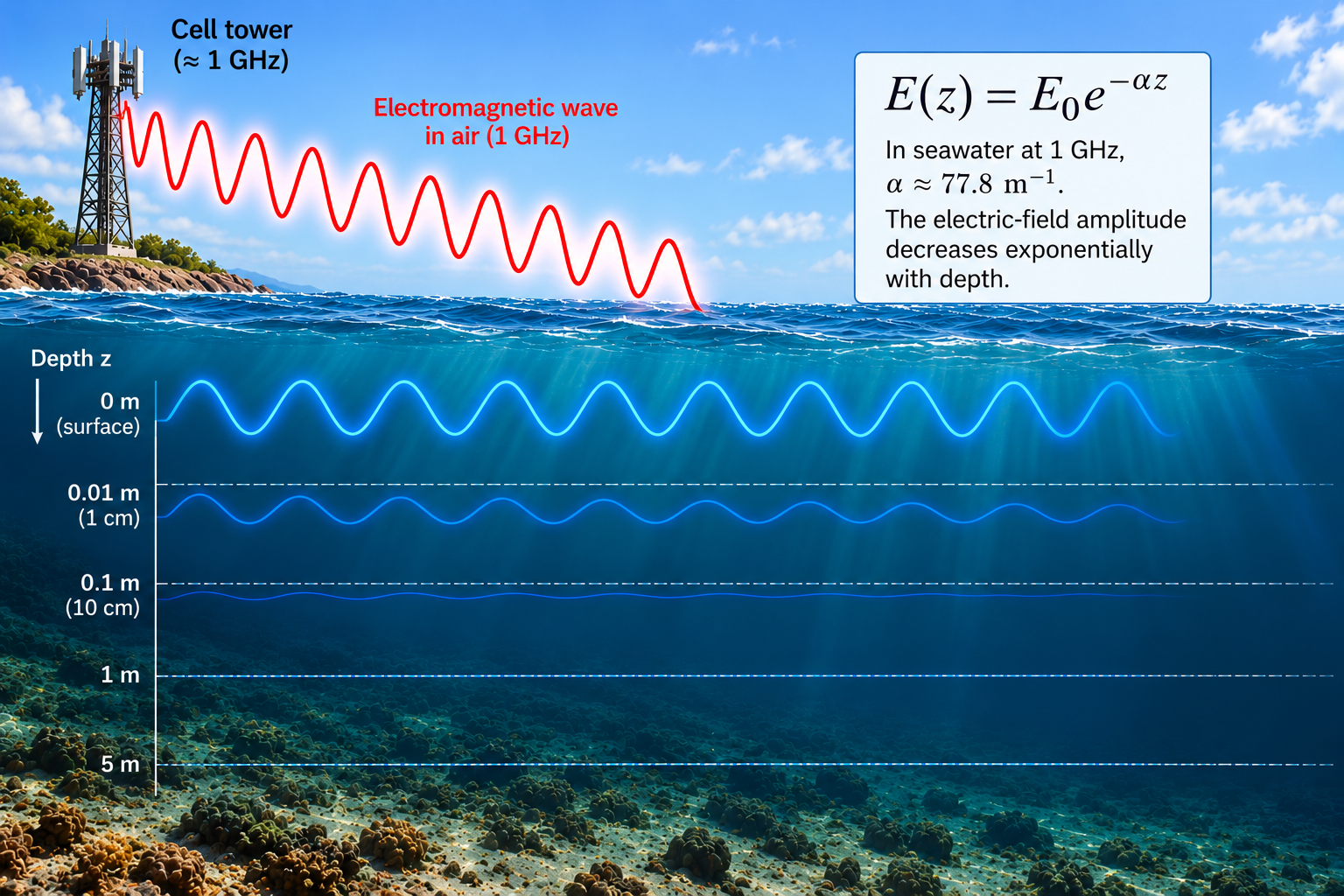
Notice how little distance is needed to produce enormous attenuation. After only 10 centimeters, less than one-thousandth of the original electric-field amplitude remains. At one meter, the idealized model predicts an extraordinarily small fraction.
Important distinction: field amplitude is not signal power. In a fixed medium, power carried by the wave scales with the square of field amplitude, so it decreases even more rapidly. Actual phone reception also depends on the antenna, geometry, frequency, and surrounding environment; this calculation isolates attenuation within seawater.
Why does seawater absorb radio waves?
Seawater contains dissolved salts that produce mobile ions. An electric field makes these charged particles move, creating electric currents. Because seawater has electrical resistance, some of the electromagnetic energy is converted into heat.
Air is a much poorer electrical conductor. That is why radio waves can travel relatively long distances through air but are strongly attenuated in seawater. Freshwater generally conducts electricity less well than seawater, so the answer changes with the water’s properties.
A mathematical challenge: How far until the signal falls to 1%?
Suppose we want to find the distance at which the electric-field amplitude has fallen to 1% of its original value. Solve
e^{-77.8z}=0.01.Taking natural logarithms gives
-77.8z=\ln(0.01),and hence
z=\frac{\ln(100)}{77.8}\approx0.0592\ \mathrm{m}.That’s only about 5.9 centimeters. This is a striking example of how logarithms help us reverse an exponential process.
How do submarines communicate, then?
Submarines do not rely on ordinary cellular signals while deeply submerged. Some submarine communication systems use much lower radio frequencies, which can penetrate seawater more effectively. These systems require specialized equipment and have major limitations, including very low data rates and, depending on the system, restrictions on depth and antenna arrangement.
Another approach is to bring an antenna nearer the surface or use a buoy. In other words, the solution is not to make an ordinary cellular signal magically pass through seawater: it is to change the communication method.
For the mathematically curious: Where does the exponential come from?
The mathematical explanation begins with Maxwell’s equations, which describe how electric and magnetic fields interact and propagate through different materials. Consider a homogeneous, isotropic conducting medium with electric permittivity \varepsilon, magnetic permeability \mu, and conductivity \sigma. Ohm’s law in differential form is
\mathbf J=\sigma\mathbf E.In a source-free region, two of Maxwell’s equations are
\nabla\times\mathbf E=-\mu\frac{\partial\mathbf H}{\partial t},
\nabla\times\mathbf H=\sigma\mathbf E+\varepsilon\frac{\partial\mathbf E}{\partial t}.
Take the curl of the first equation and substitute the second. Using \nabla\times(\nabla\times\mathbf E)=\nabla(\nabla\cdot\mathbf E)-\nabla^2\mathbf E and assuming \nabla\cdot\mathbf E=0 in the homogeneous charge-free region, we obtain
\nabla^2\mathbf E=\mu\sigma\frac{\partial\mathbf E}{\partial t}+\mu\varepsilon\frac{\partial^2\mathbf E}{\partial t^2}.Now look for a time-harmonic plane wave traveling in the positive z-direction:
\mathbf E(z,t)=\operatorname{Re}\!\left\{\hat{\mathbf x}E_0e^{-\gamma z}e^{i\omega t}\right\},where \gamma=\alpha+i\beta is the complex propagation constant. Substitution into the wave equation yields
\gamma^2=i\omega\mu\sigma-\omega^2\mu\varepsilon.Separating the real and imaginary parts gives the attenuation coefficient
\alpha=\omega\sqrt{\frac{\mu\varepsilon}{2}\left(\sqrt{1+\left(\frac{\sigma}{\omega\varepsilon}\right)^2}-1\right)}.This formula explains how frequency, conductivity, permittivity, and permeability combine to determine attenuation. It also shows why changing the radio frequency can substantially change the result.
The bigger mathematical idea
Our starting question was about a cell phone, but the underlying lesson is much broader. A simple exponential function can describe a physical effect so dramatic that centimeters make the difference between a substantial signal and an almost vanishing one.
The mathematics does more than say that seawater weakens radio waves. It tells us how quickly the weakening occurs, and it lets us calculate the distance required for any chosen reduction in amplitude.
Numerical results use an idealized homogeneous-seawater model and a 1 GHz radio wave.
The same exponential equation describes population growth, compound interest and radioactive decay: see The Population Model That Fails—and Why Its Equation Is Everywhere.
Water changes the behavior of other waves too. To see why ocean waves slow down and grow taller as they reach the beach, read Why Do Ocean Waves Slow Down Near Shore? And for the mathematics inside a modern wireless signal, see Why Does an OFDM Signal Have a Rayleigh Distribution?
Leave a Reply