
Suppose you have an extra $500 each month. Should you send it to your mortgage lender or invest it? Paying down the mortgage reduces future interest charges. Investing may build more wealth, but the outcome is uncertain. Mathematics can identify the break-even return and compare the two strategies fairly; it cannot predict market returns or decide how much risk a particular household should accept.
1. What Does an Extra Mortgage Payment Earn?
A mortgage charges interest on the outstanding balance. If the monthly interest rate is \(r\), the balance after a payment satisfies
\[B_{k+1}=(1+r)B_k-M-E_k,\]
where \(M\) is the required monthly payment and \(E_k\) is an optional extra principal payment. Every dollar of extra principal reduces the balance on which future interest is charged. (For why the early payments on a mortgage go mostly to interest, see Why Do Mortgage Payments Go Mostly Toward Interest at First?)
For example, with a 6% annual mortgage rate and monthly compounding, \(r=0.06/12=0.005\). An extra $1,000 paid toward principal reduces next month’s interest by $5, assuming the payment is applied immediately and the loan remains outstanding. The subsequent savings compound because later interest is calculated on a smaller balance.
In a simplified model with no tax effects, fees, or prepayment penalties, reducing a mortgage balance has the same mathematical accumulation factor as earning the mortgage’s interest rate on money otherwise held until payoff. The important difference is that avoided contractual interest is predictable, while an investment’s return is not.
2. The Investment Alternative
If you invest \(E\) at the end of each month and earn a constant monthly return \(i\), the accumulated value after \(n\) months is
\[F_n=E\frac{(1+i)^n-1}{i},\qquad i\ne0.\]
For \(i=0\), the formula becomes \(F_n=En\).
This is a future-value formula for an ordinary annuity. It is an exact calculation under the assumed constant return, not a forecast of what an actual investment will earn.
To compare investment returns with mortgage rates, use the same compounding convention. For instance, a nominal annual rate of 6% compounded monthly corresponds to an effective annual rate of
\[\left(1+\frac{0.06}{12}\right)^{12}-1\approx6.168\%.\]
A quoted 6% effective annual investment return instead corresponds to the monthly rate \(i=(1.06)^{1/12}-1\), which is slightly smaller than 0.005.
3. Worked Example: A $300,000 Mortgage
Consider a $300,000 fixed-rate mortgage for 30 years at a nominal annual interest rate of 6%, compounded monthly. The required monthly principal-and-interest payment is
\[M=\frac{Pr}{1-(1+r)^{-360}}\approx\$1,798.65,\qquad r=0.005.\]
Suppose an additional $500 is available every month. Compare two strategies over the same 30-year period:
- Invest first: Make only the required mortgage payment and invest $500 at the end of each month.
- Pay off first: Pay an additional $500 toward the mortgage each month. Once the mortgage is paid off, invest the entire amount previously budgeted for the mortgage and extra payment, approximately $2,298.65 per month. Any unused portion of the final payoff month’s budget is invested that month.
Both strategies use the same monthly budget. In both cases, the mortgage is gone by the end of year 30, so we can compare investment balances directly.
With the extra $500 principal payment, the mortgage is paid off during month 212, or about 17 years and 8 months, instead of month 360. That leaves roughly 148 months to invest the freed-up mortgage budget.
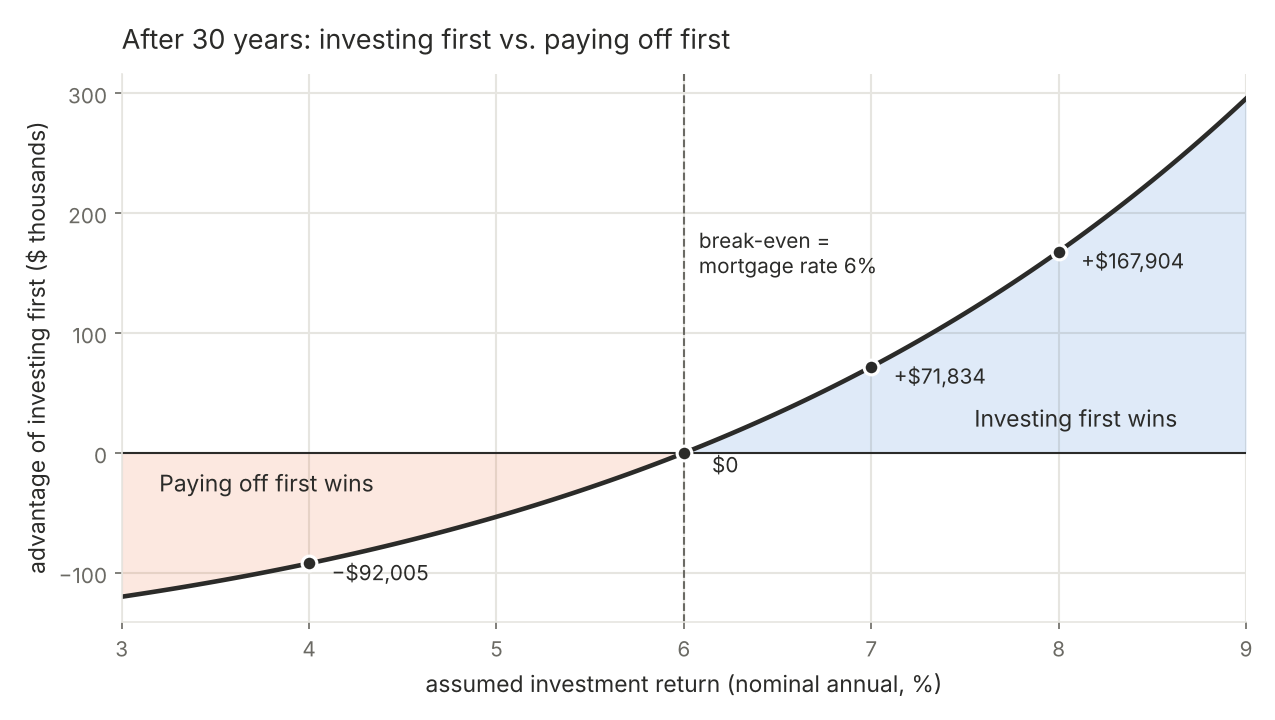
The following table assumes a constant nominal annual investment return compounded monthly, no taxes or fees, and reinvestment of all contributions. Amounts are rounded to the nearest dollar.
| Assumed investment return | Invest $500 throughout | Pay off first, then invest | Advantage of investing first |
|---|---|---|---|
| 4% | $347,025 | $439,029 | −$92,005 |
| 6% | $502,258 | $502,258 | $0 |
| 7% | $609,985 | $538,152 | +$71,834 |
| 8% | $745,180 | $577,275 | +$167,904 |
At a 4% assumed investment return, paying down the 6% mortgage first wins. At 7% or 8%, investing first wins in this simplified model. At 6%, the two approaches tie because money accumulates at the same rate whether it avoids mortgage interest or earns investment interest.
4. Why Is the Break-Even Rate the Mortgage Rate?
Here is a general way to see the result without relying on the numbers in the table. Track net wealth: the investment balance minus the mortgage balance. When the investment return equals the mortgage rate, the way each month’s budget is split between the two drops out of the calculation entirely, so every strategy with the same budget ends with the same net wealth.
Show the derivation
Suppose the remaining mortgage balance is \(B_0\), its monthly interest rate is \(r\), and the total amount available for mortgage payments and investments each month is \(C\). Let \(B_k\) be the mortgage balance after month \(k\), and let \(A_k\) be the investment balance after month \(k\).
If the amount sent to the mortgage in month \(k+1\) is \(p_{k+1}\), then
\[B_{k+1}=(1+r)B_k-p_{k+1},\]
\[A_{k+1}=(1+i)A_k+(C-p_{k+1}).\]
Assume contributions are made at the end of each month, the investment earns a constant monthly rate \(i\), and any budget not needed for the mortgage is invested. Define net financial wealth as \(W_k=A_k-B_k\). When \(i=r\), subtraction gives
\[W_{k+1}=(1+r)W_k+C.\]
The payment choice \(p_{k+1}\) disappears! Therefore, provided the strategies begin with the same balances and use the same total budget, their net wealth at any common date is identical when \(i=r\).
This is a break-even identity, not a claim that real investments earn the mortgage rate. When \(i\ne r\), the payment allocation matters.
5. Present Value and Opportunity Cost
There is another way to understand the decision. A dollar used to reduce mortgage principal cannot simultaneously be invested. The potential investment growth you give up is the opportunity cost of prepayment.
If an investment will pay \(F\) in \(n\) months and the appropriate monthly discount rate is \(i\), its present value is
\[PV=\frac{F}{(1+i)^n}.\]
But the discount rate must reflect the cash flow’s risk. A risky expected future payment should not automatically be treated as equivalent to a guaranteed reduction in debt. Comparing an expected stock-market return with a mortgage rate is useful as a scenario, but not as a risk-free arbitrage calculation.
6. Worked Example: The Importance of Taxes and Liquidity
Suppose the mortgage rate is 5% and an alternative investment has an assumed 6% annual return before taxes and fees. At first glance, investing appears better by one percentage point.
Now suppose, purely for illustration, that the investment’s gains are taxed annually at 20% and that the 6% is a simple annual return. Its after-tax return would be approximately
\[0.06(1-0.20)=0.048=4.8\%.\]
Under these simplified assumptions, 4.8% is below the 5% mortgage rate, reversing the comparison. Actual investment taxation is often more complicated: gains may be deferred, dividends and capital gains can be treated differently, and tax-advantaged accounts may change the outcome. Mortgage-interest deductions also depend on whether the taxpayer qualifies and itemizes deductions.
Liquidity matters as well. A $10,000 investment in an accessible account may be available for an emergency. An extra $10,000 mortgage principal payment increases home equity but generally cannot be withdrawn without borrowing or selling. Two strategies with similar expected wealth can therefore have very different practical consequences.
7. Risk Changes the Answer
The table in Section 3 assumes that an investment earns exactly the stated rate every month. Real returns fluctuate. A 7% long-run average does not imply a smooth 7% return, and a poor sequence of returns may leave an investor with much less money than expected.
Mortgage prepayment, by contrast, lowers a known debt obligation, subject to the loan’s terms. It can reduce required expenses sooner, but it also concentrates more of the household’s wealth in an illiquid asset: the home.
A complete comparison may therefore include expected return, variability, investment horizon, emergency reserves, tax treatment, employer retirement-plan matching, and the value of being debt-free. These considerations are not captured by a single interest-rate comparison.
8. Three Mathematical Lessons
- Compare like with like. Use the same monthly budget, time horizon, compounding convention, and treatment of leftover cash.
- The mortgage rate is the baseline break-even return in the idealized, tax-free, fee-free model with constant investment returns.
- Higher expected return is not the same as a guaranteed better outcome. Risk, taxes, and access to cash can change the decision.
9. Exercises
- A mortgage has a nominal annual rate of 4.8%, compounded monthly. What is its monthly rate? What is its effective annual rate?
- You invest $200 at the end of every month for 10 years at a nominal annual return of 6%, compounded monthly. Find the future value.
- In the idealized model, a mortgage charges 5.5% nominal annual interest compounded monthly. What nominal annual investment return compounded monthly produces the break-even result?
- Suppose a $2,000 extra principal payment is applied immediately to a mortgage charging 6% nominal annual interest compounded monthly. How much interest does this save in the following month, before accounting for any other changes?
- Explain why comparing $500 monthly investments against $500 extra mortgage payments, without investing the freed-up mortgage payment after early payoff, would be unfair over a 30-year horizon.
Show exercise solutions
- The monthly rate is \(0.048/12=0.004\), or 0.4%. The effective annual rate is \((1.004)^{12}-1\approx4.907\%\).
- With \(i=0.06/12=0.005\) and \(n=120\), the future value is \(200((1.005)^{120}-1)/0.005\approx\$32,775.87\).
- The break-even nominal annual investment return is 5.5%, provided both rates use monthly compounding and the other simplifying assumptions hold.
- The following month’s interest is lower by \(2000(0.06/12)=\$10\).
- The early-payoff strategy frees the required mortgage payment for investment. Ignoring those later contributions gives one strategy a smaller total cash budget and biases the comparison.
10. Final Perspective
Paying down a mortgage and investing are two uses of the same dollar. The mathematics shows how to compare them and why the mortgage interest rate is a natural break-even benchmark. It does not supply a universal winner. A good decision depends not only on the return one hopes to earn, but also on which risks one is willing and able to bear.
Continue exploring: The same compounding ideas appear in When a Lower Interest Rate Pays More: The Mathematics of Compounding and The Time Value of Money: From Infinite Payments to Property Prices. For the opposite question, whether to borrow at all when buying property, see Pay Cash or Put 20% Down? The Mathematics of Leverage in Real Estate.
This article is for mathematical education. Its rates and returns are illustrative assumptions, not investment forecasts or individualized financial advice.
Leave a Reply