
You tell calculus how you want the water level to rise; calculus tells you what shape to build.
In a typical related-rates exercise, we know the shape of a tank and the rate at which water flows into it. We then calculate how fast the water level rises. But what if we reverse the question? Suppose we decide in advance exactly how the water level should rise. Can we design the tank that makes it happen?
I first met this kind of inverse design problem as an engineering student at MATI in the late 1980s.
1. From a familiar problem to an inverse problem
Assume water enters a tank at a constant volumetric rate Q > 0. The tank is a surface of revolution around a vertical axis, and its radius at height h is r(h). The horizontal cross-sectional area is
A(h)=\pi r(h)^2.When the water rises by a small amount, the volume changes by dV=A(h)\,dh. The chain rule gives
\frac{dV}{dt}=\frac{dV}{dh}\frac{dh}{dt}=\pi r(h)^2\frac{dh}{dt}.Since dV/dt=Q,
\boxed{Q=\pi r(h)^2 h'(t).}This is the usual related-rates equation. Now let us reverse it.
2. The inverse-design formula
Suppose we prescribe the height of the water as h=f(t), where f is differentiable and strictly increasing, with f'(t)>0 on the interval of interest. Then t=f^{-1}(h), so the equation above determines the required radius:
\boxed{r(h)=\sqrt{\frac{Q}{\pi f'\!\left(f^{-1}(h)\right)}}.}This formula is remarkable: the desired motion of the water surface determines the geometry of the container. Faster water-level rise requires a smaller cross-section; slower rise requires a larger one.
3. Four water-level laws, four different tanks
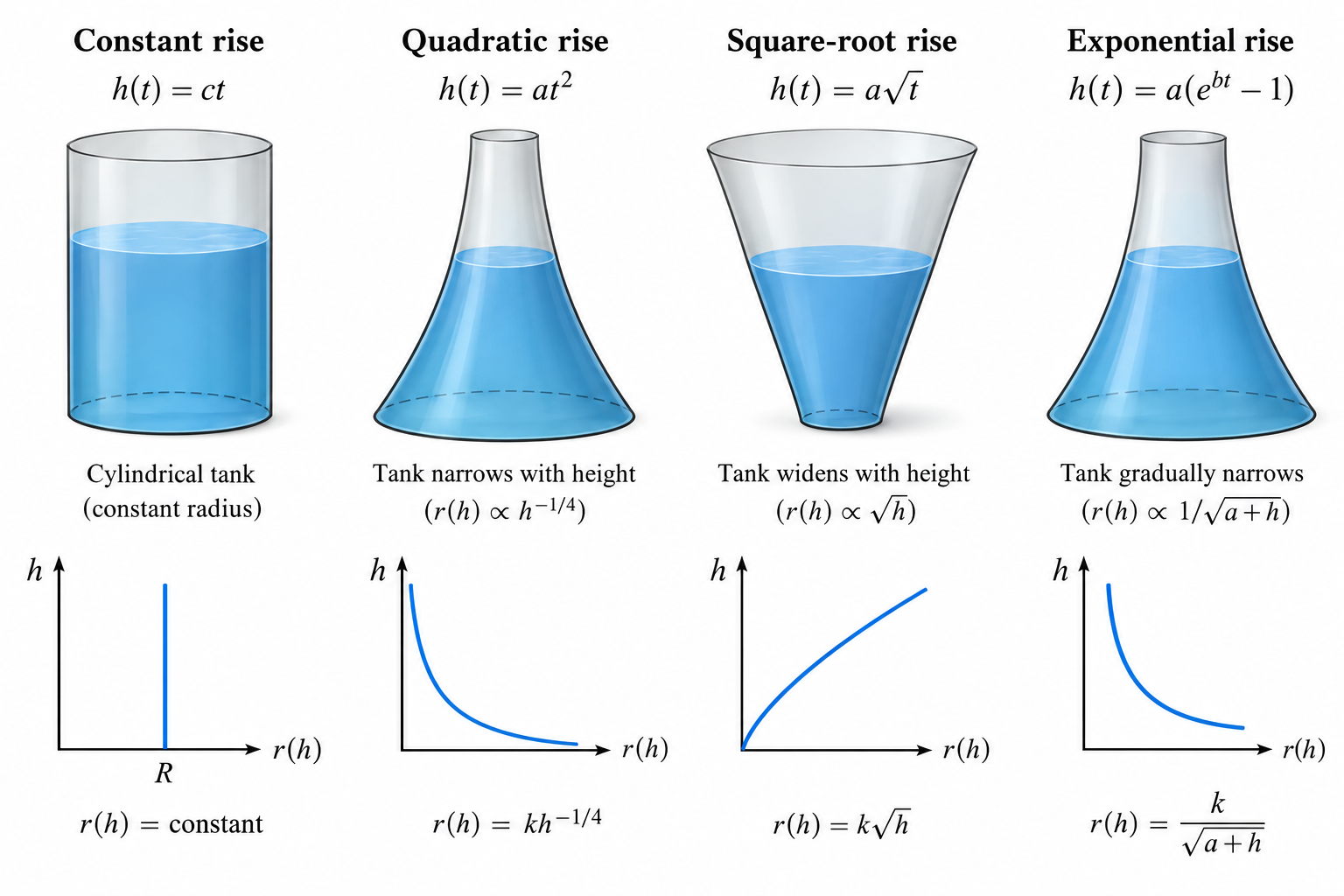
Example A: Constant rise
Suppose h(t)=ct, with c>0. Then h'(t)=c, so
r(h)=\sqrt{\frac{Q}{\pi c}}.The radius is constant. The required tank is a cylinder.
Example B: Quadratic rise
Suppose h(t)=at^2, with a>0. For t>0,
t=\sqrt{\frac{h}{a}},\qquad h'(t)=2at=2\sqrt{ah}.Thus
\boxed{r(h)=\sqrt{\frac{Q}{2\pi\sqrt{a}}}\,h^{-1/4}.}The tank narrows upward. But as h\to0^+, its radius tends to infinity! The idealized law requires an unbounded base and therefore cannot describe a tank of finite maximum width starting from empty at t=0. Nevertheless, the volume below any finite height is finite, since the singularity is integrable.
Example C: Square-root rise
Suppose h(t)=a\sqrt{t}. Then
t=\left(\frac{h}{a}\right)^2,\qquad h'(t)=\frac{a^2}{2h}.Therefore
\boxed{r(h)=\sqrt{\frac{2Q}{\pi a^2}}\,\sqrt{h}.}Now the tank widens upward, beginning at a pointed bottom. The prescribed height law has an unbounded initial slope at t=0; it is interpreted for t>0 and extended continuously to the initial instant.
Example D: Exponential rise
Suppose h(t)=a(e^{bt}-1), with a,b>0. Since e^{bt}=1+h/a,
h'(t)=ab e^{bt}=b(a+h).Consequently,
\boxed{r(h)=\sqrt{\frac{Q}{\pi b(a+h)}}.}The tank gradually narrows as the water rises. Unlike the quadratic example, it has a finite positive radius at the bottom.
4. A whole family of tanks from one formula
Consider the power-law family
h(t)=at^p,\qquad a>0,\quad p>0.We have t=(h/a)^{1/p} and
h'(t)=ap\left(\frac{h}{a}\right)^{(p-1)/p}=p a^{1/p}h^{(p-1)/p}.Substituting into the inverse-design formula yields
\boxed{r(h)=\sqrt{\frac{Q}{\pi p a^{1/p}}}\,h^{\frac{1-p}{2p}}.}We can now classify all these designs without drawing them individually:
| Exponent | Radius behavior | Geometry |
|---|---|---|
| 0\lt p\lt 1 | Increases with height | Pointed bottom, widening upward |
| p=1 | Constant | Cylinder |
| p>1 | Decreases with height; unbounded at the bottom | Idealized flaring base, not bounded in width |
The exponent p=1 separates widening and narrowing tanks. This is a useful example of how one parameter can control a whole family of geometric shapes.
5. Can every height law be realized by a physical tank?
No. A mathematical formula may prescribe a shape that cannot be built with finite dimensions.
Suppose the cross-sectional area is bounded above by A_{\max}. From Q=A(h)h'(t),
h'(t)=\frac{Q}{A(h(t))}\geq\frac{Q}{A_{\max}}>0.Therefore the water level cannot rise with zero speed while the inflow remains positive and the cross-sectional area stays bounded.
This immediately rules out h(t)=at^2 starting at t=0 in any tank with a bounded cross-sectional area: its initial slope is zero.
There is a complementary restriction. If the tank has a cross-sectional area bounded below by A_{\min}>0, then
h'(t)\leq\frac{Q}{A_{\min}}.So an infinitely fast initial rise, such as the idealized square-root law, is impossible in a tank with a strictly positive minimum cross-sectional area.
6. Design under a maximum-radius constraint
Suppose an engineer requires the tank radius never to exceed R. Then A(h)\leq\pi R^2. Hence
\boxed{h'(t)\geq\frac{Q}{\pi R^2}.}This gives a simple necessary condition on any prescribed filling law. If the desired water level ever rises more slowly than this bound, no tank of radius at most R can realize the law under constant inflow Q.
Conversely, a differentiable strictly increasing height law whose derivative satisfies this inequality produces, through our formula, a radius no greater than R wherever the inverse-design construction applies.
7. Mathematical challenge: Design a tank that changes its behavior
Water enters a tank at a constant rate Q. Suppose we want the water level to follow
h(t)=ct+at^2,\qquad a,c>0.(a) Find the radius r(h) as a function of height.
(b) Show that the radius at the bottom is finite and positive.
(c) Determine whether the tank widens or narrows as the water rises.
(d) Suppose the radius must never exceed R. Find a condition on c that guarantees this requirement.
Hint: Solve the quadratic equation for time:
t=\frac{-c+\sqrt{c^2+4ah}}{2a}.Then express h'(t)=c+2at in terms of h.
8. Beyond tanks: Calculus as an inverse-design tool
The idea extends beyond water tanks. In many mathematical models, the usual task is to predict what a system will do when its geometry or parameters are known. An inverse problem asks the opposite question: what geometry or parameters would produce a desired outcome?
In our tank model, the inverse problem is especially elegant because the chain rule gives an explicit design formula. More complicated inverse problems appear in engineering, optics, imaging, and differential equations.
Not every mathematically possible design is physically realizable, but even an impossible design can teach us something: it identifies constraints that any realistic solution must satisfy.
Final thought: You tell calculus how you want the water level to rise; calculus tells you what shape to build.
Model assumptions: The liquid is incompressible, the free surface is horizontal, the tank is rotationally symmetric, and the inflow rate is constant. The shapes are idealized and ignore construction and fluid-dynamic complications.
Continue exploring:
this post asks how to shape a tank so that it fills in a chosen way. The reverse question, how fast
a given tank empties, is answered in
How Fast Does Water Drain from a Tank?
For another case where a container’s shape changes what we expect, read
The Mathematics of a Taller Can: How Shape Can Fool the Eye.
Leave a Reply