
Watch ocean waves approach a beach. Their crests often become more closely spaced, turn nearly parallel to the shoreline, and eventually break. Why does the water depth change how quickly a wave travels? A remarkably simple square-root formula provides much of the answer.
1. A surprising comparison
Suppose a long wave travels through water 9 meters deep and then reaches water only 1 meter deep. Under the shallow-water approximation, its speed is
c=\sqrt{gh},
where c is the wave speed, g is gravitational acceleration (approximately 9.81 meters per second squared), and h is the local water depth.
At a depth of 9 meters,
c_9=\sqrt{9.81\cdot9}\approx9.40\ \text{m/s}.
At a depth of 1 meter,
c_1=\sqrt{9.81\cdot1}\approx3.13\ \text{m/s}.
Thus the speed falls to one-third of its original value. This comparison assumes the wave is long relative to the water depth in both locations.
2. What is actually moving?
A wave crest travels toward shore, but the same parcel of water does not normally travel all the way from offshore to the beach. Water particles move back and forth and up and down as the wave passes, while the wave transports energy. The speed c describes the motion of the wave pattern, not the forward speed of individual water particles.
3. Why does depth appear in the formula?
For long, small-amplitude waves in water of nearly uniform depth, a displacement of the surface produces a pressure difference. Gravity drives the water toward lower surface levels, while the depth controls how much water participates in the horizontal motion.
We can see the formula by combining two simplified conservation laws. Let η(x,t) be the small surface elevation and u(x,t) the depth-averaged horizontal velocity. For a flat bottom of constant depth h, the linearized shallow-water equations are
\eta_t+h u_x=0,\qquad u_t+g\eta_x=0.
The first expresses conservation of water; the second expresses horizontal acceleration caused by gravity and the surface slope. Differentiate the first equation with respect to time and the second with respect to position:
\eta_{tt}+h u_{xt}=0,\qquad u_{tx}+g\eta_{xx}=0.
Eliminating the velocity derivative gives
\eta_{tt}=gh\eta_{xx}.
This is the familiar one-dimensional wave equation, with wave speed
\boxed{c=\sqrt{gh}}.
Assumptions: The wave amplitude is small compared with the depth, the wavelength is much larger than the depth, the bottom changes slowly enough for a local-depth description, and friction and breaking are neglected.
4. What happens to the wavelength?
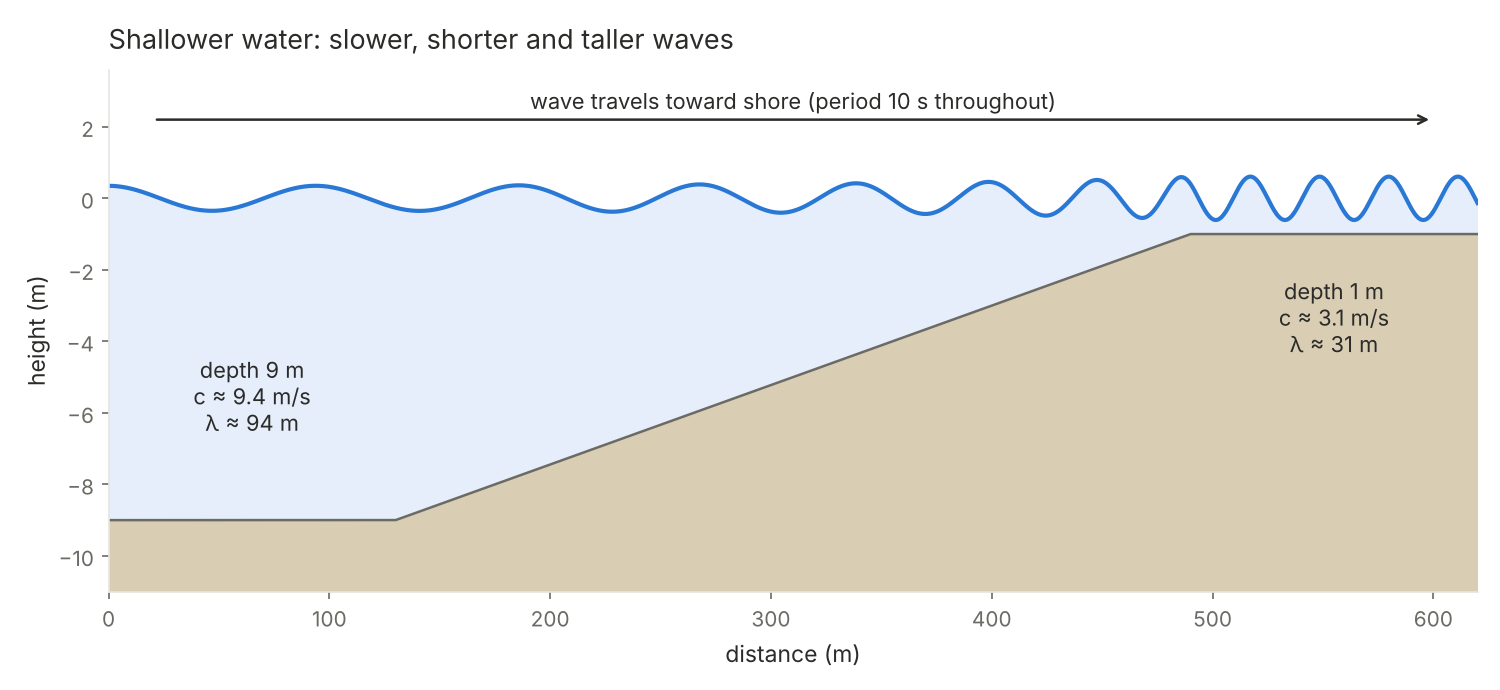
When a train of waves moves into shallower water, the period T is approximately unchanged if the environment is stationary. Since speed equals wavelength divided by period,
c=\frac{\lambda}{T},\qquad\lambda=cT.
For a wave with a period of 10 seconds, the shallow-water approximation predicts
\lambda_9\approx94.0\ \text{m},\qquad\lambda_1\approx31.3\ \text{m}.
The wavelength becomes one-third as large. Notice that a 10-second wave is not very long compared with a depth of 9 meters; the numerical values here illustrate the shallow-water model rather than an exact prediction for a typical 10-second swell.
5. Why do waves turn toward the shore?
Imagine a wave crest approaching a beach at an angle. The portion that reaches shallow water first slows down, while the part still in deeper water moves faster. The crest rotates. This process is called wave refraction.
For approximately parallel depth contours, the local ray angle θ, measured from the direction perpendicular to the contours, satisfies the refraction relation
\frac{\sin\theta_1}{c_1}=\frac{\sin\theta_2}{c_2}.
Because the speed decreases in shallow water, the ray angle generally decreases too. The wave travels more nearly perpendicular to the shoreline, so its crest becomes more nearly parallel to it. Real shorelines and seabeds are irregular, so wave directions can be more complicated.
6. Why can waves grow taller as they slow?
As waves approach shore, their energy can become concentrated into a shorter wavelength and a shallower water column. Under ideal conditions, conservation of wave-energy flux helps explain shoaling, the increase in wave height. For small-amplitude waves, energy per unit horizontal area is proportional to the square of the wave height:
E\approx\frac18\rho gH^2.
Here ρ is water density and H is wave height. In shallow water, group speed is approximately c, so if energy flux Ec is constant along a ray tube of unchanged width,
H^2c\approx\text{constant},\qquad H\propto h^{-1/4}.
This is Green’s law for idealized one-dimensional shallow-water shoaling. It is not a universal law for every breaking wave: refraction, dissipation, currents, nonlinear effects, and changes in ray-tube width can all modify the result.
7. Does every ocean wave obey the square-root rule?
No. For small-amplitude surface gravity waves of wavenumber k in water of constant depth h, neglecting surface tension, the more general dispersion relation is
\omega^2=gk\tanh(kh),\qquad k=\frac{2\pi}{\lambda}.
The phase speed is therefore
c=\frac\omega k=\sqrt{\frac gk\tanh(kh)}.
When kh is much smaller than 1, we have tanh(kh) approximately equal to kh, and the formula reduces to c approximately equal to the square root of gh. In deep water, where kh is large, the speed depends primarily on wavelength instead of depth. This is why ordinary short ocean swells and extremely long tsunami waves cannot always be treated in the same way.
8. Three questions to try
- Depth and speed. A long wave travels at 6 m/s in shallow water. Estimate the depth.
Show solution
h=c^2/g=36/9.81\approx3.67\ \text{m}. - How much slower? If the depth falls from 16 meters to 4 meters, by what factor does the shallow-water wave speed change?
Show solution
c_2/c_1=\sqrt{4/16}=1/2. The speed is halved.
- Wave refraction. A wave ray makes an angle of 30 degrees to the shore-normal direction in 9-meter-deep water. Estimate its angle in 1-meter-deep water using the shallow-water approximation.
Show solution
\sin\theta_2=(c_2/c_1)\sin30^\circ=(1/3)(1/2)=1/6. Therefore \theta_2=\arcsin(1/6)\approx9.59^\circ.
9. The larger mathematical picture
One short equation explains several features of coastal waves: slowing in shallower water, shorter wavelengths, and refraction toward the shore-normal direction. Its derivation also shows how conservation laws lead naturally to differential equations.
For a related introduction to traveling disturbances, see Why Do Waves Travel? The Mathematics of a Vibrating String.
Continue exploring: For another wave whose speed depends on the medium, see Why Doesn’t Your Cell Phone Work Underwater? The shallow-water model leads to the same wave equation as in Why Do Waves Travel? The Mathematics of a Vibrating String.
Further reading
For the underlying theory, see standard treatments of linear surface-gravity waves and the shallow-water equations, such as Dean and Dalrymple, Water Wave Mechanics for Engineers and Scientists (World Scientific, 1991), and Holthuijsen, Waves in Oceanic and Coastal Waters (Cambridge University Press, 2007).
Leave a Reply