
Pluck a rope, and a bump travels away from your hand. The rope itself does not travel across the room: each small piece moves up and down while the disturbance moves along it. How can a local motion produce a traveling wave?
The answer comes from a surprisingly simple equation. We will derive it from Newton’s second law, see an exact traveling-wave solution, and calculate how quickly a disturbance crosses a 10-meter rope.
1. A rope is made of moving pieces
Imagine a rope stretched horizontally under a constant tension T. Let u(x,t) be the small vertical displacement of the rope at horizontal position x and time t. Let \mu denote its mass per unit length, in kilograms per meter.
We assume that the rope is uniform, the tension is approximately constant, and the slopes and displacements are small. We also neglect friction and air resistance. These are idealizations, but they capture the essential mechanism.
A short piece of rope is pulled by its neighbors. When the rope is curved, the upward and downward components of the tension do not quite cancel. That imbalance accelerates the piece.
2. From Newton’s law to the wave equation
Consider the segment from x to x+\Delta x. For a small slope, the vertical component of the tension at either end is approximately T u_x, evaluated at that end. Hence the net vertical force is approximately
F_y\approx T\bigl(u_x(x+\Delta x,t)-u_x(x,t)\bigr).The mass of this segment is \mu\Delta x. Newton’s second law therefore gives
\mu\Delta x\,u_{tt}\approx T\bigl(u_x(x+\Delta x,t)-u_x(x,t)\bigr).Divide by \Delta x and let the segment become very short. The difference quotient approaches u_{xx}, so
\mu u_{tt}=T u_{xx}.Writing c^2=T/\mu, we obtain the one-dimensional wave equation:
\boxed{u_{tt}=c^2u_{xx}},\qquad \boxed{c=\sqrt{\frac{T}{\mu}}}.The notation u_{tt} means the second derivative with respect to time (vertical acceleration); u_{xx} is the second derivative with respect to position (the curvature measure in the small-slope model). Thus curvature causes acceleration.
3. Why does the disturbance travel?
Suppose the rope has a smooth bump whose shape is described by a function f. Consider
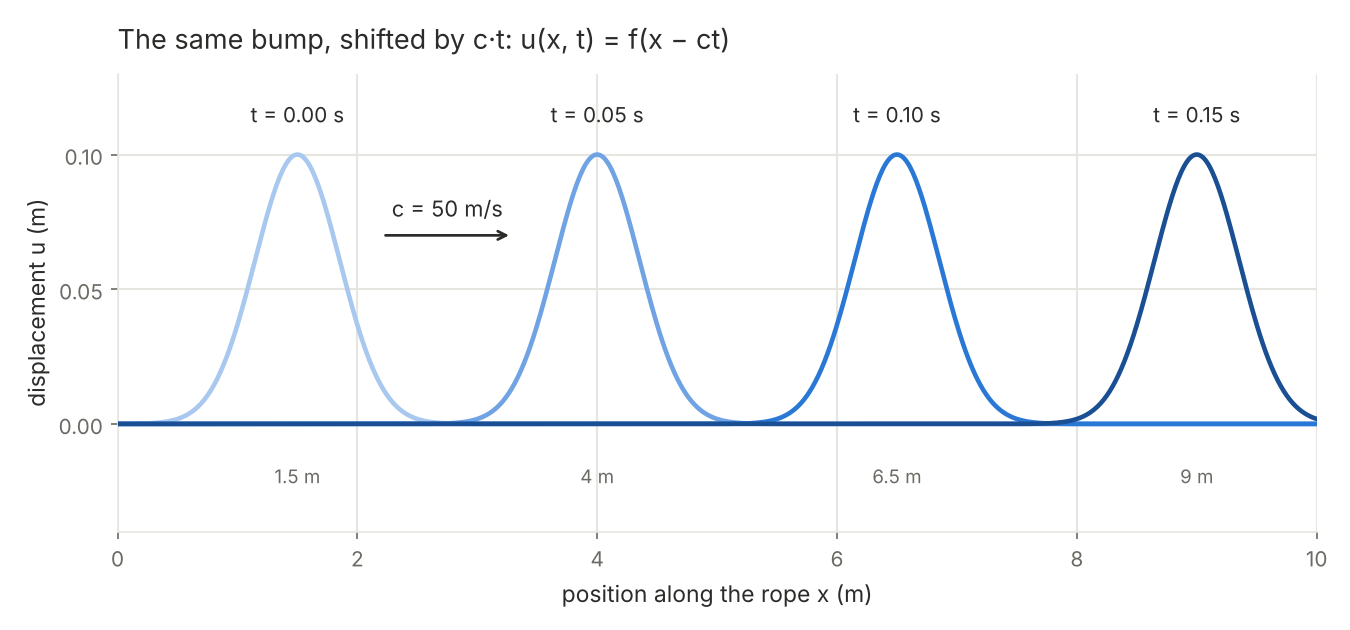
u(x,t)=f(x-ct).At time t=0, the shape is f(x). Later, the same feature occurs where x-ct has the same value, so the entire bump has shifted to the right by ct. Its speed is c.
We can check this without solving a difficult differential equation. By the chain rule,
u_{xx}=f''(x-ct),\qquad u_{tt}=c^2f''(x-ct).Therefore u_{tt}=c^2u_{xx} exactly. Similarly, g(x+ct) is a wave traveling to the left. Because the equation is linear,
u(x,t)=f(x-ct)+g(x+ct)also solves it. A general disturbance can be understood as the combination of right-moving and left-moving waves, subject to suitable initial conditions.
4. Example: a wave crossing a 10-meter rope
Consider a uniform, taut 10-meter rope with tension T=100\,\mathrm{N} and linear mass density \mu=0.040\,\mathrm{kg/m}. These values are assumptions for our example: rope length alone is not enough to determine the wave speed.
The wave speed is
c=\sqrt{\frac{100}{0.040}}=\sqrt{2500}=50\,\mathrm{m/s}.A disturbance traveling from one end to the other takes
t=\frac{L}{c}=\frac{10}{50}=\boxed{0.20\,\mathrm{s}}.So the signal crosses the rope in one-fifth of a second. This is the travel time of the initial disturbance; if the rope has fixed ends, the disturbance may then reflect and continue moving.
5. What changes the speed?
The formula c=\sqrt{T/\mu} has two useful consequences.
- Greater tension means faster waves. Multiplying the tension by four doubles the speed.
- A heavier rope means slower waves. Multiplying the mass per meter by four halves the speed, with tension unchanged.
Notice that the amplitude of a small wave does not appear in this speed formula. In the ideal small-amplitude model, a gentle bump and a somewhat larger bump travel at the same speed. Very large disturbances can violate the assumptions behind the equation.
6. Traveling waves are not the same as standing waves
Our example describes a disturbance moving along a rope. If both ends are fixed, waves reflect and can combine to create standing-wave patterns. That leads to the frequencies of vibrating guitar strings, a separate topic in this series. For now, the key point is that the local restoring force creates motion that propagates through the material.
7. Try it yourself
Exercise 1. Double the tension
A rope has wave speed 30\,\mathrm{m/s}. What is the speed if its tension doubles while its mass per meter stays constant?
Solution. Speed is proportional to the square root of tension, so c_{\mathrm{new}}=30\sqrt{2}\approx42.4\,\mathrm{m/s}.
Exercise 2. Change the rope
The mass per meter becomes nine times as large, with the same tension. By what factor does the wave speed change?
Solution. c_{\mathrm{new}}=c/3. The speed becomes one-third as large.
Exercise 3. Travel time
How long does a wave take to cross a 12-meter rope if its speed is 24\,\mathrm{m/s}?
Solution. t=L/c=12/24=0.50\,\mathrm{s}.
Challenge. Check a traveling wave
Verify that u(x,t)=A\sin(k(x-ct)) satisfies the wave equation.
Solution. Differentiating twice gives u_{xx}=-Ak^2\sin(k(x-ct)) and u_{tt}=-Ak^2c^2\sin(k(x-ct)). Thus u_{tt}=c^2u_{xx}.
8. The larger idea
The wave equation connects three things: a physical force, a local acceleration, and a disturbance that travels through space. Similar mathematical ideas appear in sound, elastic vibrations, and electromagnetic waves, although the physical mechanisms and governing equations differ.
The central conclusion is simple: for an ideal stretched rope, wave speed is determined by tension and mass per unit length—not by the length of the rope or the size of a small disturbance.
Continue exploring: Two other famous equations of mathematical physics behave very differently. In Why Does Heat Spread? The Heat Equation, a bump spreads out and flattens instead of traveling. In How Does Electricity Know Where to Flow? Laplace’s Equation, nothing changes in time at all. For waves whose speed depends on depth, see Why Do Ocean Waves Slow Down Near Shore?
Waves also explain how wireless communication works. Unlike mechanical waves traveling along a string, electromagnetic waves can travel through empty space. But what happens when they enter seawater? Explore the mathematics in our related article, Why Doesn’t Your Cell Phone Work Underwater? The Mathematics of Electromagnetic Waves.
Leave a Reply