
Why Do Vibrations Die Out? Damped Oscillations
Drive over a bump, and your car briefly moves up and down. But it does not keep bouncing forever. Why does the motion gradually disappear? The answer is a competition between two effects: a spring-like restoring force that produces oscillation and a damping force that removes mechanical energy.
1. Two forces acting on a moving object
Imagine a mass attached to a spring and a shock absorber. Let x(t) denote its displacement from equilibrium at time t. For small displacements, a spring pulls the mass back toward equilibrium with force −kx. In a simple model, the shock absorber resists motion with force −bx’, proportional to velocity.
Newton’s second law says that mass times acceleration equals the sum of forces:
Rearranging gives the damped oscillator equation:
Here m is the mass (kg), b the damping coefficient (N·s/m), and k the spring constant (N/m). Primes denote derivatives with respect to time: x’ is velocity and x” is acceleration. We assume constant coefficients and no external driving force.
2. What happens without damping?
If there were no shock absorber, we would set b = 0. The equation would become
Its solutions are combinations of sine and cosine:
The oscillations would continue indefinitely in this idealized model. Real systems lose energy to friction, fluid resistance, internal deformation, and other effects.
3. How damping changes the motion
To solve the damped equation, try an exponential motion of the form x(t) = ert. Substitution gives the characteristic equation:
Its roots are
The expression under the square root determines three kinds of motion.
Underdamping: the object oscillates while settling
When b² < 4mk, the system continues to swing back and forth, but the amplitude decreases. The solution can be written
The sine and cosine describe the back-and-forth motion. The exponential factor makes that motion fade over time.
Critical damping: settling without oscillation
When b² = 4mk, the solution has the form
For a mass released from rest at a positive displacement, critical damping returns it toward equilibrium without crossing it. Among systems that return without overshooting under these assumptions, it gives the fastest return.
Overdamping: a slower return
When b² > 4mk, the roots are distinct negative real numbers. The motion is a sum of two decaying exponentials:
For release from rest, the object returns without oscillating, but more slowly than in the critically damped case.
4. Worked example: why a car stops bouncing
Consider a simplified suspension model with m = 1 kg, b = 2 N·s/m, and k = 10 N/m. These are convenient teaching values, not specifications for a real car. The differential equation is
Because b² = 4 and 4mk = 40, the motion is underdamped. Its characteristic roots are
Suppose the mass is initially displaced by 10 centimeters and released from rest:
The resulting displacement, measured in meters, is
The oscillation has angular frequency 3 radians per second, so its period is
The magnitude of the displacement is bounded by the decaying envelope
After 2 seconds, this bound is about 1.43 centimeters. The object may still be moving, but the vibration has become much smaller.
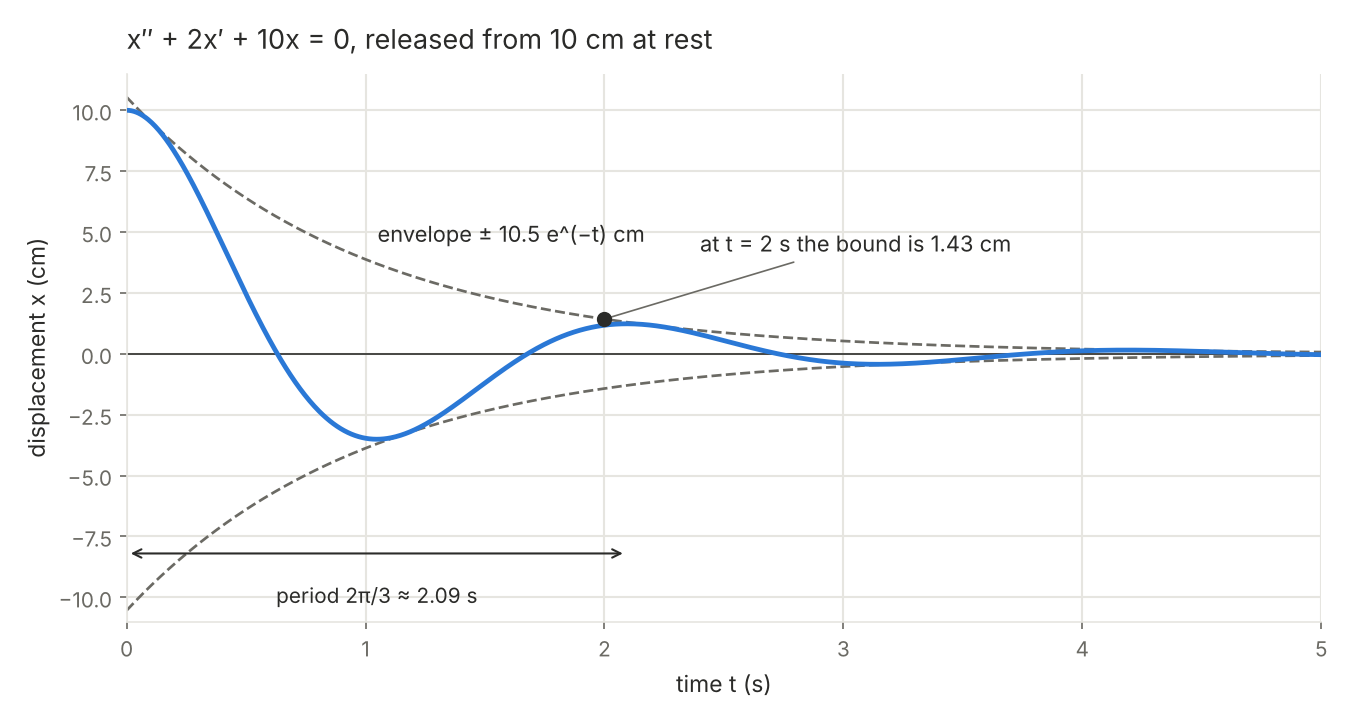
Notice that this is a bound on displacement, not the exact displacement at that instant.
5. Where does the energy go?
The system stores energy in two forms: kinetic energy of the moving mass and potential energy in the spring. Their sum is
Differentiate and use the governing equation:
This equation tells us something important: mechanical energy never increases in the undriven damped model. Whenever the mass moves and b is positive, energy is dissipated, usually as heat. The spring still pulls the mass toward equilibrium, but the motion gradually fades.
6. What the model does—and does not—explain
The equation describes small vibrations when the restoring force is approximately proportional to displacement and damping is approximately proportional to velocity. Actual car suspensions involve more than one mass, nonlinear shock absorbers, tire behavior, road forcing, and other effects. Still, this simple equation captures the central reason a car settles after a bump.
There is also an important distinction: damping does not always mean oscillation. With sufficiently strong damping, the mass returns toward equilibrium without swinging back and forth at all.
7. The mathematical lesson
One short equation combines three physical ideas: inertia, restoring force, and resistance to motion. Its solutions explain why a vibration can persist briefly, weaken exponentially, and eventually become practically imperceptible.
Mathematical Physics Through Simple Equations. For the related idealized oscillation model, see Why Does a Pendulum Swing?.
Continue exploring: With b = 0 this becomes the equation of Why Does a Pendulum Swing? A forced, damped system is solved with algebra alone in How Can We Solve Differential Equations Using Algebra? The Laplace Transform. For vibrations that travel instead of fading in place, see Why Do Waves Travel?
Leave a Reply