A gasoline engine becomes more efficient when its compression ratio is increased. So why not simply make the compression ratio as large as possible?
There is a physical obstacle: increasing the compression ratio also increases the pressure inside the cylinder. An engine can withstand only a limited pressure.
This gives us a natural optimization problem:
For a fixed amount of heat released during combustion and a fixed maximum allowable cylinder pressure, what compression ratio gives the greatest possible efficiency?
The answer comes from combining a simple model of a gasoline engine with calculus.
The ideal Otto cycle
We use the ideal Otto cycle, the standard simplified model for a spark-ignition gasoline engine.
Let
be the compression ratio, where is the cylinder volume before compression and is the volume after compression.
Let and be the initial pressure and temperature.
For an ideal gas undergoing adiabatic compression,
and
Here
and for air we use the familiar approximation
Efficiency increases with compression
The thermal efficiency of the ideal Otto cycle is
Differentiate:
Since and , we have
Thus, according to the ideal model, efficiency always increases as the compression ratio increases.
So there is no unconstrained maximum. Mathematics would simply tell us to keep increasing .
A real engine, however, cannot withstand unlimited pressure. This is where the optimization problem becomes interesting.
Adding a pressure constraint
Suppose combustion adds a fixed amount of heat per unit mass of air.
In the ideal Otto model, heat is added at constant volume. Therefore,
Hence
Because the volume does not change during combustion, the ideal-gas law gives
Therefore,
Now substitute
and
We obtain
The key equation
Define
Then the maximum pressure reached during the idealized cycle is
Suppose the engine can safely withstand a maximum cylinder pressure . Then
Define
The pressure constraint becomes
Where does the maximum occur?
We already proved that the efficiency is increasing.
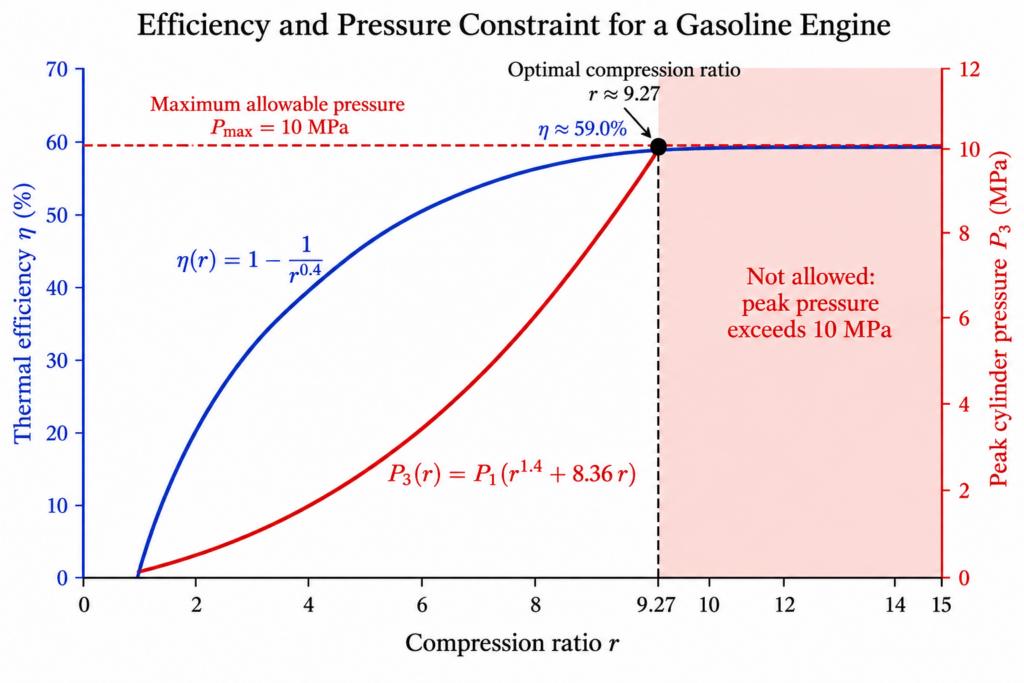
Therefore, the most efficient engine uses the largest compression ratio permitted by the pressure constraint.
The optimum must occur when the pressure reaches its allowable maximum:
This is an interesting kind of optimization problem. We do not find the optimum by solving . There is no critical point.
Instead, calculus tells us that efficiency is increasing, and the physical constraint tells us where we must stop.
A numerical example
Take
Use
and suppose combustion supplies
Then
Suppose the maximum allowable cylinder pressure is
Therefore,
Using , the optimal compression ratio satisfies
Solving this equation numerically gives
Thus, in this simplified model, the greatest possible efficiency under the pressure restriction occurs at a compression ratio of approximately 9.27:1.
What efficiency does this give?
For , the ideal Otto-cycle efficiency is
Using ,
So the theoretical efficiency is approximately
This is the efficiency of the idealized mathematical model, not the efficiency we should expect from a real gasoline engine. Real engines have friction, heat loss, pumping losses, finite combustion time, changing specific heats, and other effects that the ideal Otto cycle does not include.
An unexpected seventh-degree polynomial
There is one more mathematical surprise.
We used
Therefore the equation determining the optimal compression ratio has the form
Let
Then
and
So our engine-design equation becomes
For our numerical example,
A practical question about the design of a gasoline engine has led us to a seventh-degree polynomial.
We do not need to solve this polynomial symbolically. A numerical method gives the physically relevant positive root and therefore the optimal compression ratio.
The mathematical lesson
Without a pressure restriction, the ideal Otto model says
larger compression ratio → greater efficiency.
There is no finite optimum.
But an engine has to withstand the pressure produced inside its cylinder. Once we impose the constraint
the optimization problem has a finite solution.
The optimum occurs precisely when increasing the compression ratio any further would violate the pressure constraint:
This illustrates an important idea in applied calculus: sometimes the optimum is not created by a critical point of the function—it is created by the constraint.
Leave a Reply