
Geometric series, compound interest, and why a promise to pay forever can be worth less than cash today.
Imagine winning a lottery and being offered two choices:
- Receive $1 million immediately.
- Receive $5,000 every month for 30 years.
Which would you choose? The second option promises $1.8 million in total, almost twice the immediate payment. Surely it must be better?
Not necessarily.
The answer depends on something the totals leave out: interest. Using a geometric series, we can compare the two offers exactly, and the mathematics leads to a surprising conclusion: even an infinite stream of payments can be worth less than a finite sum received today.
1. The Lottery Puzzle
Suppose a winner must choose between $1,000,000 now and $5,000 at the end of each month for 30 years. Ignoring interest, the total of the monthly payments is
5{,}000\cdot 12\cdot 30=\$1{,}800{,}000.The payments first reach $1 million after
\frac{1{,}000{,}000}{5{,}000}=200\text{ months},or 16 years and 8 months. But this simple calculation overlooks a basic principle: a dollar received today can be invested, while a dollar received years from now cannot earn interest during the intervening years.
2. Present Value and a Geometric Series
Suppose money earns a monthly rate of interest r. A payment of P received k months from now has present value
\frac{P}{(1+r)^k}.For n payments of P, made at the end of each month, the present value is
V_n=\frac{P}{1+r}+\frac{P}{(1+r)^2}+\cdots+\frac{P}{(1+r)^n}.This is a finite geometric series. Summing it gives
\boxed{V_n=P\frac{1-(1+r)^{-n}}{r}.}Let L be the lump sum offered today. The two alternatives have the same present value precisely when
L=P\frac{1-(1+r)^{-n}}{r}.Rearranging and taking logarithms gives the break-even number of months:
\boxed{n=\frac{-\ln(1-rL/P)}{\ln(1+r)}.}This formula requires 0<rL/P<1. The first whole-number payment count that reaches or exceeds the lump sum is the ceiling of n. When r=0, the break-even time is simply L/P.
For an effective annual interest rate i, the equivalent monthly rate is
r=(1+i)^{1/12}-1.3. The Surprise: Payments May Never Catch Up
Return to the lottery example with L=1{,}000{,}000 and P=5{,}000. Suppose the effective annual discount rate is 5%. Then
r=1.05^{1/12}-1\approx 0.00407412.The present value of 360 monthly payments is
V_{360}=5{,}000\frac{1-(1+r)^{-360}}{r}\approx\$943{,}298.Although the nominal payments total $1.8 million, their present value at 5% is less than the $1 million lump sum.
The chart below shows how much the interest rate matters. It plots the present value of the payments received so far against the $1 million lump sum.
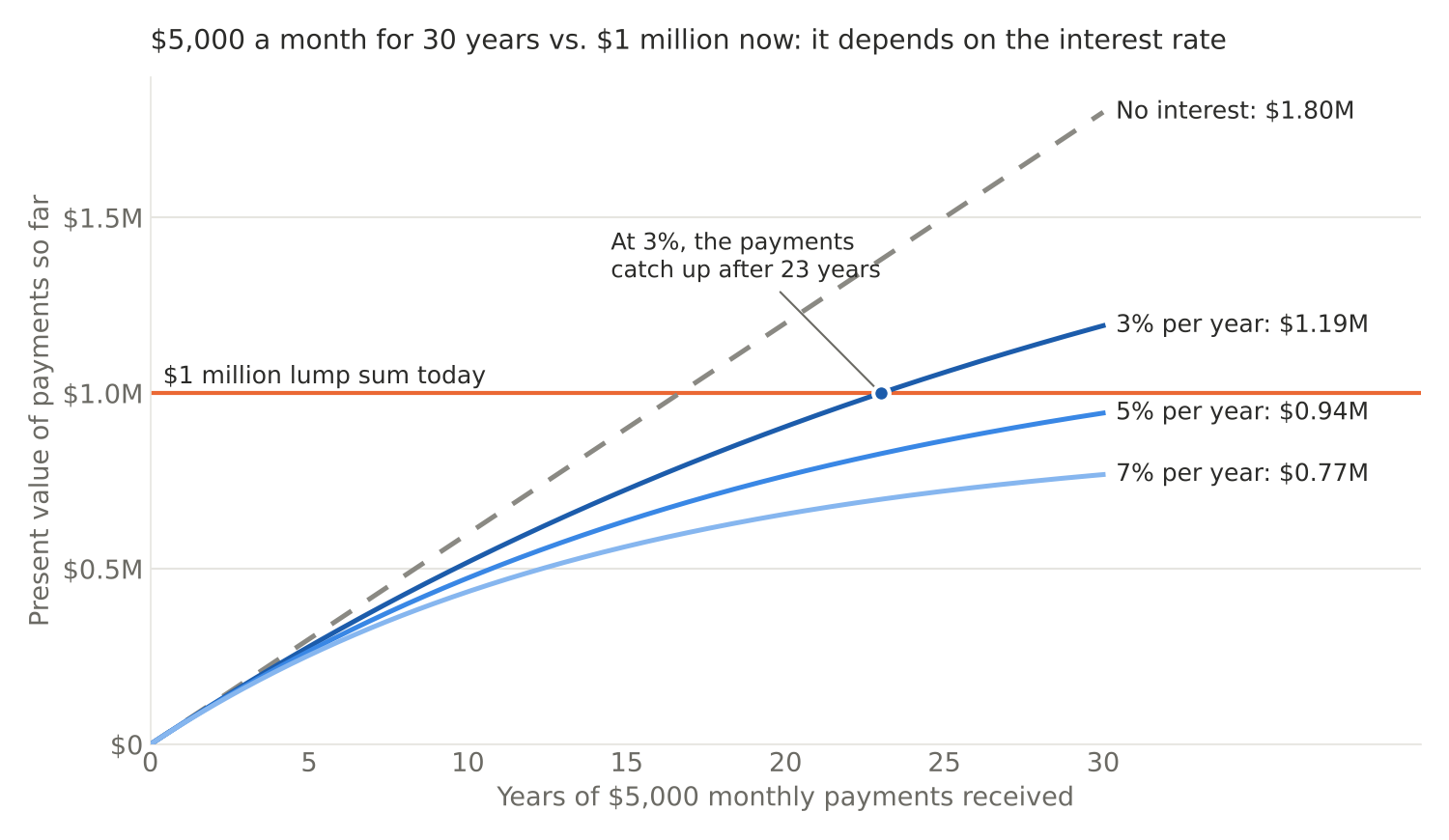
Now imagine the payments continue forever. Since (1+r)^{-n}\to 0 as n\to\infty, we obtain
\boxed{V_{\infty}=\frac{P}{r}.}This is the value of a perpetuity. It gives a striking criterion:
\boxed{P\le rL\quad\Longrightarrow\quad V_n<L\text{ for every finite }n.}If P<rL, even infinitely many payments have a present value below L. At equality, their present value approaches L without reaching it in finite time.
For example, at 7% the monthly rate is about 0.565%, so even payments that never stop are worth only about $5,000/0.00565 ≈ $884,000, less than the lump sum.
Mathematical surprise: A promise to pay forever is not necessarily worth more than cash today.
4. Final Thought: Timing Is Value
The total number of dollars received is not enough to determine financial value. Timing matters, and interest matters. A geometric series turns that idea into an exact comparison, and the perpetuity formula shows its limit: receiving money forever is not necessarily worth more than receiving a large amount today.
Continue exploring: the same mathematics, run in reverse, decides whether a retiree should trade savings for lifetime payments. See When Does a Lifetime Annuity Pay Off? Break-Even Age and Life Expectancy.
All dollar amounts, interest rates, and annuity offers in this article are hypothetical and are used to illustrate mathematical principles. This article is educational and is not individualized financial advice.
For another surprising application of compound interest, see our article When a Lower Interest Rate Pays More: The Mathematics of Compounding , where we explore how the frequency of compounding can change investment outcomes.
The same mathematics can help answer another important financial question: Is a college degree worth the cost of tuition, student loans, and lost earnings? Explore this question in our article Is College Worth the Cost? The Mathematics of Student Loans and Lost Earnings .
Leave a Reply