
Suppose you have a fixed length of fencing. What shape should you build to enclose the largest possible garden? A rectangle? A hexagon? A circle? This question leads to one of the most beautiful inequalities in geometry.
1. A rectangle: why the square wins
Let a rectangle have sides x and y, with fixed perimeter P. Then
2x+2y=P,\qquad A=xy.
Since (x-y)^2\ge 0, we have 4xy\le(x+y)^2. Therefore
A\le\frac{P^2}{16}.
Equality occurs exactly when x=y. Among rectangles of fixed perimeter, the square encloses the most area.
2. Regular polygons: more sides, more area
Consider a regular polygon with n sides and perimeter P. Divide it into n congruent triangles by joining its center to the vertices. Each triangle has base P/n and apothem P/(2n\tan(\pi/n)). Consequently,
A_n=\frac{P^2}{4n\tan(\pi/n)}.
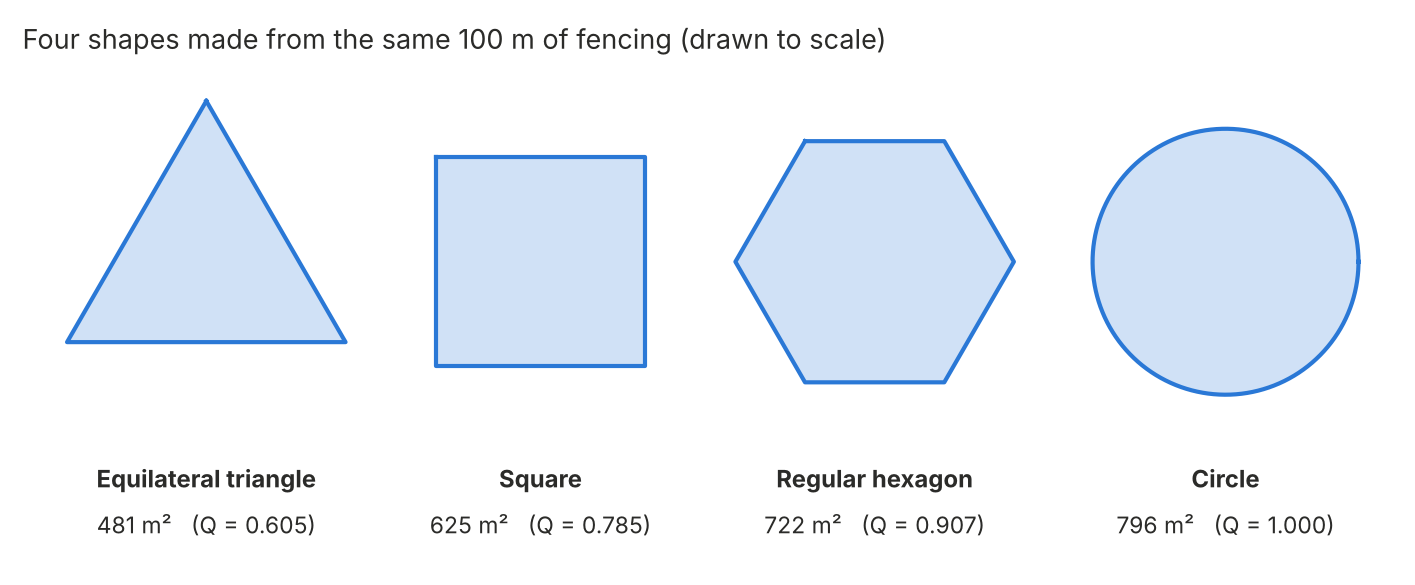
Here are the corresponding coefficients in A_n=c_nP^2:
| Shape | Area for perimeter P |
|---|---|
| Equilateral triangle | P^2/(12\sqrt3) |
| Square | P^2/16 |
| Regular hexagon | \sqrt3 P^2/24 |
| Circle | P^2/(4\pi) |
For regular polygons, the area increases as the number of sides increases. Indeed, writing t=\pi/n, we have A_n=(P^2/(4\pi))(t/\tan t). The function t/\tan t decreases on 0<t<\pi/2, so it increases as n increases. Since \tan t/t\to1 as t\to0,
\lim_{n\to\infty}A_n=\frac{P^2}{4\pi}.
Important distinction: This proves the limit within the family of regular polygons, not yet that no irregular shape can do better.
3. The isoperimetric inequality
For every simple closed rectifiable plane curve with enclosed area A and perimeter P,
4\pi A\le P^2.
Equality holds if and only if the curve is a circle. Equivalently, a shape of area A must have perimeter at least 2\sqrt{\pi A}. This is the isoperimetric inequality.
4. A rigorous proof using a periodic inequality
We first prove the theorem for smooth simple closed curves. The general rectifiable case follows by standard approximation of such curves by smooth ones, with convergence of perimeter and enclosed area.
Parameterize the boundary by arc length s\in[0,P], writing \gamma(s)=(x(s),y(s)). Then
x'(s)^2+y'(s)^2=1.
Translate the coordinate system so the mean values of x and y over one period are both zero. Translation changes neither area nor perimeter.
Wirtinger’s inequality. If a continuously differentiable, P-periodic function f has mean zero, then
\int_0^P f(s)^2\,ds\le\left(\frac{P}{2\pi}\right)^2\int_0^P f'(s)^2\,ds.
Equality holds precisely for a linear combination of \cos(2\pi s/P) and \sin(2\pi s/P). One proof expands f in its Fourier series: the zero-mean assumption eliminates the constant term, and each remaining frequency has squared frequency at least one.
Apply Wirtinger’s inequality to x and y, then add:
\int_0^P(x^2+y^2)\,ds\le\frac{P^2}{4\pi^2}\int_0^P(x'^2+y'^2)\,ds=\frac{P^3}{4\pi^2}.
By Green’s theorem, for a counterclockwise orientation,
2A=\int_0^P(xy'-yx')\,ds.
Apply Cauchy–Schwarz to the vectors (x,y) and (y',-x'):
2A\le\left(\int_0^P(x^2+y^2)\,ds\right)^{1/2}\left(\int_0^P(x'^2+y'^2)\,ds\right)^{1/2}.
Substituting the previous bounds yields
2A\le\sqrt{\frac{P^3}{4\pi^2}}\sqrt P=\frac{P^2}{2\pi},
which is exactly 4\pi A\le P^2.
When is there equality? Equality in Cauchy–Schwarz forces (x,y)=c(y',-x') for a positive constant c. Because the curve is parameterized by arc length, this gives x^2+y^2=c^2 at every point: the boundary lies on a circle centered at the translated origin. As it is a simple closed curve, it is the entire circle. Conversely, every circle achieves equality.
5. Measuring how far a shape is from a circle
Define the isoperimetric quotient
Q=\frac{4\pi A}{P^2}.
The theorem says 0<Q\le1 for a region with positive area, and Q=1 exactly for a circle. A square has Q=\pi/4\approx0.7854; an equilateral triangle has Q=\pi/(3\sqrt3)\approx0.6046. The quotient is unchanged when a shape is enlarged or reduced.
6. A practical example: 100 meters of fencing
With 100 meters of fencing, the best rectangle is a square of side 25 meters, enclosing 625\,\mathrm{m}^2. A circle with circumference 100 meters has radius 50/\pi meters and area
A=\frac{2500}{\pi}\approx795.77\,\mathrm{m}^2.
That is about 27.3% more area than the best rectangle using the same amount of fencing.
7. Why this inequality matters
The result is a model of optimization under a constraint: the perimeter is fixed and the area is maximized. Its ideas connect elementary geometry with calculus, Fourier analysis, variational methods, and higher-dimensional questions about spheres. The surprising point is that one perfectly symmetric shape beats every competitor, including irregular ones.
8. Try it yourself
Exercise 1. Show that a rectangle with perimeter 40 has area at most 100.
Show solution
Its side lengths satisfy x+y=20. Thus xy\le((x+y)/2)^2=100, with equality at x=y=10.
Exercise 2. Compute the isoperimetric quotient of a regular hexagon.
Show solution
For side length a, A=3\sqrt3a^2/2 and P=6a. Hence Q=4\pi A/P^2=\pi\sqrt3/6\approx0.9069.
Exercise 3. A circular enclosure has area 100 square meters. What is the minimum perimeter of any enclosure with that area?
Show solution
From P^2\ge4\pi A, P\ge20\sqrt\pi\approx35.45 meters, attained by a circle.
9. Further reading and connections
For the Cauchy–Schwarz step in the proof, see One Inequality, Many Worlds: From Geometry to Calculus (check this internal link against your published URL before posting).
Continue exploring: Among triangles alone, the equilateral one wins: Why the Equilateral Triangle Wins: Maximum Area for a Fixed Perimeter. Wirtinger’s inequality in section 4 rests on Fourier series: How Can Sine Waves Create a Square Wave?
The isoperimetric inequality is classical. A standard reference is R. Osserman, “The Isoperimetric Inequality,” Bulletin of the American Mathematical Society 84 (1978), 1182–1238. For the periodic inequality used in the proof, consult a standard Fourier analysis text under “Wirtinger’s inequality.”
Leave a Reply