Category: Geometry

  • The Geometry of a Tetrahedron: From Pythagoras to Vector Identities

    A tetrahedron is the simplest three-dimensional polyhedron: four vertices, six edges, and four triangular faces. Yet it hides some remarkable relationships. We will discover why its four face-area vectors add to zero, derive its volume from coordinates, prove a three-dimensional Pythagorean theorem, and uncover identities connecting face areas and dihedral angles. Four discovery problems, with solutions hidden at the end, invite you to go further.

    Labeled tetrahedronPerspective tetrahedron with vertices P at the top, Q at left, R at right, and S behind the lower front edge. Hidden edges from S are dashed.PQRS
    Figure 1. A tetrahedron with vertices P, Q, R, and S. Dashed edges indicate edges that may be hidden in the three-dimensional view.

    1. The four faces and their area vectors

    For each face, choose the unit normal pointing outward from the solid. Multiply that normal by the area of the face. The resulting vector is called its outward area vector. Denote the four vectors by N1, …, N4, and their lengths (the face areas) by A1, …, A4.

    N1+N2+N3+N4=0

    Geometric proof by projection

    Choose any direction, represented by a unit vector u. The signed area of a face projected onto a plane perpendicular to u is the dot product of its outward area vector with u. Looking through the tetrahedron along u, each projected interior point is entered through a face and exited through another. The positive and negative projected contributions cancel. Thus the sum of the four dot products with u is zero. Since this is true for every direction u, the sum of the area vectors itself must be zero.

    Algebraic proof by cross products

    Write a = Q − P, b = R − P, and c = S − P. Assume the orientation is chosen so that det(a, b, c) is positive. The outward area vectors for the faces opposite S, R, Q, and P, respectively, are

    NS=−12(a×b),NR=12(a×c),NQ=−12(b×c),NP=12(b×c−a×c+a×b).

    Adding these four expressions gives the zero vector. If the determinant is negative, all four displayed normals reverse direction; the sum remains zero.

    2. The volume of a tetrahedron

    Let the vertices have position vectors P, Q, R, S. Set a = Q − P, b = R − P, c = S − P. The parallelepiped spanned by these vectors has volume equal to the absolute value of their scalar triple product. A tetrahedron occupies one-sixth of that parallelepiped:

    V=16|det(a,b,c)|=16|(a×b)·c|.

    Why one-sixth? The base triangle has half the area of the parallelogram spanned by a and b. A pyramid has one-third the volume of a prism with the same base and height. Multiplying these factors gives one-sixth.

    Tetrahedron with hidden rear edges dashed and perpendicular altitudeBase triangle PQR in perspective, with rear vertex R. Rear base edges PR and RQ are dashed. Apex S above the base, and internal altitude SH dashed.SPQRHhbase PQR
    Figure 2. Base PQR and perpendicular altitude SH. Rear edges PR, RQ, and RS are dashed; the internal altitude is dashed as well.

    A new numerical example

    Consider the tetrahedron with vertices P = (0, 0, 0), Q = (4, 0, 0), R = (0, 3, 0), and S = (1, 1, 6). This is different from the example in the textbook. The three edge vectors based at P are (4, 0, 0), (0, 3, 0), and (1, 1, 6). Therefore

    V=16|det⁡(401031006)|=726=12.

    We can verify this without determinants: triangle PQR is right-angled, with area (4 × 3)/2 = 6. Since S has third coordinate 6, its perpendicular distance from the plane z = 0 is 6. Thus V = (1/3)(6)(6) = 12 cubic units.

    3. The three-dimensional Pythagorean theorem

    Suppose the three edges meeting at S are mutually perpendicular. Such a vertex is called tri-rectangular. Let A, B, C denote the areas of the three faces meeting at S, and D the area of the opposite face PQR. Then

    D2=A2+B2+C2.

    This is de Gua’s theorem, a three-dimensional counterpart of the Pythagorean theorem.

    Tri-rectangular tetrahedron with rear edge dashedTetrahedron SPQR with vertex S in front, and three mutually perpendicular edges SP SQ SR. Rear edge QR of opposite face PQR is dashed where hidden by the front faces.PQRSopposite face PQRSP ⟂ SQ, SQ ⟂ SR, SR ⟂ SP (in space)
    Figure 3. Three mutually perpendicular edges meet at S. The rear edge QR is dashed where it passes behind the front faces. Projected angles need not appear to be 90°.

    Proof using area vectors

    The three faces meeting at S lie in mutually perpendicular planes. Their outward area vectors are therefore pairwise perpendicular. By Section 1, the outward area vector of PQR is the negative of their sum. Squaring its length and using the Pythagorean theorem for orthogonal vectors gives D² = A² + B² + C².

    Independent coordinate proof

    Place S at the origin and the other vertices at P = (a, 0, 0), Q = (0, b, 0), R = (0, 0, c), with positive a, b, c. The three faces at S have areas ab/2, ac/2, and bc/2. The area of PQR is half the length of (Q − P) × (R − P), which equals (bc, ac, ab). Consequently

    D2=a2b2+a2c2+b2c24=A2+B2+C2.

    4. A surprising inequality for the four face areas

    Let A₁, A₂, A₃, A₄ be the areas of the faces of any nondegenerate tetrahedron. Since N₁ = −(N₂ + N₃ + N₄), the triangle inequality gives

    A1=‖N2+N3+N4‖≤A2+A3+A4.

    In a nondegenerate tetrahedron the inequality is strict: equality in the vector triangle inequality would require all three outward normals on the right to point in the same direction, impossible for three distinct faces of a genuine tetrahedron. The same argument applies to every face.

    Immediate test: no tetrahedron can have face areas 2, 3, 4, and 10, because 10 is greater than 2 + 3 + 4.

    5. The angle between two faces

    Two faces sharing an edge meet at an interior dihedral angle θ. The angle between their outward normals is π − θ, not θ. Thus, if their outward area vectors have lengths Aᵢ and Aⱼ, the dot product formula gives

    Ni·Nj=AiAjcos⁡(π−θij)=−AiAjcos⁡θij.
    Interior dihedral angle and outward normalsA perpendicular cross-section through two faces meeting at an edge. Their rays form interior angle theta above O. Each orange outward normal is perpendicular to its corresponding face ray and points away from the wedge. The angle between normals is pi minus theta.θOface 1face 2n₁ outwardn₂ outwardπ − θ
    Figure 4. Cross-section perpendicular to the common edge. The blue rays enclose the interior dihedral angle θ. The orange outward normals are perpendicular to their respective rays; their angle is π − θ.

    For a regular tetrahedron, the interior dihedral angle satisfies cos θ = 1/3. The outward normals therefore have dot product −A²/3, where A is their common face area.

    6. An identity involving all six dihedral angles

    Start with the zero-sum identity N₁ + N₂ + N₃ + N₄ = 0. Take the squared length of both sides:

    0=∑i=14Ai2+2∑i<jNi·Nj.

    Substitute the dot-product formula from Section 5 and rearrange:

    ∑i=14Ai2=2∑i<jAiAjcos⁡θij.

    The second sum runs over the six unordered pairs of faces. This identity holds for every nondegenerate tetrahedron, whether or not any of its angles are right angles. De Gua’s theorem is a special orthogonal configuration of the same area-vector principle.

    Discovery problems

    Try these before opening the solutions. The problems become progressively more demanding.

    Problem 1. The regular tetrahedron

    A regular tetrahedron has six edges of length a. Find (i) the area of one face, (ii) its altitude, (iii) its volume, and (iv) its interior dihedral angle.

    Problem 2. Which face areas are possible?

    Can a nondegenerate tetrahedron have face areas 2, 3, 4, and 10? Prove your answer. Then decide whether the four numbers 2, 3, 4, and 8 are ruled out by the same argument.

    Problem 3. An inverse problem

    If the areas of all four faces are known, must the tetrahedron’s volume be uniquely determined? Prove your answer by constructing two tetrahedra with the same four face areas but different volumes.

    Problem 4. Higher-dimensional Pythagoras

    In n-dimensional Euclidean space, let an n-simplex have n mutually perpendicular edges meeting at one vertex. Prove that the square of the (n − 1)-dimensional volume of its opposite facet equals the sum of the squares of the (n − 1)-dimensional volumes of its other n facets.

    Solutions to the discovery problems

    Each solution is hidden until you choose to expand it.

    Solution 1 — Regular tetrahedron

    Each face is equilateral, so its area is √3 a²/4. The foot of an altitude is the centroid of the opposite equilateral triangle. The distance from that centroid to a vertex is a/√3, so the altitude is √(a² − a²/3) = a√(2/3). Hence V = (1/3)(√3 a²/4)(a√(2/3)) = √2 a³/12.

    All four outward area vectors have the same length A and sum to zero. By symmetry, the dot product between any two distinct outward area vectors is a common value c. Squaring their sum gives 0 = 4A² + 12c, so c = −A²/3. Therefore −A² cos θ = −A²/3 and θ = arccos(1/3) (approximately 70.53°).

    Solution 2 — Which face areas are possible?

    The largest face cannot exceed the sum of the other three, and in a genuine tetrahedron the inequality must be strict. Since 10 > 2 + 3 + 4 = 9, the first collection is impossible. For 2, 3, 4, 8, the largest area is 8 and the sum of the other three is 9, so the same necessary inequality does not rule it out. Passing this test alone does not construct a tetrahedron.

    Solution 3 — Same face areas, different volumes

    Consider the four vertices (x,y,z), (x,−y,−z), (−x,y,−z), (−x,−y,z), with x,y,z > 0. Each face has the same area

    A=2x2y2+x2z2+y2z2,

    while its volume is 8xyz/3. First choose x = y = z = 1. Every face has area 2√3 and the volume is 8/3. Next choose x = y = 1/√2 and z = √11/2. Then x²y² + x²z² + y²z² = 1/4 + 11/8 + 11/8 = 3, so again every face has area 2√3. But the volume is (8/3)(1/2)(√11/2) = 2√11/3, different from 8/3. Thus the four face areas do not determine the volume.

    Solution 4 — The n-dimensional Pythagorean theorem

    Put the right-angle vertex at the origin and the other vertices at a₁e₁, …, aₙeₙ, where the eᵢ form an orthonormal basis and each aᵢ > 0. The (n − 1)-dimensional volume Fᵢ of the facet opposite aᵢeᵢ (which contains the origin) is

    Fi=∏j≠iaj(n−1)!.

    Let F₀ denote the volume of the opposite facet. The full simplex has n-volume V = (a₁⋯aₙ)/n!. Its opposite facet lies in the hyperplane x₁/a₁ + ⋯ + xₙ/aₙ = 1, whose distance from the origin is h = 1/√(Σᵢ 1/aᵢ²). The pyramid formula V = F₀h/n gives

    F0=a1⋯an(n−1)!∑i=1n1ai2.

    Squaring and distributing the product shows F₀² = Σᵢ Fᵢ², as required. For n = 3 this is de Gua’s theorem; for n = 2 it is the ordinary Pythagorean theorem.

    Final perspective

    The central insight is that face areas of a tetrahedron are not merely four unrelated numbers: they are the lengths of four outward vectors whose sum is zero. That simple fact produces an area inequality, de Gua’s theorem, and a six-angle identity. The same ideas extend to simplices in higher dimensions, where the geometry of facet normals continues to organize the geometry of the whole solid.

    The tetrahedron is the simplest three-dimensional simplex. For a related exploration of simplex geometry, see The Steiner Inellipse and Its Area Characterization .

    Area vectors and surface normals also play an important role in integration over spheres. For another application, see our article on integrals over the sphere .
  • Steiner Inellipse: A Surprising Area Characterization

    Given a triangle, there are many ellipses that can be drawn inside it. Among them, one has a particularly beautiful and distinguished place in geometry: the Steiner inellipse.

    What is the Steiner inellipse?

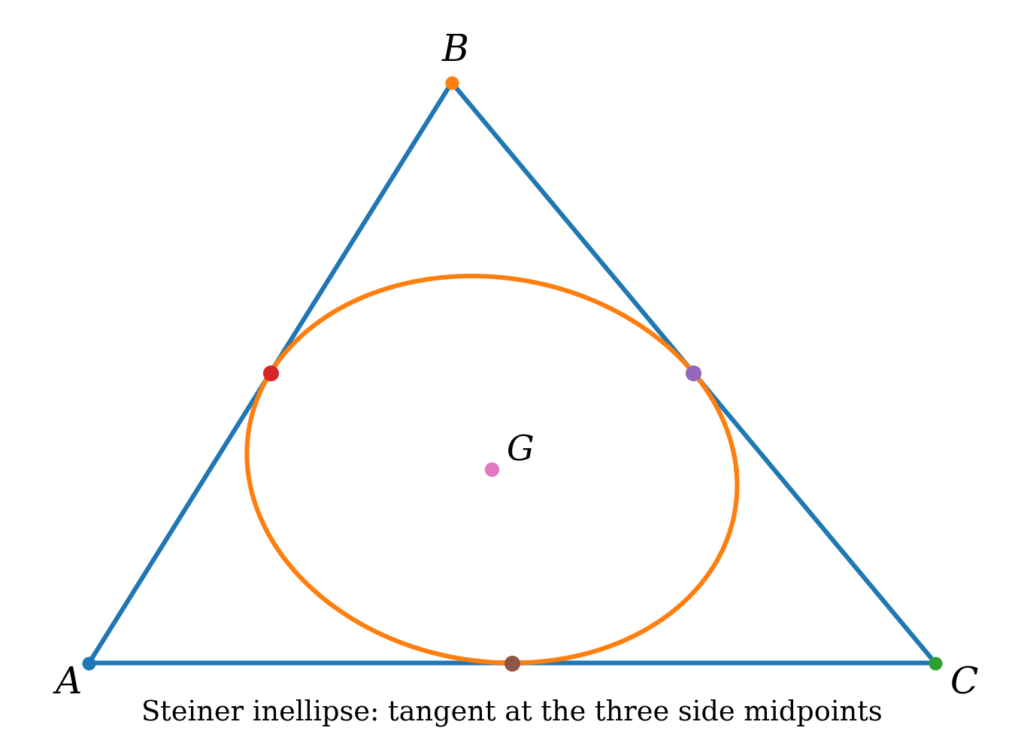
    Let ABC be any triangle. The Steiner inellipse is the unique ellipse contained in the triangle that is tangent to the three sides at their midpoints.

    Thus, if D, E, and F are the midpoints of BC, CA, and AB, respectively, the Steiner inellipse passes through all three points and is tangent to the corresponding sides there.

    Its center is the centroid G of the triangle—the point where the three medians intersect.

    The Steiner inellipse also has an extremal property: among all ellipses contained in a given triangle, it has the largest possible area.

    Why does the Steiner inellipse naturally appear?

    One way to understand the Steiner inellipse is through affine geometry. Every triangle can be obtained from an equilateral triangle by an invertible affine transformation.

    For an equilateral triangle, the Steiner inellipse is simply its incircle. The incircle touches the three sides at their midpoints and is centered at the common centroid, incenter, and circumcenter.

    Under an affine transformation, a circle generally becomes an ellipse, midpoints remain midpoints, and tangency is preserved. Therefore the incircle of an equilateral triangle is transformed into an ellipse tangent to the three sides of the new triangle at their midpoints. That ellipse is precisely the Steiner inellipse.

    So the Steiner inellipse may be viewed as the affine image of the incircle of an equilateral triangle.

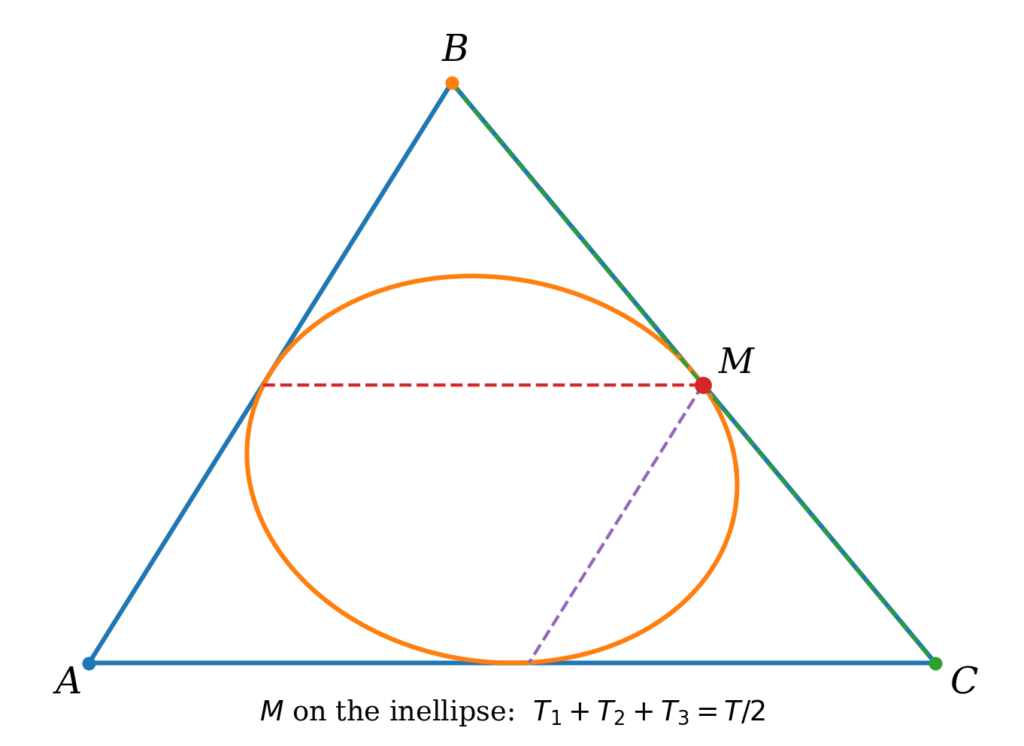
    Triangle ABC containing the Steiner inellipse, tangent to each side at its midpoint and centered at centroid G.
    Figure 1. The Steiner inellipse of triangle ABC.
    It is the unique ellipse tangent to the three sides at their midpoints,
    and its center is the centroid G.

    A different way to recognize the same ellipse

    The definition above characterizes the Steiner inellipse by tangency: it touches the sides of the triangle at three special points.

    But there is another, rather unexpected way to detect whether a point lies on this ellipse—one that does not initially mention an ellipse, tangency, or even distances.

    It uses only parallel lines and areas.

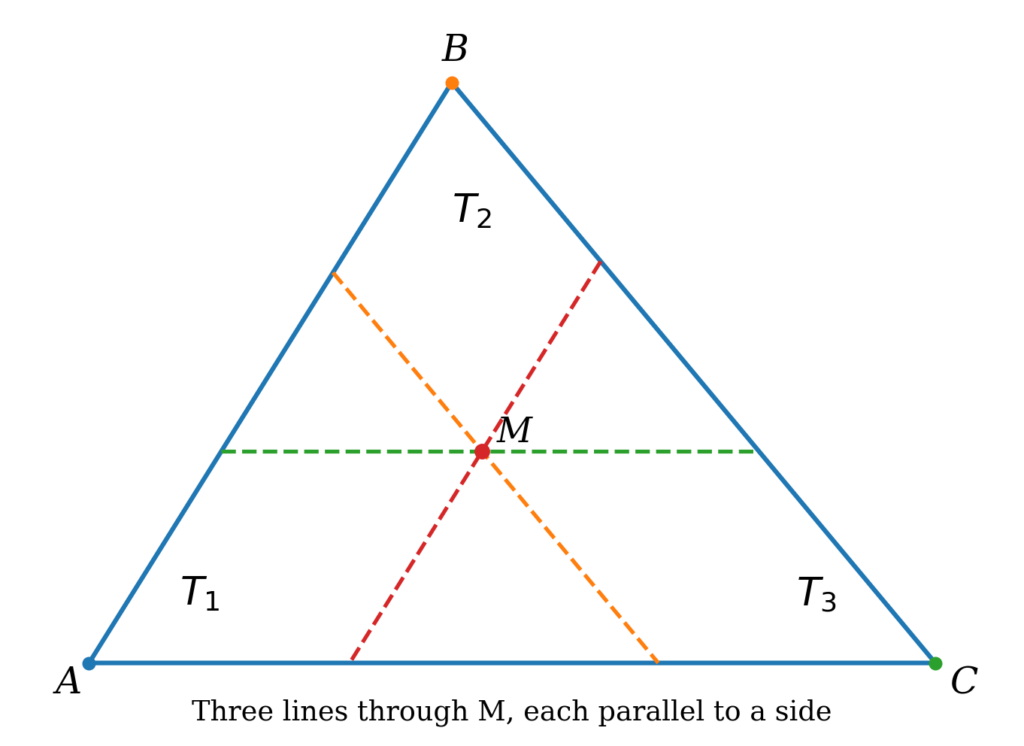
    Choose an arbitrary point M inside triangle ABC. Through M, draw three lines, each parallel to one side of the triangle.

    These three lines cut off three smaller triangles at the vertices A, B, and C. Let their areas be

    T1 , T2 , T3 .

    Let T denote the area of the original triangle.

    Now ask a simple question:

    For which points M is the sum of the three corner areas exactly one-half of the area of the original triangle?

    T1 + T2 + T3 = T2 ?

    At first glance, there is no obvious reason that the answer should involve an ellipse at all.

    Triangle ABC with an interior point M and three lines through M parallel to the sides, forming three corner triangles labeled T₁, T₂, and T₃.
    Figure 2. Through an arbitrary interior point M,
    draw three lines parallel to the sides of triangle ABC.
    The three corner triangles have areas T₁, T₂, and T₃.

    The surprising answer

    The answer is remarkably simple: the points satisfying this area condition are exactly the points on the Steiner inellipse.

    Theorem. Let ABC be a triangle with area T , and let M be a point in its interior. Through M, draw three lines parallel to the sides of the triangle, cutting off three corner triangles with areas T1 , T2 , and T3 . Then

    M ∈ Steiner inellipse ⇔ T1 + T2 + T3 = T 2 .

    In other words, a point M lies on the Steiner inellipse if and only if the three corner triangles together have exactly half the area of the original triangle.

    This is unexpected because the construction itself contains no ellipse. We choose a point, draw three parallel lines, and measure three areas. Yet the condition that their sum equals one-half of the total area traces out precisely the Steiner inellipse.

    Why should this be an ellipse?

    The key is affine geometry. An invertible affine transformation sends triangles to triangles, preserves parallelism and ratios of areas, and sends ellipses to ellipses.

    We can therefore transform our original triangle into an equilateral triangle without changing the essential area condition. In an equilateral triangle, the Steiner inellipse becomes something much more familiar: the incircle.

    So it is enough to determine which points satisfy the area condition in the equilateral case.

    Triangle ABC with its Steiner inellipse and a point M on the ellipse. Three lines through M parallel to the sides illustrate the three corner triangles whose total area is half the area of triangle ABC.
    Figure 3. A point M on the Steiner inellipse.
    For this point, the three corner areas satisfy T₁ + T₂ + T₃ = T/2.

    The equilateral case

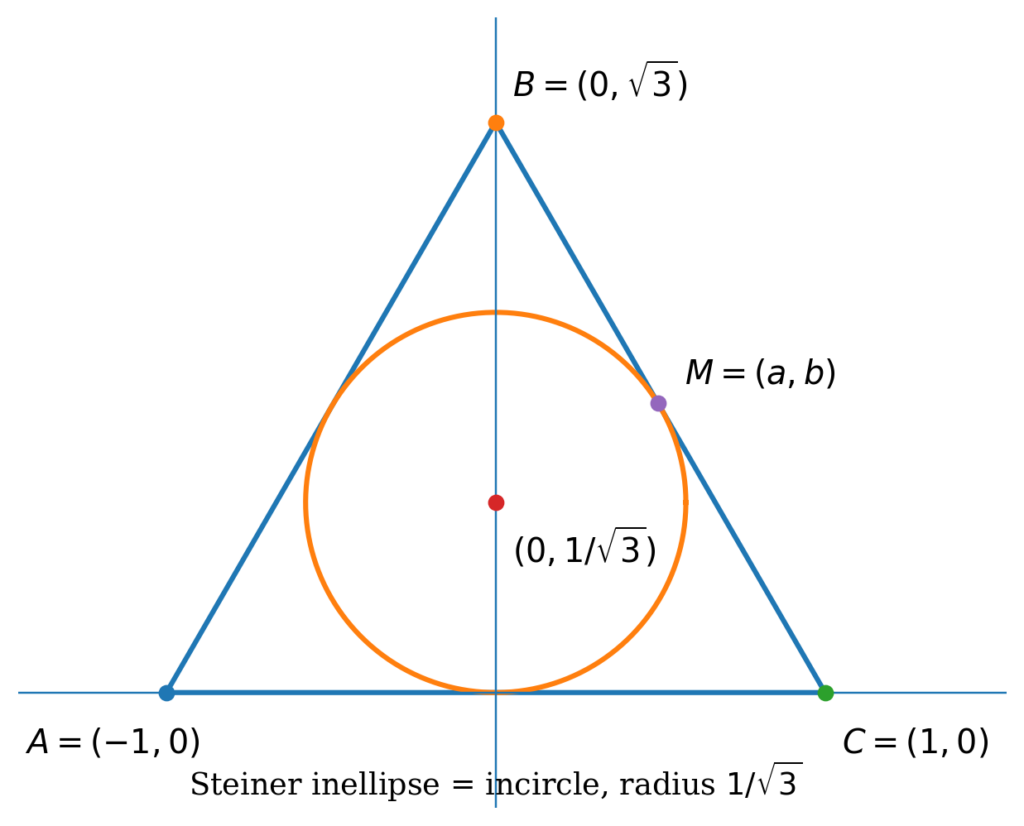
    Consider the equilateral triangle with vertices

    A=(−1,0), B=(0,3), C=(1,0).

    The base has length 2 and the height is 3 , so the area of the triangle is

    T = 2·3 2 = 3.

    Let M=(a,b) be an interior point. The three lines through M parallel to the sides cut off three smaller triangles. Because each corner triangle is similar to the original equilateral triangle, their areas can be written in terms of a and b.

    A direct calculation gives

    T1 = 34 ( 1 +a − b3 ) 2 , T2 = 34 ( 1 −a − b3 ) 2 ,

    and

    T3 = b2 3 .

    Now impose our area condition:

    T1 + T2 + T3 = T2 = 32.

    Substituting the three expressions above and simplifying gives

    a2 + b2 − 2b 3 = 0.

    Completing the square transforms this into

    a2 + ( b − 13 ) 2 = 13.

    But this is the equation of the circle centered at

    ( 0, 13 )

    with radius 13. This is precisely the incircle of our equilateral triangle.

    Therefore, in the equilateral case, the points satisfying

    T1 + T2 + T3 = T2

    are exactly the points on the incircle.

    Equilateral triangles often turn geometric questions into especially elegant problems. For another example, see Equilateral Triangle Maximum Area .

    Equilateral triangle with vertices A, B, and C and its incircle. The circle is centered at (0, 1/√3), has radius 1/√3, and contains the point M = (a,b).
    Figure 4. In the equilateral case, the Steiner inellipse is the incircle. The area condition produces a circle centered at (0, 1/√3) with radius 1/√3.

    Returning to the original triangle

    We have proved that, for an equilateral triangle, the condition

    T1 + T2 + T3 = T2

    describes exactly the incircle.

    Now apply the inverse affine transformation that carries the equilateral triangle back to the original triangle. Parallel lines remain parallel, and all areas are multiplied by the same factor, so the area condition is preserved. The incircle is transformed into the Steiner inellipse.

    Therefore, for any triangle, a point M satisfies the area condition if and only if M lies on the Steiner inellipse.

    A related area identity

    There is another elegant relation involving the same three corner triangles. Unlike the characterization above, this identity holds for every interior point M, not only for points on the Steiner inellipse.

    Since each corner triangle is similar to the original triangle, the ratio of corresponding side lengths is the square root of the ratio of the corresponding areas. The three relevant length ratios add to 1, which gives

    T1 + T2 + T3 = T .

    The contrast between the two identities is worth noticing.

    For every interior point M,

    T1 + T2 + T3 = T.

    But without the square roots,

    T1 + T2 + T3 = T2

    holds precisely when M lies on the Steiner inellipse. Thus the same three corner areas give both a universal identity and a geometric characterization of a special ellipse.

    There is another remarkable way in which the Steiner inellipse appears. If the vertices of the triangle are regarded as the three complex roots of a cubic polynomial, the zeros of its derivative are exactly the two foci of the Steiner inellipse. See Marden’s Theorem: How the Derivative of a Cubic Finds an Ellipse .

    References and further reading

    1. A. Eydelzon, “On a New Property of the Steiner Inellipse” , The American Mathematical Monthly, Vol. 127, No. 10 (2020), pp. 933–935.
    2. NCS/MAA Team Contest, Thirteenth Annual Contest (2009), Problem 9 , “Square roots of area ratios.”
    3. D. Kalman, “An Elementary Proof of Marden’s Theorem” , The American Mathematical Monthly, Vol. 115, No. 4 (2008), pp. 330–338.

    The first reference contains the area characterization of the Steiner inellipse discussed in this article. The second gives an earlier appearance of the classical square-root area problem. The third provides additional background on the Steiner inellipse and its connection with Marden’s theorem.

    A triangle is a two-dimensional simplex, while a tetrahedron is its three-dimensional counterpart. For a related exploration of simplex geometry, see The Geometry of a Tetrahedron: From Pythagoras to Vector Identities .

  • Can a Curve Fill a Square? The Mathematics of Space-Filling Curves

    Can a Curve Fill a Square?

    A curve is one-dimensional. A square is two-dimensional. So it seems impossible that a single continuous curve could pass through every point of a square.

    Surprisingly, it can.

    There exists a continuous function

    H : [0,1] → [0,1] × [0,1]

    whose image is the entire unit square. In other words, as the parameter moves continuously from 0 to 1, the point H(t) eventually reaches every point of the square.

    Such a curve is called a space-filling curve.

    The Hilbert Curve

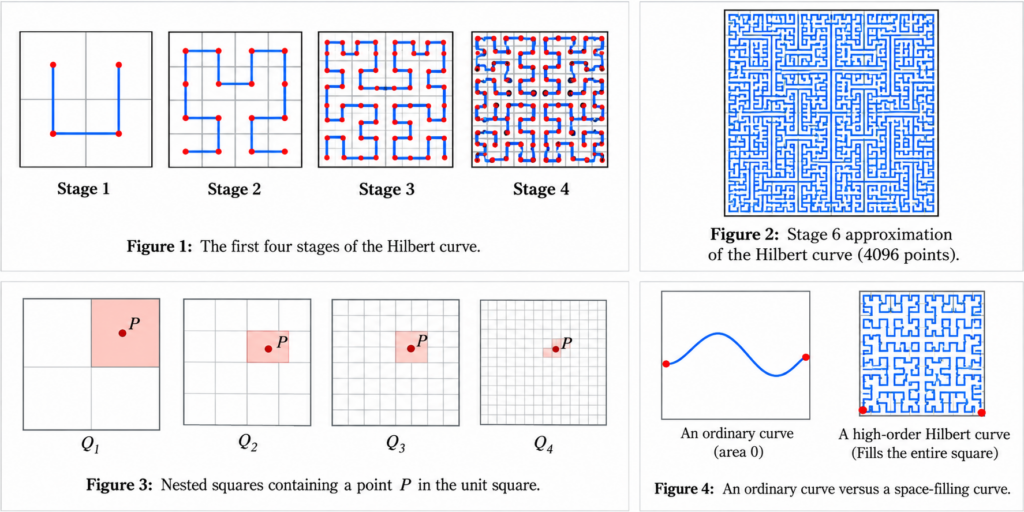
    One of the most beautiful examples is the Hilbert curve. Instead of trying to draw the final curve immediately, we construct a sequence of increasingly complicated polygonal curves.

    Start with a square. Divide it into four equal smaller squares and connect their centers in an order that forms a U-shaped path.

    This is the first approximation.

    For the second approximation, divide each of the four squares into four smaller squares. We now have

    42 = 16

    small squares. Inside each group of four, place a suitably rotated or reflected copy of the previous pattern and connect the pieces.

    Repeat the process again and again.

    At stage n, the square has been divided into

    4n

    small squares, each having side length

    2 −n .

    The Squares Become Tiny

    The important feature of the construction is not merely that the number of squares increases. Their size simultaneously decreases to zero.

    A small square at stage n has side length

    12n,

    so its diameter is

    2 2n .

    Therefore,

    2 2n → 0 as n → ∞.

    The construction is examining the square on smaller and smaller scales.

    Why Does the Limit Fill the Square?

    Take any point P in the unit square.

    At the first stage, P belongs to at least one of the four small squares. Call one such square Q1.

    At the second stage, choose one of the smaller squares containing P and call it Q2. Continue in this way.

    We obtain nested squares

    Q1 ⊇ Q2 ⊇ Q3 ⊇ ⋯

    containing P, while

    diam ( Qn ) → 0.

    Since the squares shrink to a point, their intersection is precisely

    ⋂ n=1 ∞ Qn = {P}.

    The Hilbert construction assigns corresponding nested parameter intervals

    I1 ⊇ I2 ⊇ I3 ⊇ ⋯

    whose lengths also tend to zero. Their intersection therefore determines a parameter value t. For this value,

    H (t) = P.

    But P was an arbitrary point of the square. Thus the limiting curve reaches every point of the square.

    A Curve Whose Image Has Area 1

    This produces a remarkable conclusion.

    The domain of the Hilbert curve is the interval [0,1], but its image is

    H ( [0,1] ) = [0,1] × [0,1].

    Consequently, the image of this continuous curve has area

    1.

    This is very different from an ordinary smooth curve, whose area in the plane is zero.

    What Happens to the Length?

    The polygonal approximations also reveal something interesting.

    At stage n, the curve visits 4n small squares. The characteristic distance between neighboring points is of order

    2 −n .

    Therefore the total length is of order

    4n · 2 −n = 2n.

    As n→∞, this quantity tends to infinity.

    2n → ∞.

    Thus the approximations stay inside a square of area 1, but their lengths grow without bound.

    Does This Mean an Interval and a Square Are the Same?

    No.

    The Hilbert curve is continuous and onto, but it is not one-to-one. Different parameter values can correspond to the same point of the square.

    This distinction is essential. There is no continuous one-to-one correspondence with a continuous inverse between an interval and a square.

    The space-filling curve does something subtler: it continuously folds an interval over itself infinitely many times until its image covers the entire square.

    A Dimensional Clue

    There is another way to see why the numbers in the construction fit together so naturally.

    When lengths are reduced by a factor of 2, the number of pieces increases by a factor of 4:

    4 = 22.

    If we informally ask for a dimension d satisfying

    4 = 2d,

    then

    d = log4 log2 = 2.

    This scaling behavior gives a hint of how a construction beginning with a one-dimensional parameter can produce an image that occupies a two-dimensional region.

    Why Space-Filling Curves Are Useful

    Space-filling curves are not only mathematical curiosities. Hilbert-type orderings are useful whenever multidimensional data must be arranged in a one-dimensional sequence.

    The Hilbert ordering has an important locality property: points that are close along the curve tend to remain relatively close in space. This idea appears in spatial indexing, image processing, databases, and algorithms for organizing multidimensional data.

    A construction that originally seemed almost paradoxical therefore connects pure mathematics with practical computation.

    The Main Idea

    The Hilbert curve demonstrates how misleading our finite-dimensional intuition can be when a limiting process is repeated infinitely many times.

    Every finite approximation is just an ordinary polygonal curve. None of these approximations fills the square.

    But the subdivisions become arbitrarily small, and in the limit every point of the square is reached.

    A continuous image of a one-dimensional interval can therefore fill an entire two-dimensional square.


    Continue exploring: Another surprising example of how strange continuous functions can be: Can a Function Be Continuous Everywhere but Differentiable Nowhere?

    Not all interesting curves are as unusual as space-filling curves. Some are designed to create smooth, controllable shapes using only a few points. Discover how this works in Bézier Curves: How Four Points Create Beautiful Shapes .

  • Can a Circle Centered Outside Another Circle Cut Its Area Exactly in Half?

    Choose any point outside a circle. Can we draw a second circle, centered at that point, that covers exactly half the area of the original circle?

    Surprisingly, the answer is always yes. Even better, there is exactly one such circle.

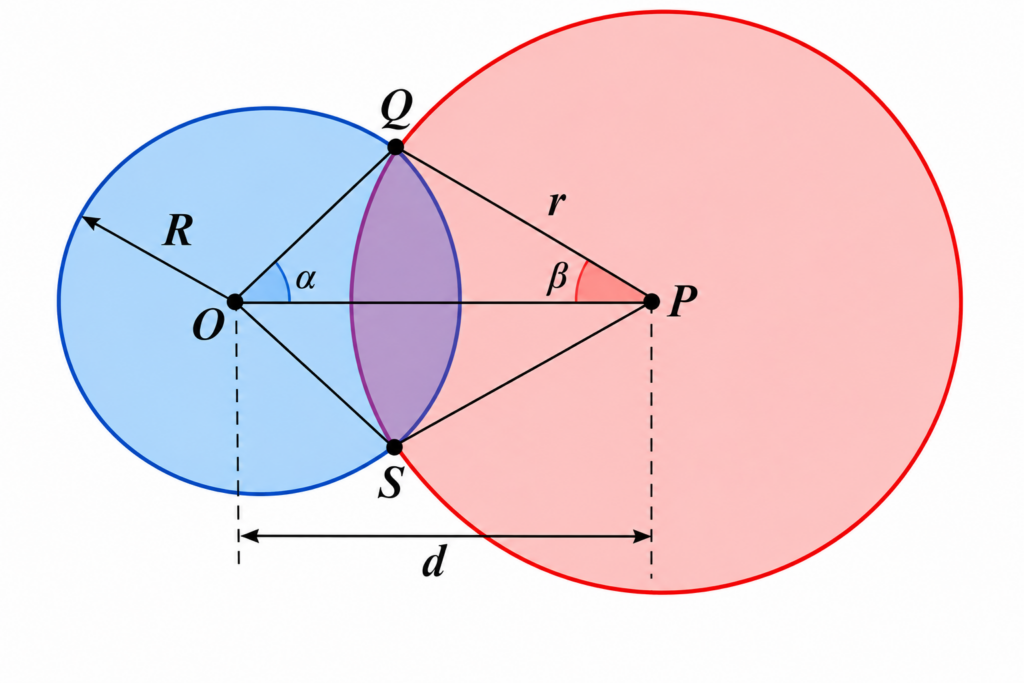
    Let the original circle have center O and radius R. Choose a fixed point P outside the circle, and let

    d=OP>R.

    We want to find the radius r of a circle centered at P that covers exactly half of the original disk.

    Why must such a circle exist?

    Before calculating anything, we can prove that the desired circle must exist.

    Let A(r) denote the area of the part of the original disk covered by the circle centered at P with radius r.

    Since P is outside the original circle, the distance from P to the nearest point of the original circle is

    d−R.

    Therefore, when

    r=d−R,

    the two circles are externally tangent. They meet at only one point, so their common area is zero:

    A ( d−R ) =0.

    Now continue increasing r. Eventually,

    r=d+R.

    At this point the circle centered at P contains the entire original disk. Hence

    A ( d+R ) = πR2.

    As r increases, the circle centered at P grows continuously. Consequently, the area A(r) that it covers inside the original circle also changes continuously.

    It starts at

    0

    and eventually reaches

    πR2.

    Therefore, by the Intermediate Value Theorem, at some intermediate radius it must equal

    12 πR2.

    Thus there is at least one radius satisfying

    d−R <r< d+R

    for which the second circle covers exactly half of the original disk.

    Why is the radius unique?

    Suppose

    r1 < r2.

    The disk centered at P with the smaller radius is strictly contained in the disk with the larger radius. While the two circles intersect, increasing the radius captures an additional region of positive area inside the original disk.

    Therefore A(r) is strictly increasing for

    d−R <r< d+R.

    So the value

    A(r) = 12 πR2

    can occur only once. The required circle is therefore unique.

    Now let us calculate its radius

    Let the two circles intersect at points Q and S. Consider the triangle formed by O, P, and Q.

    Its side lengths are

    OQ=R,   PQ=r,   OP=d.

    Let α be the angle at O between OP and OQ, and let β be the angle at P between PO and PQ.

    By the Law of Cosines,

    cosα = d2 + R2 − r2 2dR .

    Hence

    α = arccos ( d2 + R2 − r2 2dR ).

    Applying the Law of Cosines at P gives

    cosβ = d2 + r2 − R2 2dr ,

    so

    β = arccos ( d2 + r2 − R2 2dr ).

    The area of the overlap

    The common lens consists of two circular segments.

    At O, the full central angle subtending the common chord is 2α. The area of the corresponding sector is

    R2α.

    The triangle inside this sector has area

    R2 sinα cosα.

    Thus the first circular segment has area

    R2 ( α − sinα cosα ).

    Similarly, the second circular segment has area

    r2 ( β − sinβ cosβ ).

    Therefore the total overlap area is

    A(r) = R2 ( α − sinα cosα ) + r2 ( β − sinβ cosβ ).

    The equation for the radius

    We want the overlap to be exactly half the area of the original circle. Therefore r must satisfy

    R2 ( α − sinα cosα ) + r2 ( β − sinβ cosβ ) = 12 πR2,

    where

    α = arccos ( d2 + R2 − r2 2dR )

    and

    β = arccos ( d2 + r2 − R2 2dr ).

    This is a transcendental equation, so in general the radius is found numerically. But our geometric argument has already established something important: for every d > R, this equation has exactly one solution in

    d−R <r< d+R.

    A scale-free version

    The problem really depends only on the ratio d/R. Define

    D=dR,   ρ=rR.

    Then D > 1, and the required value of ρ depends only on D. Once ρ is found, the actual radius is simply

    r=ρR.

    For example, if the outside point happens to satisfy

    d=2R,

    the numerical solution is

    r≈2.08225R.

    But this is only one example. The construction works for every point outside the original circle.

    The geometric conclusion

    We have proved the following result:

    Given any point outside a circle, there exists a unique circle centered at that point whose intersection with the original disk has exactly half the area of the original disk.

    The calculation of its radius requires solving a transcendental equation, but its existence does not. It follows from a simple geometric idea: start with a circle that barely touches the original circle and continuously increase its radius. The covered area grows continuously from zero to the entire area of the original disk, and therefore it must pass through exactly one-half.

    Some numerical examples

    Because the problem is unchanged by scaling, we may take

    R=1.

    For several choices of the distance d from the center of the original circle to the outside point, the table below gives the unique radius r that covers exactly half of the original disk.

    Distance d Required radius r
    1.10 1.24543
    1.25 1.37910
    1.50 1.60860
    2.00 2.08225
    2.50 2.56611
    3.00 3.05523
    5.00 5.03326

    For a circle of arbitrary radius R, these numbers should be interpreted as ratios. For example,

    dR =2

    gives

    rR ≈2.08225,

    or equivalently,

    r≈2.08225R.

    The table also reveals an interesting pattern: as the outside point moves farther from the original circle, the required radius becomes increasingly close to the distance d itself.


    Another Equal-Area Problem

    Dividing the area of a circle exactly in half with another circle raises a natural geometric question: can a circle do the same thing to a triangle?

    Continue exploring: Can a Circle Cut a Triangle in Half?

  • Can a Circle Cut a Triangle in Half?

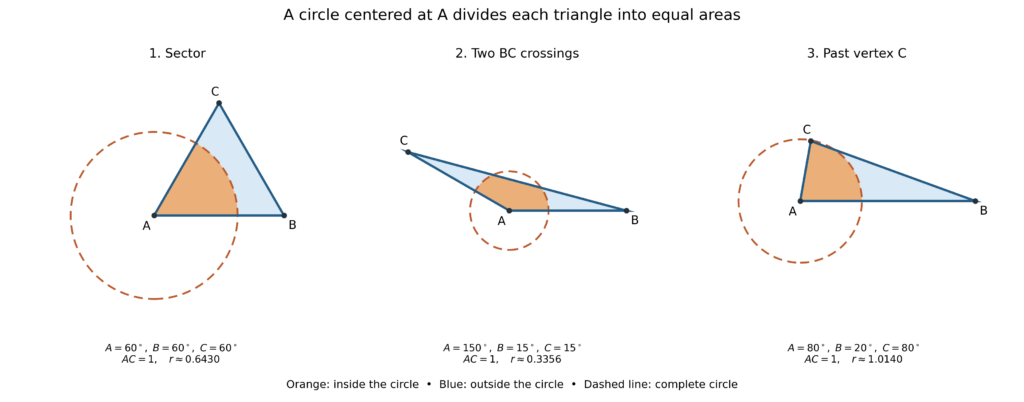
    Orange is inside the circle; blue is outside. Each occupies half the triangle.

    Take a triangle ABCABC. Place a compass point at AA, draw a circle, and adjust its radius until half the triangle lies inside the circle. What does the answer look like?

    For an equilateral triangle of side 11, the calculation is pleasantly short. The portion inside the circle is a sector with angle π/3\pi/3. Since the triangle has area 3/4\sqrt3/4, we want

    πr26=38,hencer=334π. \frac{\pi r^2}{6}=\frac{\sqrt3}{8}, \qquad\text{hence}\qquad r=\sqrt{\frac{3\sqrt3}{4\pi}}.

    The circle has not yet reached the opposite side BCBC, so the sector calculation really does describe the part of the triangle inside the circle. A vertex-centered circular arc bisecting an equilateral triangle also appears in Sanjoy Mahajan’s 2008 MIT course materials.

    Now change the triangle. The circle might meet BCBC before it captures half the area. Or it might grow past one of the other vertices. The figure above shows the three possible pictures.

    A radius always exists

    As the radius increases from 00, the area of the triangle inside the circle increases continuously from 00 to the area of the whole triangle. It increases strictly until the farther vertex is reached. Therefore exactly one radius divides the triangle into equal areas.

    We can scale the triangle without changing which of the three pictures occurs. To simplify the calculations, label the vertices so that AC≤ABAC\le AB, and set AC=1AC=1. Write A,B,CA,B,C for the angles, measured in radians. By the sine rule,

    AB=L=sinCsinB,T=area(ABC)=LsinA2. AB=L=\frac{\sin C}{\sin B}, \qquad T=\operatorname{area}(ABC)=\frac{L\sin A}{2}.

    The desired area inside the circle is T/2T/2.

    Case 1: A sector is enough

    While the circle remains inside the triangle’s angle at AA, its area inside the triangle is Ar2/2Ar^2/2. The candidate radius is thus

    r0=TA=LsinA2A. \boxed{r_0=\sqrt{\frac{T}{A}}=\sqrt{\frac{L\sin A}{2A}}.}

    We still need to check whether the circle reaches BCBC. If both base angles are acute, the distance from AA to BCBC is h=sinCh=\sin C, so this is the answer precisely when r0≤hr_0\le h. The test can be written entirely in angles:

    cotB+cotC≤2A. \boxed{\cot B+\cot C\le 2A.}

    If CC is right or obtuse, the nearest point of the segment BCBC to AA is CC. In that situation the sector answer works when r0≤AC=1r_0\le AC=1.

    Case 2: The circle crosses BCBC twice

    Suppose both base angles are acute, h<r<1h<r<1, and the circle cuts BCBC at two points. Start with a sector and subtract the circular segment lying beyond BCBC:

    S(r)=Ar22−r2arccos(hr)+hr2−h2,h=sinC. S(r)=\frac{Ar^2}{2} -r^2\arccos\!\left(\frac{h}{r}\right) +h\sqrt{r^2-h^2}, \qquad h=\sin C.

    The equal-area radius is the unique solution of S(r)=T/2S(r)=T/2 in (h,1)(h,1). We can determine before solving whether it lies there. At r=1r=1,

    S(1)=C−B2+sinCcosC. S(1)=\frac{C-B}{2}+\sin C\cos C.

    If the sector candidate already exceeds hh, and S(1)≥T/2S(1)\ge T/2, we are in this case. Equality gives the boundary case r=1r=1.

    For example, a triangle with A=150∘A=150^\circ and B=C=15∘B=C=15^\circ has an equal-area radius of approximately 0.3355930.335593 when AC=1AC=1. Its circle crosses BCBC twice.

    Case 3: The circle passes a vertex

    If half the area has still not been captured at r=1r=1, the circle passes the nearer vertex CC. The remaining part outside the circle sits near BB, and 1<r<L1<r<L.

    Let DD be the circle’s intersection with BCBC, and set ϕ=∠BAD\phi=\angle BAD. The sine rule in triangle ABDABD gives

    ϕ=arcsin(sinCr)−B. \phi=\arcsin\!\left(\frac{\sin C}{r}\right)-B.

    The outside area equals the area of triangle ABDABD minus a sector centered at AA:

    U(r)=Lrsinϕ−r2ϕ2. U(r)=\frac{Lr\sin\phi-r^2\phi}{2}.

    Set U(r)=T/2U(r)=T/2, or equivalently Lrsinϕ−r2ϕ=TLr\sin\phi-r^2\phi=T. This determines the unique radius between 11 and LL. As an example, A=80∘,B=20∘,C=80∘A=80^\circ, B=20^\circ, C=80^\circ gives r≈1.014031r\approx1.014031 when AC=1AC=1.

    The equilateral triangle leads to a square-root formula. Other triangles lead to a circular segment, and some require us to measure the outside area instead. The same question changes character as the angles change.


    Another Equal-Area Problem

    Here the challenge was to use a circle to divide the area of a triangle exactly in half. What happens if we reverse the roles and ask a circle to divide the area of another circle in half? Surprisingly, we can even require the center of the cutting circle to lie outside the original circle.

    Continue exploring: Can a Circle Centered Outside Another Circle Cut Its Area Exactly in Half?