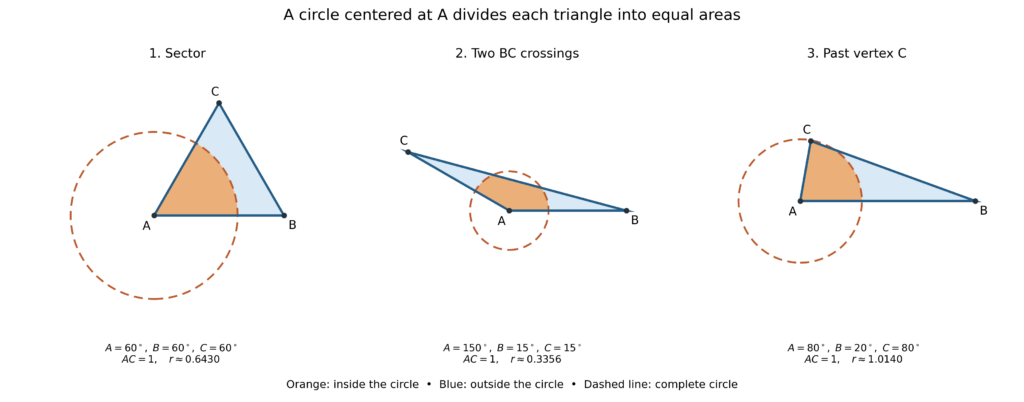
Take a triangle . Place a compass point at , draw a circle, and adjust its radius until half the triangle lies inside the circle. What does the answer look like?
For an equilateral triangle of side , the calculation is pleasantly short. The portion inside the circle is a sector with angle . Since the triangle has area , we want
The circle has not yet reached the opposite side , so the sector calculation really does describe the part of the triangle inside the circle. A vertex-centered circular arc bisecting an equilateral triangle also appears in Sanjoy Mahajan’s 2008 MIT course materials.
Now change the triangle. The circle might meet before it captures half the area. Or it might grow past one of the other vertices. The figure above shows the three possible pictures.
A radius always exists
As the radius increases from , the area of the triangle inside the circle increases continuously from to the area of the whole triangle. It increases strictly until the farther vertex is reached. Therefore exactly one radius divides the triangle into equal areas.
We can scale the triangle without changing which of the three pictures occurs. To simplify the calculations, label the vertices so that , and set . Write for the angles, measured in radians. By the sine rule,
The desired area inside the circle is .
Case 1: A sector is enough
While the circle remains inside the triangle’s angle at , its area inside the triangle is . The candidate radius is thus
We still need to check whether the circle reaches . If both base angles are acute, the distance from to is , so this is the answer precisely when . The test can be written entirely in angles:
If is right or obtuse, the nearest point of the segment to is . In that situation the sector answer works when .
Case 2: The circle crosses twice
Suppose both base angles are acute, , and the circle cuts at two points. Start with a sector and subtract the circular segment lying beyond :
The equal-area radius is the unique solution of in . We can determine before solving whether it lies there. At ,
If the sector candidate already exceeds , and , we are in this case. Equality gives the boundary case .
For example, a triangle with and has an equal-area radius of approximately when . Its circle crosses twice.
Case 3: The circle passes a vertex
If half the area has still not been captured at , the circle passes the nearer vertex . The remaining part outside the circle sits near , and .
Let be the circle’s intersection with , and set . The sine rule in triangle gives
The outside area equals the area of triangle minus a sector centered at :
Set , or equivalently . This determines the unique radius between and . As an example, gives when .
The equilateral triangle leads to a square-root formula. Other triangles lead to a circular segment, and some require us to measure the outside area instead. The same question changes character as the angles change.
Another Equal-Area Problem
Here the challenge was to use a circle to divide the area of a triangle exactly in half. What happens if we reverse the roles and ask a circle to divide the area of another circle in half? Surprisingly, we can even require the center of the cutting circle to lie outside the original circle.
Continue exploring: Can a Circle Centered Outside Another Circle Cut Its Area Exactly in Half?
Leave a Reply