
Why Does a Pendulum Swing?
Pull a pendulum to one side and release it. It swings toward the middle, passes through the lowest point, rises on the other side, and returns. Why doesn’t it simply stop at the bottom? And why does a longer pendulum take more time to complete a swing?
The answers come from gravity, inertia, and one remarkably simple differential equation.
1. Gravity pulls the pendulum toward equilibrium
Imagine a small mass attached to a light string of length L, swinging without friction. Let θ be the angle between the string and the downward vertical. The lowest position, θ = 0, is the equilibrium position.
Gravity acts downward, but only part of its force acts along the circular path. That tangential component is −mg sin(θ). The minus sign means the force points toward equilibrium.
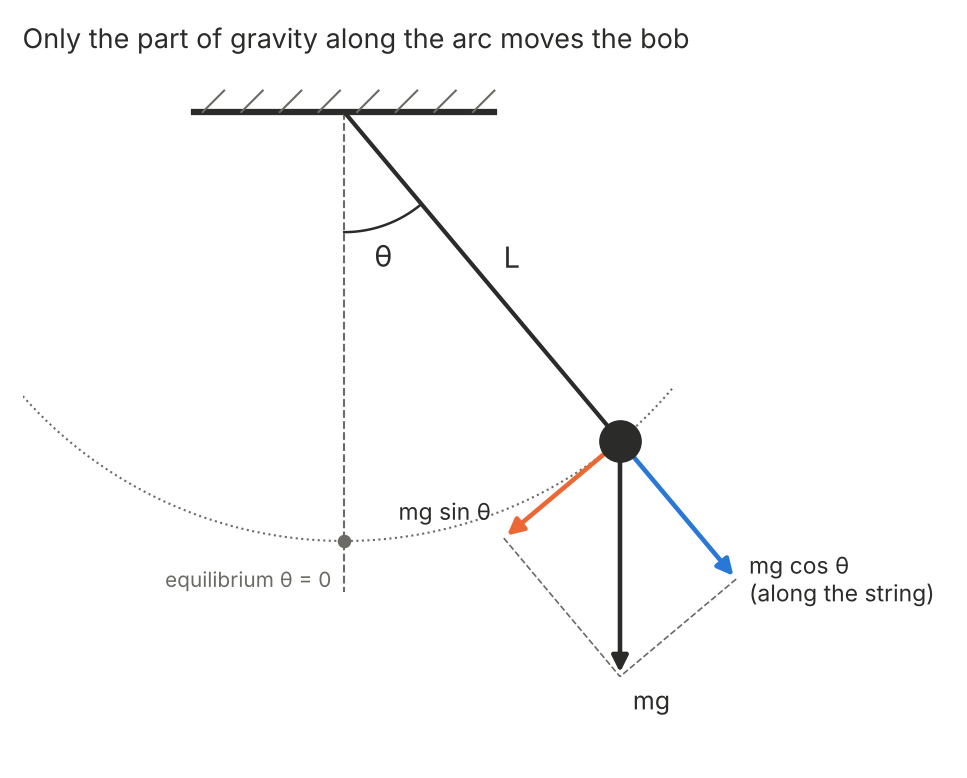
Since the mass moves along a circle of radius L, its tangential acceleration is Lθ”. Newton’s second law gives
Canceling the mass produces the exact ideal-pendulum equation:
Here g is gravitational acceleration, approximately 9.81 meters per second squared near Earth’s surface. Notice that mass has disappeared: in this ideal model, a heavier bob does not swing faster than a lighter one.
2. Why does it pass through the bottom?
When the pendulum is released from one side, gravity accelerates it toward the bottom. As it descends, gravitational potential energy becomes kinetic energy. At the lowest point, the restoring force along the arc is zero, but the bob is moving at its greatest speed. Its inertia carries it past equilibrium.
On the other side, gravity opposes the motion and slows the bob until it stops momentarily, reverses direction, and begins another swing. Without air resistance or friction, the motion continues indefinitely. A real pendulum gradually loses energy and eventually comes to rest.
3. A small angle makes the equation simple
The sine function makes the exact equation nonlinear. But for small angles measured in radians,
We therefore obtain the small-angle approximation:
Writing \omega=\sqrt{\frac{g}{L}}, this becomes
This is the equation of simple harmonic motion. Its solutions are combinations of sine and cosine:
For a pendulum released from rest at a small angle \theta_0, we have \theta(0)=\theta_0 and \theta'(0)=0, so
The cosine describes repeated motion back and forth. The quantity ω is the angular frequency, measured in radians per second.
4. Why does a longer pendulum swing more slowly?
A complete oscillation occurs when the cosine’s argument increases by 2\pi. Thus the approximate period (the time for one complete back-and-forth oscillation) is
This formula predicts that the period is proportional to the square root of the length, not to the length itself.
Example. Compare two small-angle pendulums on Earth, one with length 1 meter and another with length 4 meters.
For the first pendulum,
For the second,
So making the string four times longer doubles the period. More generally, multiplying the length by k multiplies the small-angle period by \sqrt{k}.
5. What if we take the pendulum to the Moon?
Gravity also affects the period. The Moon’s gravitational acceleration is about 1.62\text{ m/s}^2. For a 1-meter pendulum,
That is more than twice its period on Earth. Weaker gravity produces slower oscillations.
6. Where does the simple formula stop working?
The formula T=2\pi\sqrt{L/g} is an approximation for small angles. For large swings, \sin\theta is no longer close enough to \theta. The exact nonlinear equation predicts a longer period that depends on the release angle.
For example, at a release angle of 60 degrees, the ideal pendulum’s exact period is about 7.3% longer than the small-angle prediction. Air resistance, friction at the pivot, string mass, and the size of the bob introduce further differences in real experiments.
7. The surprising lesson
A pendulum’s motion is a balance between gravity pulling it back and inertia carrying it forward. A simple equation predicts the rhythm of that motion:
For small oscillations, the period does not depend on the bob’s mass and is nearly independent of how far the pendulum is initially displaced. These properties help explain why pendulums were so useful in clocks.
Continue exploring: A real pendulum slowly stops; Why Do Vibrations Die Out? Damped Oscillations adds friction to the same equation. The equation θ″ + ω²θ = 0 can also be solved with algebra alone in How Can We Solve Differential Equations Using Algebra? The Laplace Transform.
Try it yourself: Hang a small weight from a string, measure the time for ten complete oscillations, and divide by ten. Then make the string four times as long. Does the period approximately double?
Mathematical Physics Through Simple Equations. For related ideas, read Why Do Waves Travel?
Leave a Reply