
Choose any point inside a rectangle. Draw segments from that point to the four vertices, and measure its perpendicular distances to the four sides. We now have eight distances. Are they related?
Surprisingly, they satisfy a beautiful identity that holds regardless of where the point is located. This observation leads to a classical theorem, an optimization problem, and a family of geometric inequalities.
1. Eight Distances from One Point
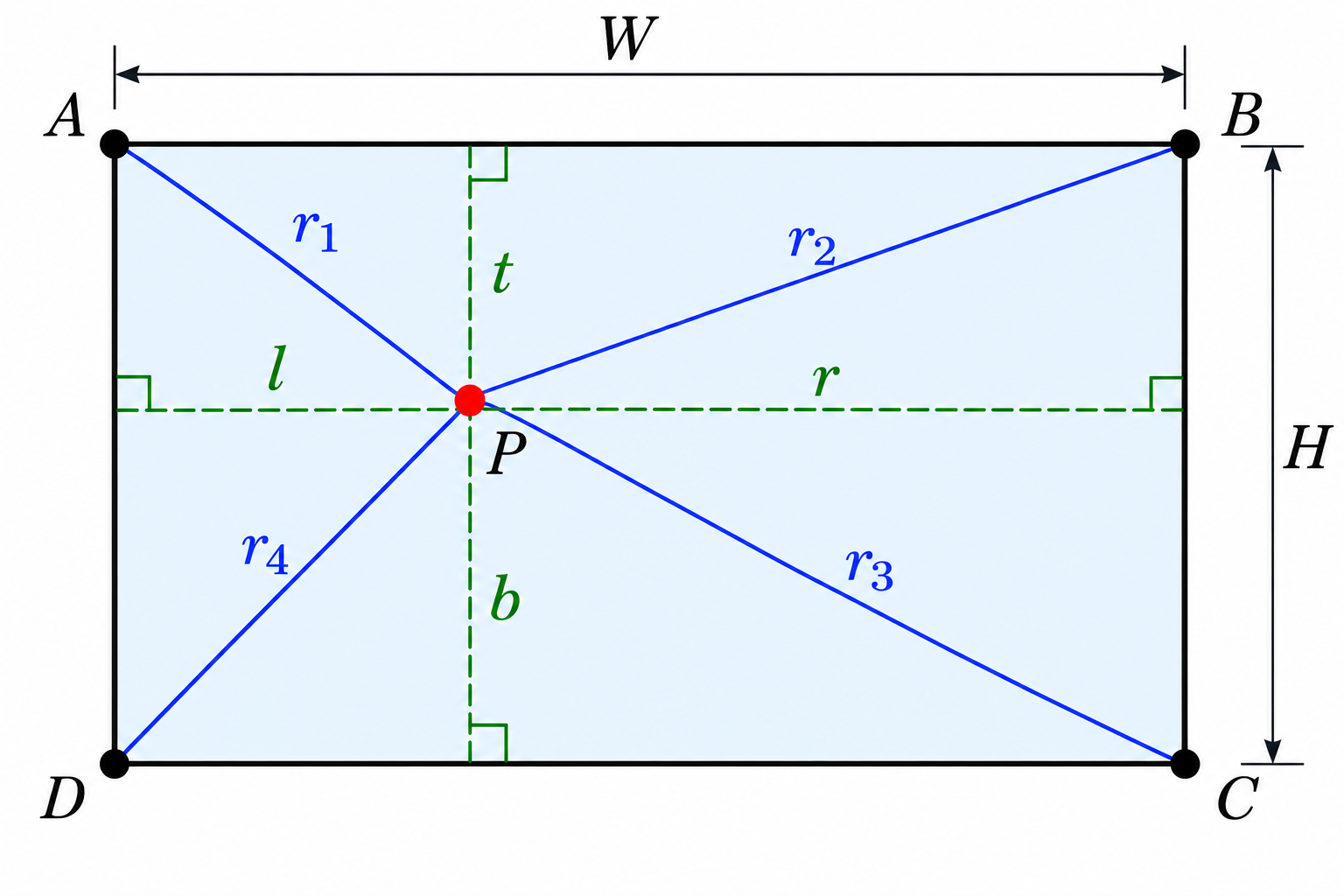
Let ABCD be a rectangle of width W and height H, and let P be any point inside it.
Denote the distances from P to the four vertices by
r_1=PA,\quad r_2=PB,\quad r_3=PC,\quad r_4=PD.Let l, r, t, and b be the perpendicular distances from P to the left, right, top, and bottom sides, respectively. Clearly,
l+r=W,\qquad t+b=H.2. A Surprising Eight-Distance Identity
By the Pythagorean theorem,
\begin{aligned}r_1^2&=l^2+t^2,\\r_2^2&=r^2+t^2,\\r_3^2&=r^2+b^2,\\r_4^2&=l^2+b^2.\end{aligned}Adding gives
\boxed{r_1^2+r_2^2+r_3^2+r_4^2=2(l^2+r^2+t^2+b^2).}The sum of the squared distances to the four vertices is twice the sum of the squared distances to the four sides. The identity holds for every interior point and every rectangle.
3. The British Flag Theorem
The same four equations imply
\begin{aligned}r_1^2+r_3^2&=l^2+r^2+t^2+b^2,\\r_2^2+r_4^2&=l^2+r^2+t^2+b^2.\end{aligned}Consequently,
\boxed{PA^2+PC^2=PB^2+PD^2.}This is the classical British Flag Theorem: the sums of squared distances to opposite vertices of a rectangle are equal.
4. Where Should the Point Be Placed?
Let O be the center of the rectangle and d its diagonal:
d=\sqrt{W^2+H^2}.Using symmetry about O, or expanding the squared distances, gives the exact formula
\boxed{PA^2+PB^2+PC^2+PD^2=d^2+4OP^2.}Since the second term is nonnegative,
\boxed{PA^2+PB^2+PC^2+PD^2\ge d^2.}Equality holds precisely at the center P=O. Thus the center uniquely minimizes the sum of squared distances to the vertices.
5. What If We Remove the Squares?
Consider the ordinary-distance sum
S(P)=PA+PB+PC+PD.Applying the triangle inequality along each diagonal,
PA+PC\ge AC=d,\qquad PB+PD\ge BD=d.Hence
\boxed{S(P)\ge 2d.}Equality requires P to lie on both diagonals, so P=O.
Can We Find the Maximum?
The distance to a fixed vertex is a convex function of P; therefore their sum is convex. Since any point of a rectangle is a convex combination of its vertices, the maximum over the closed rectangle occurs at a vertex. At a vertex the distances are 0, W, H, and d.
Thus we obtain the sharp bounds
\boxed{2\sqrt{W^2+H^2}\le PA+PB+PC+PD\le W+H+\sqrt{W^2+H^2}.}The lower bound is attained only at the center, and the upper bound only at a vertex. For an interior point the upper inequality is strict.
6. A Generalization: Arbitrary Powers
Study the family
F_p(P)=PA^p+PB^p+PC^p+PD^p,\qquad p\ge1.For p at least 1, each distance raised to the power p is convex. If P’ is the reflection of P about the center O, then O is the midpoint of P and P’, and symmetry gives Fp(P’)=Fp(P). By convexity,
F_p(O)\le\frac{F_p(P)+F_p(P')}{2}=F_p(P).All four vertices lie at distance d/2 from the center, so
\boxed{F_p(P)\ge4\left(\frac d2\right)^p=2^{2-p}d^p,\qquad p\ge1.}Equality holds only at the center. For p=1 this is the ordinary-distance inequality; for p=2 it is the squared-distance inequality.
7. A Challenge for the Reader
- What happens for exponents between 0 and 1, when convexity no longer applies?
- Can the eight-distance identity be generalized to a rectangular box in three dimensions?
- What changes if the rectangle is replaced by a parallelogram?
Conclusion
An elementary question about eight distances leads from the Pythagorean theorem to the British Flag Theorem, sharp inequalities, convexity, and optimization. Changing just one ingredient—such as replacing squares by ordinary distances or arbitrary powers—opens a new mathematical investigation.
Continue exploring:
what happens when the rectangle becomes a parallelogram? Sums of squared distances lead to
Can the Parallelogram Law Define Euclidean Geometry?
And for a three-dimensional relative of the Pythagorean theorem, see
The Geometry of a Tetrahedron: From Pythagoras to Vector Identities.
Leave a Reply