
There is a familiar fact about every parallelogram: the sum of the squares of its two diagonals equals the sum of the squares of its four sides. But this innocent-looking identity has an unexpected consequence. It can tell us whether a way of measuring distance is genuinely Euclidean.
We will begin with elementary geometry, try two unusual definitions of distance, and discover a theorem that reconstructs the dot product from lengths alone.
1. A remarkable identity about parallelograms
Let the adjacent sides of a parallelogram be represented by vectors u and v. Its diagonals have lengths \lVert u+v\rVert and \lVert u-v\rVert. The parallelogram law says
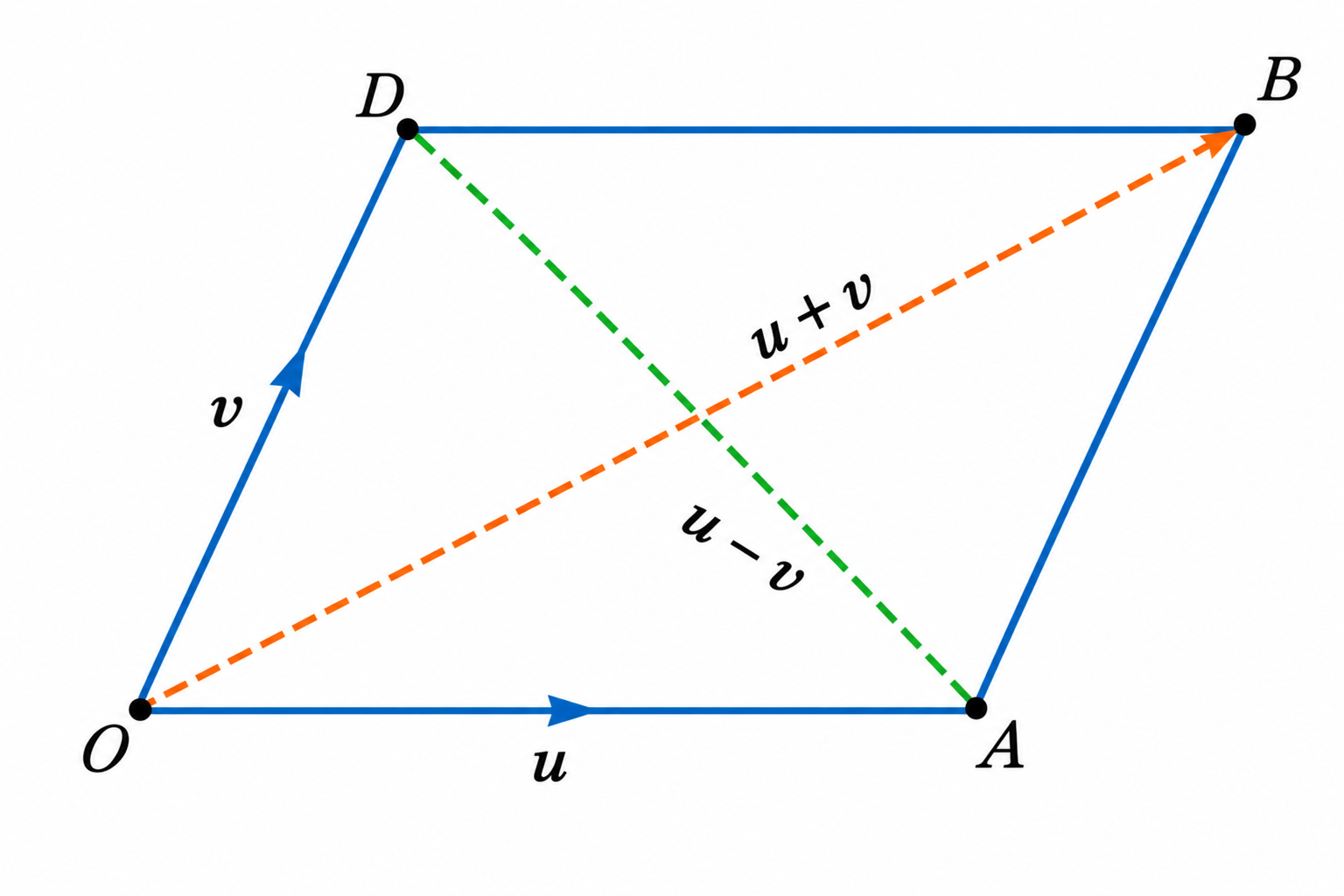
For example, if the sides are the perpendicular vectors u=(3,0) and v=(0,4), both diagonals have length 5, and
The identity is not restricted to rectangles. It holds for every parallelogram in the Euclidean plane.
2. Why the law works
Recall that Euclidean squared length is computed using the dot product:
Expanding the two diagonal lengths gives
When we add the equations, the mixed terms cancel. This proves the parallelogram law immediately.
So far, we have shown that the usual dot product implies the parallelogram law. The surprising question is whether the converse holds.
3. Not every distance behaves this way
In the plane, the familiar Euclidean length is
But there are other useful ways to measure vectors. Two examples are Manhattan length and maximum length:
Both satisfy the standard rules of a norm, including the triangle inequality. Yet they do not satisfy the parallelogram law.
Take u=(1,0) and v=(0,1). In Manhattan length,
but
For maximum length, the left side is 1+1=2, while the right side is still 4. Both fail.
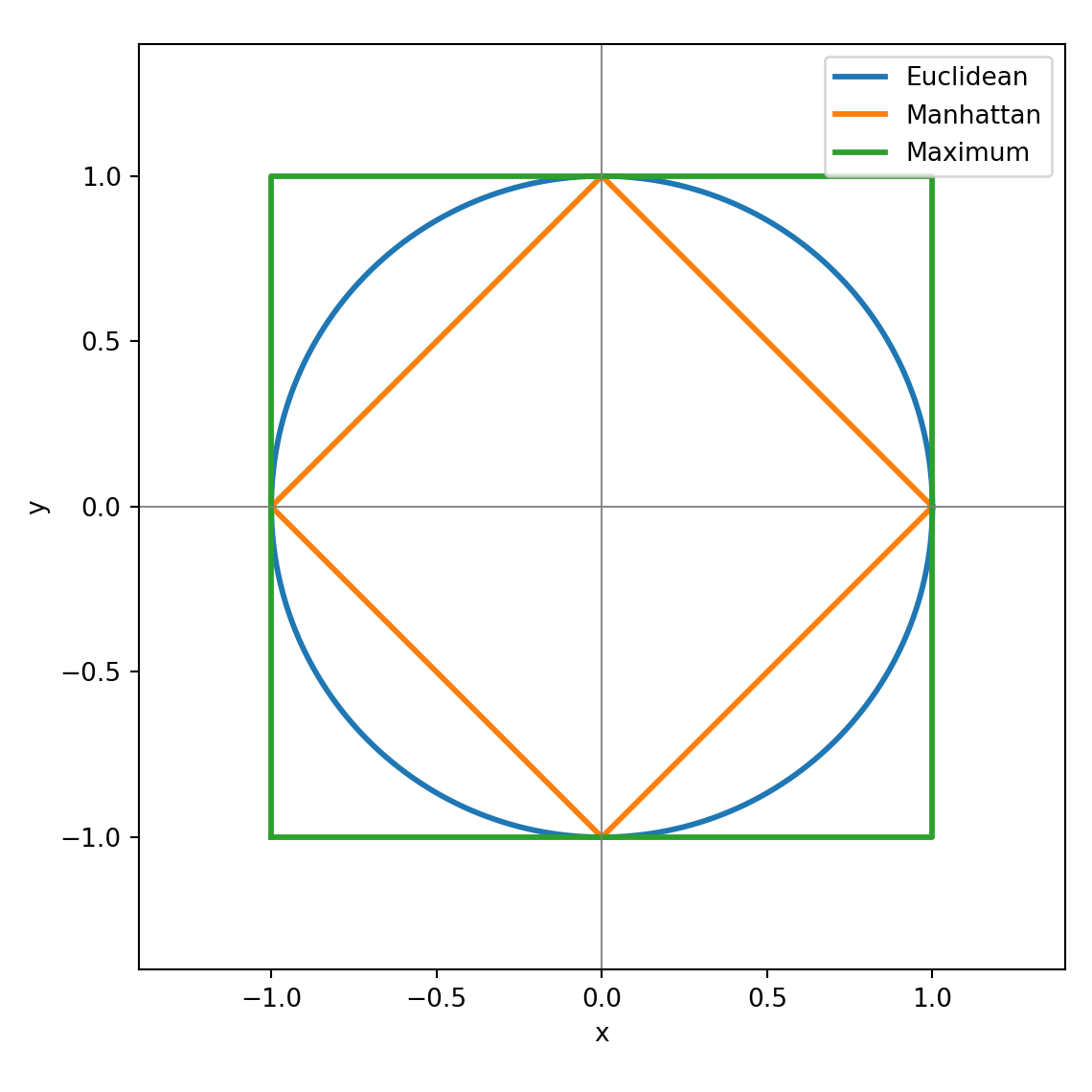
The word “circle” here means the set of points whose length is one. For a general norm, that set need not look round.
4. Can lengths recover angles?
In Euclidean geometry,
Solving for the dot product yields
If the parallelogram law holds, an equivalent and more symmetric formula is
This is called the polarization identity. It suggests a striking possibility: even if we are given only a way to measure lengths, perhaps we can construct an inner product—and hence recover angles—from those lengths.
5. The Jordan–von Neumann theorem
Theorem. A norm on a real vector space is induced by an inner product if and only if it satisfies the parallelogram law for every pair of vectors.
The forward implication is the calculation from Section 2. For the reverse implication, define \langle u,v\rangle using the polarization identity. One must prove that this expression is linear in each variable, symmetric, and positive definite. The parallelogram law provides the crucial algebraic identities needed to establish linearity.
To see part of the mechanism, write Q(w)=\lVert w\rVert^2. Then the parallelogram law becomes
Define
Applying the parallelogram law repeatedly gives
and, because B(-u,v)=-B(u,v), replacing u by (u+z)/2 and z by (u-z)/2 leads to additivity:
Additivity gives homogeneity for rational scalars. Continuity of the norm extends it to all real scalars. Symmetry is immediate from the definition, and B(u,u)=\lVert u\rVert^2. Thus B is an inner product.
In other words, a single identity involving the lengths of four vectors completely characterizes inner-product geometry.
6. What the 1974 paper adds
In their 1974 note Apollonius and Inner Products, Desmond Fearnley-Sander and J. S. V. Symons revisit this characterization from an even more general perspective. They show that one can begin with a nonnegative length-like function satisfying absolute homogeneity and the parallelogram identity, and use polarization to obtain a nonnegative symmetric bilinear form. With the additional condition that only the zero vector has zero length, the result is an inner product.
The authors also explain why some regularity assumption matters if one weakens the usual norm axioms. The familiar theorem for genuine norms is the accessible heart of their argument; the weaker-assumption version is a deeper extension.
7. Try it yourself
Exercise 1. Verify the parallelogram law for u=(2,1) and v=(1,3) in Euclidean length.
u+v=(3,4) has squared length 25; u-v=(1,-2) has squared length 5. Their sum is 30. Meanwhile 2\lVert u\rVert^2+2\lVert v\rVert^2=2(5)+2(10)=30.
Exercise 2. Find the dot product of u=(2,1) and v=(1,3) using only their diagonal lengths.
By polarization, u\cdot v=(25-5)/4=5. Directly, 2(1)+1(3)=5.
Exercise 3. Does the norm \lVert(x,y)\rVert_\infty satisfy the parallelogram law?
No. For u=(1,0) and v=(0,1), the left side is 2, while the right side is 4.
Challenge. If a norm satisfies the parallelogram law, show that \langle u,u\rangle=\lVert u\rVert^2 for the polarization formula.
Since \lVert 2u\rVert^2=4\lVert u\rVert^2 and \lVert 0\rVert=0,
8. A geometric identity with a surprising consequence
Apollonius’s law is much more than a convenient formula for parallelograms. It distinguishes Euclidean-style distance from other perfectly legitimate notions of length. When the law holds for every pair of vectors, an inner product is hiding behind the distance formula—and the polarization identity reveals it.
Further Reading
D. Fearnley-Sander and J. S. V. Symons, “Apollonius and Inner Products,” The American Mathematical Monthly 81, no. 9 (1974), 990–993. Read on JSTOR.
For the classical characterization, see P. Jordan and J. von Neumann, “On Inner Products in Linear, Metric Spaces,” Annals of Mathematics 36 (1935), 719–723.
Related Reading
Inner products also lead to one of the most important inequalities in mathematics: the Cauchy–Schwarz inequality. To explore its geometric meaning and applications, read One Inequality, Many Worlds: From Geometry to Calculus .
Leave a Reply