
I came up with this puzzle myself and have not seen it elsewhere. The key fact behind it, the curvature of an ellipse at its vertex, is classical, but the way the contact point splits in two seemed worth writing up.
A circle-placement puzzle reveals a critical eccentricity, a change in tangency geometry, and a familiar 30°–60°–90° triangle.
1. A circle-placement puzzle
Draw an ellipse that is taller than it is wide. Place the largest circle centered at the center of the ellipse: its radius is the horizontal semiaxis a. Two crescent-shaped regions remain, one above and one below. How large a circle can we fit in each region?
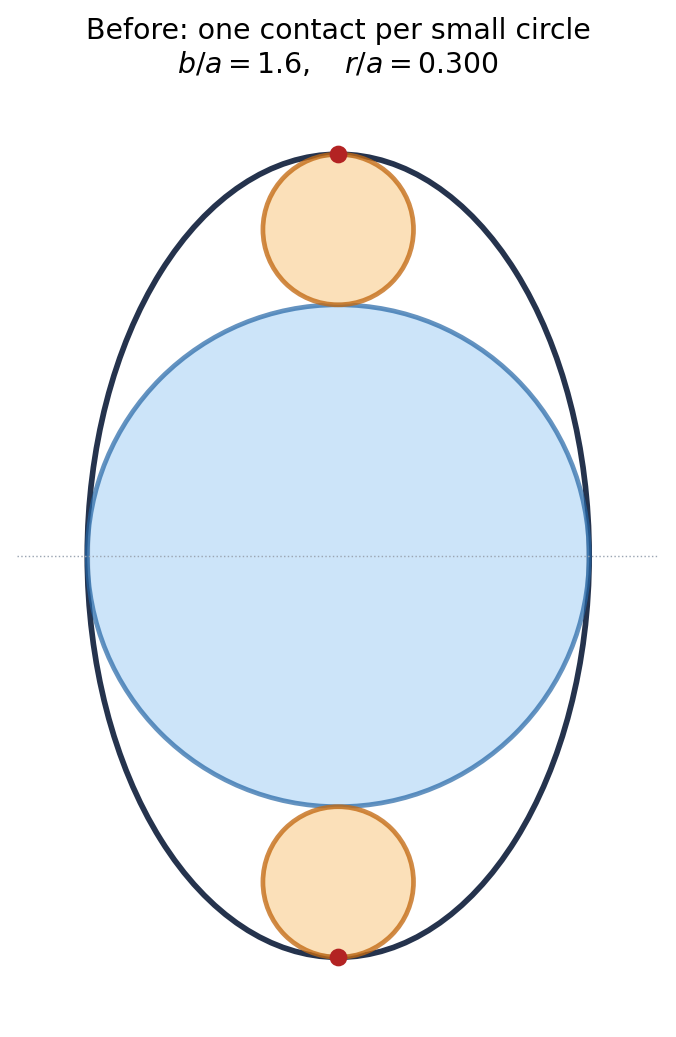
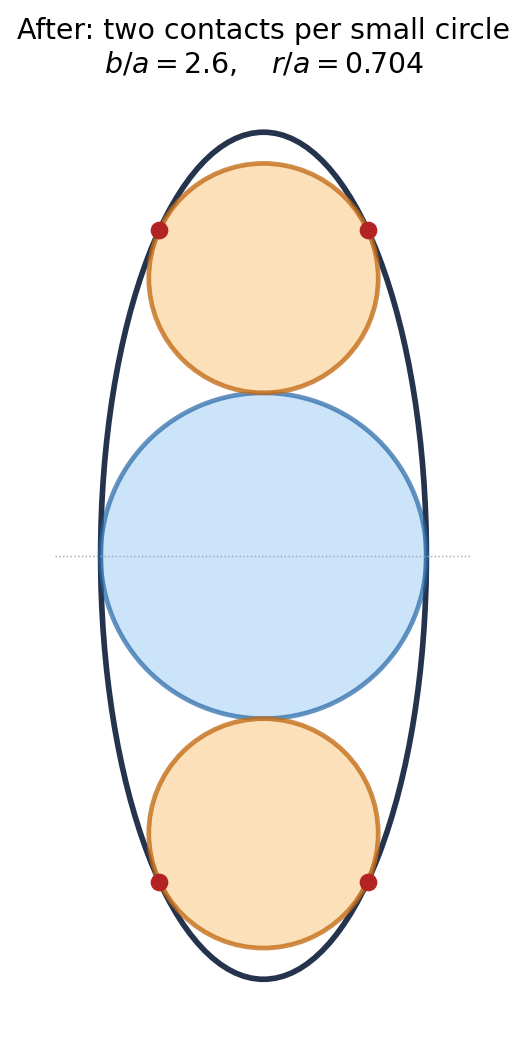
It seems natural that each smaller circle should touch the ellipse at the top or bottom. But when the ellipse becomes sufficiently elongated, something unexpected happens: one point of contact splits into two.
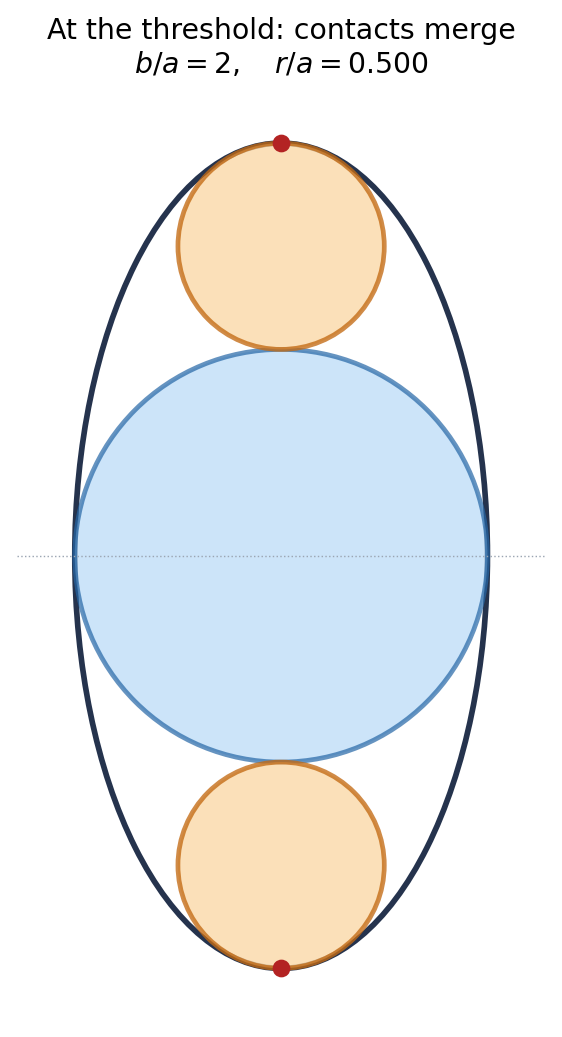
The red dots mark where each small circle touches the ellipse. Compare the three stages:
2. Set up the geometry
Write the ellipse as
\frac{x^2}{a^2}+\frac{y^2}{b^2}=1,\qquad 0<a<b.
The central circle has radius a. By symmetry, an optimal upper small circle can be centered on the vertical axis at (0, a + r), where r is its radius. We now determine the largest possible r.
3. First possibility: a single contact
If the upper circle touches the ellipse only at its top vertex (0, b), its topmost point must be at height b. Hence
a+2r=b,\qquad r=\frac{b-a}{2}.
This gives the maximal symmetric circle in the upper cap when b ≤ 2a. But why does the formula stop working beyond that threshold? The answer comes from measuring distances to the ellipse away from its vertex.
4. Second possibility: two contacts
Let the upper small circle have center (0, c), where c = a + r. A point (x, y) on the ellipse satisfies
x^2=a^2\left(1-\frac{y^2}{b^2}\right).
Its squared distance from (0, c) is therefore
d^2=a^2+c^2-2cy+\left(1-\frac{a^2}{b^2}\right)y^2.
This is a quadratic function of y. Its minimum occurs at
y=\frac{cb^2}{b^2-a^2}.
At tangency the minimum distance equals r. Substituting c = a + r and solving gives the nonzero solution
r=a\left(1-\frac{2a^2}{b^2}\right).
For this solution, the contact points have the especially simple coordinates
\left(\pm a\sqrt{1-\frac{4a^2}{b^2}},\,2a\right).
They are distinct precisely when b > 2a. Notice the surprise: both points lie on the horizontal line y = 2a, regardless of how large b becomes.
5. The critical axis ratio
Combining the two regimes, the radius of either smaller circle is
r=\begin{cases}\dfrac{b-a}{2},&a<b\le 2a,\\[6pt]a\left(1-\dfrac{2a^2}{b^2}\right),&b\ge 2a.\end{cases}
At b=2a, both formulas give r=a/2. But the transition is more subtle than the continuity of the radius. Keep a fixed and differentiate with respect to b. On the two sides of the threshold,
r'_-(b)=\frac12,\qquad r'_+(b)=\frac{4a^3}{b^3}.
At b=2a, both derivatives equal 1/2. Therefore the radius has a continuous first derivative, even though its formula changes.
Differentiate again:
r''_-(b)=0,\qquad r''_+(b)=-\frac{12a^3}{b^4}.
Consequently,
\boxed{r''_-(2a)=0,\qquad r''_+(2a)=-\frac{3}{4a}.}
The radius is continuously differentiable, but not twice continuously differentiable: it is C^1 but not C^2 at the transition. The contact pattern changes abruptly while the radius and its slope do not.
6. The critical eccentricity
For a vertically elongated ellipse, the eccentricity is
e=\sqrt{1-\frac{a^2}{b^2}}.
At the threshold b = 2a, this becomes
e_c=\sqrt{1-\frac14}=\frac{\sqrt3}{2}\approx0.866025.
Thus the geometric change occurs at the exact eccentricity √3/2, not at an arbitrary numerical value.
7. A 30°–60°–90° triangle hidden in the ellipse
Let c denote the distance from the center of the ellipse to either focus. The semiaxes and focal distance form a right triangle:
a^2+c^2=b^2.
At the critical ratio b = 2a, we obtain c=\sqrt3\,a. Its three side lengths are therefore a,\sqrt3\,a,2a: exactly the proportions of a 30°–60°–90° triangle.
In particular, e=c/b=\sqrt3/2=\sin60^\circ=\cos30^\circ. The familiar special angles are a genuine geometric feature of the critical ellipse.
8. Why call this a bifurcation?
For b > 2a, the horizontal distance between the two upper contact points is
D=2a\sqrt{1-\frac{4a^2}{b^2}}.
In terms of eccentricity, this becomes
D=2a\sqrt{4e^2-3}.
Near the threshold, the separation is proportional to the square root of the amount by which e exceeds its critical value:
D\sim4a\sqrt{\sqrt3\,(e-e_c)}.
Why a square root? At the threshold, the two contact points coincide, so their horizontal separation is zero. Just above the threshold, the quantity inside the square root, 4e^2-3, grows approximately linearly with e-e_c. Taking its square root gives the characteristic behavior D\propto\sqrt{e-e_c}.
This means the contacts initially move apart surprisingly quickly: multiplying the excess eccentricity by four only doubles their separation. The distance is continuous at the threshold, but its slope with respect to eccentricity becomes unbounded as e\downarrow e_c from above. This square-root splitting is a familiar signature of a bifurcation.
9. The curvature explanation
The radius of curvature of the ellipse at its upper vertex is a²/b. At b = 2a, this equals a/2, precisely the radius of the upper small circle. So at the transition the two curves not only touch: they have the same curvature. For a more elongated ellipse, the vertex is no longer the nearest point of the ellipse to the small-circle center, and the contact moves to two off-axis points.
This is also related to the medial axis: the locus of centers of maximal inscribed disks. The center of our upper small circle reaches the endpoint of the ellipse’s medial-axis segment at the critical ratio. This gives a geometric interpretation of why the contact pattern changes.
10. A question to explore
Suppose we replace the ellipse by another smooth, vertically symmetric convex curve. Must there still be a critical parameter at which one tangency splits into two? If so, does the separation always follow a square-root law? These questions lead naturally from elementary geometry toward the study of curvature and bifurcations.
Takeaway: A simple circle-packing puzzle reveals an exact eccentricity threshold, a change in the number of contacts, a hidden special right triangle, and a beautiful connection between elementary geometry and bifurcation theory.
Further Exploration: Three Tangent Circles
What happens with three circles that all touch each other? The curved gap between them leaves part of their centers’ triangle empty, and equal circles turn out to leave the most. See Three Circles in a Triangle: How Small Can the Empty Space Be?
Leave a Reply