
Why 18° is easier than 20°, and what regular polygons have to do with square roots.
We memorize the sine and cosine of 30°, 45°, and 60°. But why these angles? Can we calculate the trigonometric functions of 18°, 20°, 36°, or even 360°/17 exactly? The answer depends on what we mean by exactly.
1. Beyond the familiar angles
The addition and half-angle formulas already give many exact values. For example, subtracting 30° from 45° yields
\sin15^\circ=\frac{\sqrt6-\sqrt2}{4},\qquad \cos15^\circ=\frac{\sqrt6+\sqrt2}{4}.The regular pentagon leads to
\cos36^\circ=\frac{1+\sqrt5}{4},\qquad \sin18^\circ=\frac{\sqrt5-1}{4}.Thus some angles have values involving only square roots. But this pattern does not continue for every integer number of degrees.
2. The surprise at 20 degrees
Let x=\cos20^\circ. The triple-angle identity gives
\cos60^\circ=4\cos^320^\circ-3\cos20^\circ,so
8x^3-6x-1=0.This is an exact algebraic description of \cos20^\circ. Yet the cubic is irreducible over the rational numbers: by the rational-root theorem, its only possible rational roots are \pm1,\pm\frac12,\pm\frac14,\pm\frac18, and none works.
Consequently, \cos20^\circ has algebraic degree three. It cannot be obtained from rational numbers by any sequence of additions, subtractions, multiplications, divisions, and square roots. In particular, a 20° angle cannot be constructed by straightedge and compass alone.
3. Every rational multiple of pi is algebraic
Although square roots do not always suffice, there is a general theorem:
Theorem. If \theta/\pi is rational, then \sin\theta and \cos\theta are algebraic numbers.
To see why, suppose \theta=2\pi k/n and set z=e^{i\theta}. Then z^n=1. Since z is a root of a polynomial with integer coefficients, it is algebraic. Now
2\cos\theta=z+z^{-1},\qquad 2i\sin\theta=z-z^{-1}.Both trigonometric values are therefore algebraic. The same holds for tangent whenever it is defined.
4. How complicated can the answer be?
For n\ge3, the number 2\cos(2\pi/n) has algebraic degree
\frac{\varphi(n)}2,where \varphi is Euler’s totient function, counting the integers from 1 to n that are relatively prime to n.
For example, 2\cos(2\pi/7) satisfies
x^3+x^2-2x-1=0.Because \varphi(7)=6, its degree is three. For n=17, the corresponding degree is eight. Surprisingly, the 17-gon is nevertheless constructible, because eight is a power of two and the relevant field extensions can be built through successive square roots.
5. Which angles can be constructed with ruler and compass?
The classical Gauss–Wantzel theorem says that a regular n-gon is constructible exactly when
n=2^k p_1p_2\cdots p_r,where the p_j are distinct Fermat primes: primes of the form 2^{2^m}+1. The known examples are 3, 5, 17, 257, and 65537. It is not known whether any more Fermat primes exist.
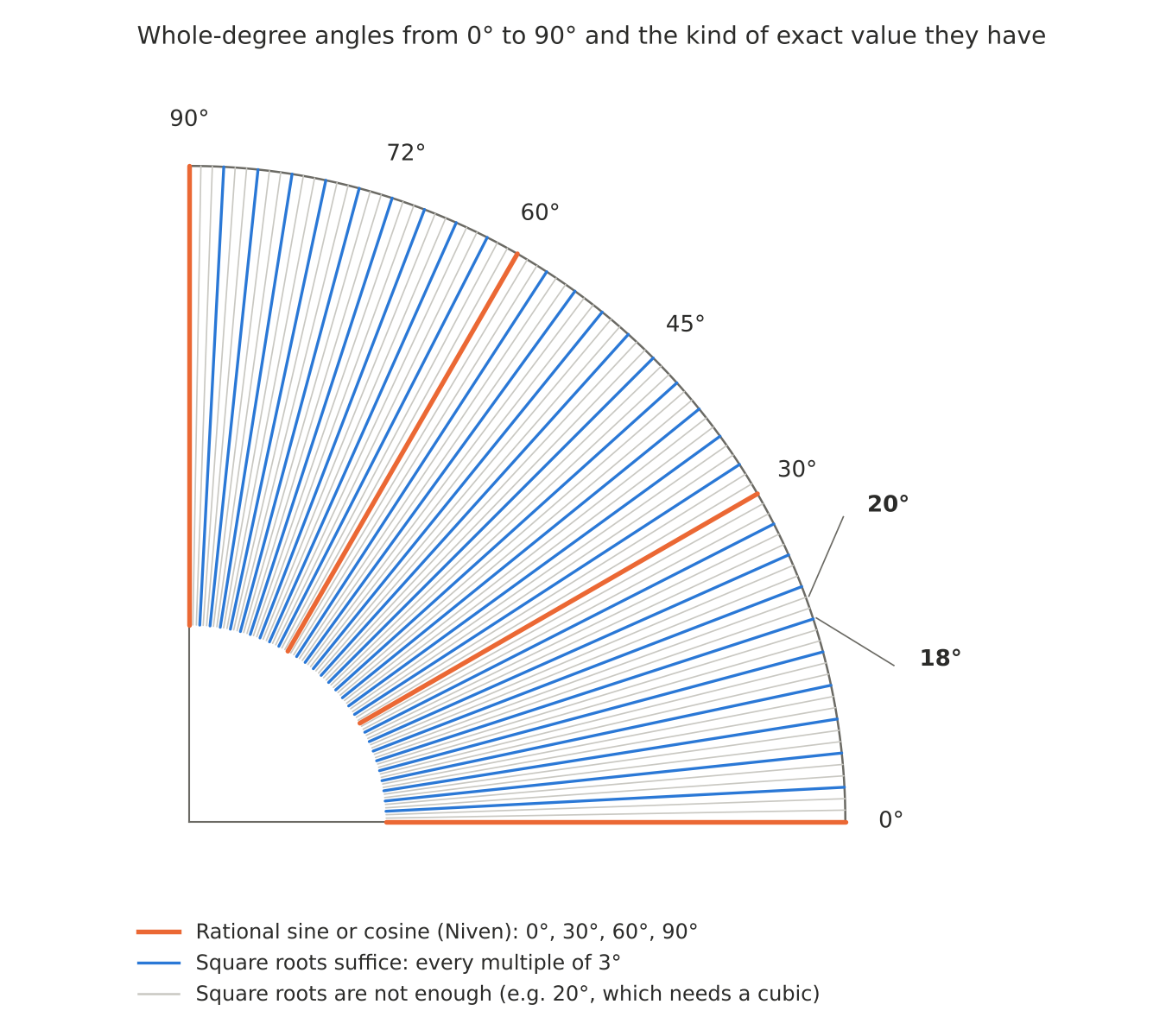
This explains the striking contrast between 18° and 20°: 18° is associated with the constructible regular 20-gon, whereas 20° corresponds to the nonconstructible regular 18-gon.
6. When is the answer rational?
There is an even more restrictive classification, often called Niven’s theorem.
Theorem. If \theta/\pi is rational and \sin\theta is rational, then
\sin\theta\in\left\{0,\pm\frac12,\pm1\right\}.The same list applies to rational cosine values. Rational tangent values at rational multiples of \pi are limited to 0,\pm1.
Proof idea. Put u=2\cos\theta. If \theta/\pi is rational, then u=z+z^{-1} for a root of unity z, so u is an algebraic integer. If \cos\theta is rational, then u is a rational algebraic integer, hence an integer. Because -2\le u\le2, it must be one of -2,-1,0,1,2. The sine result follows by replacing \theta with \pi/2-\theta. Finally, if \tan\theta=t is rational, then \cos2\theta=(1-t^2)/(1+t^2) is rational and therefore belongs to the same five-value list; checking the possibilities gives t=0,\pm1 whenever tangent is defined.
There is a subtle distinction here: infinitely many angles have rational sine and cosine. For example,
\cos\theta=\frac45,\qquad\sin\theta=\frac35.But Niven’s theorem tells us that this particular angle is not a rational multiple of \pi.
7. Questions to explore
- Use angle subtraction to derive exact formulas for \sin75^\circ and \cos75^\circ.
- Find a cubic polynomial satisfied by 2\cos40^\circ.
- Show that if \theta/\pi is rational and \tan\theta is rational, then the tangent is 0, 1, or −1.
- Why can a regular 17-gon be constructed, but a regular 7-gon cannot?
- Use the rational parametrization of the unit circle to produce infinitely many pairs of rational sine and cosine values.
Final thought
There is no shortage of angles with exact trigonometric values. Every rational multiple of \pi has algebraic sine and cosine. The real question is what kind of exact expression we allow: rational numbers, square roots, general radicals, or solutions of polynomial equations. That simple distinction connects school trigonometry with geometry, number theory, and the algebra of roots of unity.
Continue exploring:
angle trisection, the same problem that makes 20° so difficult, leads to one of geometry’s most beautiful surprises in
Morley’s Miracle: The Equilateral Triangle Hidden Inside Every Triangle.
For more on angles, complex numbers and number theory, see
Arctangent Identities, Gaussian Integers, and Number Theory.
Leave a Reply