
Why does a pyramid have exactly one-third the volume of a prism with the same base and height? The familiar formula is easy to memorize, but its factor of one-third deserves an explanation. Here is a beautiful approach that uses geometry and an infinite geometric series rather than integration.
1. The question
Consider a right square pyramid with base side length a and perpendicular height h. Write its volume as V(a,h). The formula we want to explain is
V(a,h)=\frac{a^2h}{3}.
The corresponding prism has volume a^2h. Why is the pyramid’s volume exactly one-third of that amount?
2. A surprising geometric decomposition
In a short 2022 note, André Pierro de Camargo describes a dissection of a square pyramid into a parallelepiped of volume a^2h/4 and two smaller pyramids, each similar to the original with half its linear dimensions. The accompanying drawing in the published note is the key geometric step. We use the resulting volume identity:
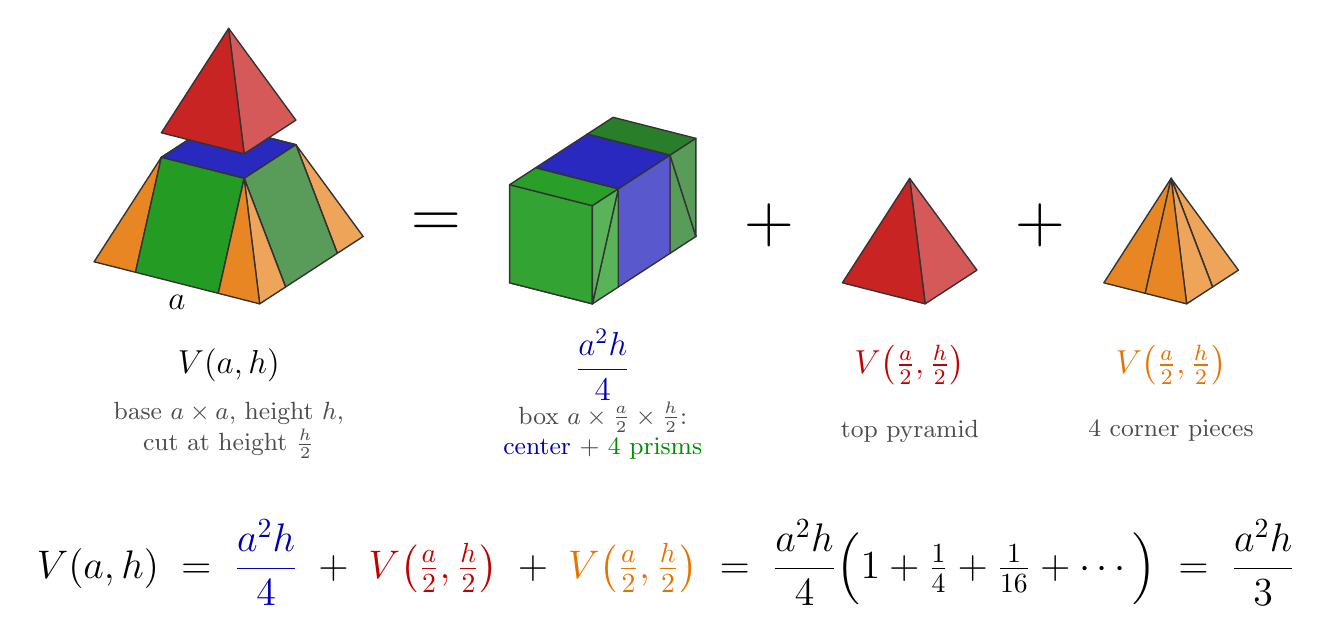
V(a,h)=\frac{a^2h}{4}+2V\left(\frac a2,\frac h2\right).
Notice what makes this unusual: instead of using the pyramid-volume formula to calculate the pieces, we use a decomposition to discover that formula.
3. Repeat the process
Apply the same decomposition to each smaller pyramid. At the next stage, the two smaller pyramids contribute a total parallelepiped volume of
2\cdot\frac{(a/2)^2(h/2)}4=\frac{a^2h}{16}.
Repeating gives the successive known volumes
\frac{a^2h}{4},\quad\frac{a^2h}{16},\quad\frac{a^2h}{64},\quad\ldots
After k stages, the decomposition reads
V(a,h)=\frac{a^2h}{4}\sum_{j=0}^{k-1}\left(\frac14\right)^j+2^kV\left(\frac{a}{2^k},\frac{h}{2^k}\right).
The final term is the total volume of the pyramids not yet decomposed.
4. Why the leftover volume vanishes
Each remaining pyramid fits inside a box whose base is (a/2^k)\times(a/2^k) and whose height is h/2^k. Therefore its volume is at most that box’s volume. The combined remainder R_k satisfies
0\le R_k\le 2^k\left(\frac{a}{2^k}\right)^2\frac{h}{2^k}=\frac{a^2h}{4^k}.
Because 4^k grows without bound, the remainder tends to zero. We can therefore sum the geometric series:
V(a,h)=\frac{a^2h}{4}\left(1+\frac14+\frac1{16}+\cdots\right).
Since
1+\frac14+\frac1{16}+\cdots=\frac1{1-1/4}=\frac43,
we obtain the desired result:
V(a,h)=\frac{a^2h}{3}.
5. A numerical example
Suppose a square pyramid has base side a=6 centimeters and height h=9 centimeters. The prism with the same base and height has volume 6^2\cdot9=324 cubic centimeters. Our result gives
V=\frac{6^2\cdot9}{3}=108\ \text{cm}^3.
We can also watch the approximation improve. The first parallelepiped contributes 81 cubic centimeters; the second stage adds 20.25; the third adds 5.0625. These partial totals are 81, 101.25, and 106.3125, approaching 108.
6. How accurate is a finite approximation?
Even without finishing infinitely many steps, we can bound the error. After k stages, the remainder is at most
R_k\le\frac{a^2h}{4^k}.
In fact, once the formula has been established, the exact remainder is
R_k=\frac{a^2h}{3\cdot4^k}.
Thus each additional stage reduces the remaining volume by a factor of four. This is a striking example of how a self-similar geometric process leads to rapid numerical convergence.
7. Does the formula work for other pyramids?
Yes: every pyramid with base area B and perpendicular height h has volume
V=\frac13 Bh.
However, the particular dissection discussed above establishes the result for a square pyramid. Extending the formula to arbitrary bases requires an additional argument, such as slicing and Cavalieri’s principle. The general formula should not be mistaken for something proved directly by this one dissection.
8. Try it yourself
Exercise 1. A square pyramid has base side 10 cm and height 12 cm. Find its volume.
The base area is 100, so V=100\cdot12/3=400\ \text{cm}^3.
Exercise 2. What fraction of the pyramid’s volume is captured after the first two stages?
The two contributions total \frac{a^2h}{4}(1+\frac14)=\frac{5a^2h}{16}. Dividing by a^2h/3 gives 15/16.
Exercise 3. After how many stages is the remaining fraction less than 1/1000?
The exact remaining fraction is 4^{-k}. Since 4^5=1024, five stages suffice.
Exercise 4. If both the base side and height double, by what factor does the volume change?
All three linear dimensions double, so the volume is multiplied by 2^3=8.
9. The bigger idea
This proof connects three themes: geometric dissection, self-similarity, and infinite series. A formula often introduced through calculus can also emerge from repeatedly breaking a shape into smaller copies of itself. The factor 1/3 is not a coincidence; here it comes from the sum of a geometric series.
Continue exploring:
Archimedes used the same kind of reasoning, a shape cut into ever smaller pieces whose areas form a geometric series, to find the area of a parabolic segment; see
How the Ancient Greeks Summed Infinite Series Without Calculus.
A tetrahedron is a pyramid with a triangular base, and its volume can also be computed from coordinates; see
The Geometry of a Tetrahedron: From Pythagoras to Vector Identities.
Reference
André Pierro de Camargo, “A Short Proof for the Volume of Square Pyramids,” The American Mathematical Monthly 129, no. 8 (2022), p. 784. DOI: 10.1080/00029890.2022.2094181. The recursive decomposition used here is credited to Camargo; the explanations, numerical example, and exercises are adapted for educational presentation.
Leave a Reply