
Open a small hole near the bottom of a water tank. At first, water rushes out; later, the stream weakens. Why does the flow slow down, and can mathematics predict exactly when the tank will be empty?
The answer comes from Torricelli’s law and a simple differential equation. We will use an idealized cylindrical tank, then explain what changes in a real experiment.
1. Why does water leave the tank?
Imagine an open tank containing water to height h above a small outlet. Because of the weight of the water above it, the hydrostatic pressure inside the tank near the outlet is greater than atmospheric pressure. In an ideal fluid, the loss of gravitational potential energy becomes kinetic energy of the escaping water.
mgh=\frac12 mv^2
Canceling the mass and solving for speed gives Torricelli’s law:
v=\sqrt{2gh}.
Here g is gravitational acceleration (approximately 9.81 m/s²), h is the water height above the outlet (in meters), and v is the ideal exit speed (in m/s). Greater height means faster flow. This result assumes a large tank relative to the opening, negligible viscosity and energy losses, and both the water surface and the outlet exposed to atmospheric pressure.
2. From speed to a differential equation
Let A be the horizontal cross-sectional area of a cylindrical tank, and a the area of the small outlet. In a short time interval, the volume leaving is approximately the outlet area times the speed times the elapsed time. Therefore, the outgoing volume per second is
Q=a\sqrt{2gh}.
Since the volume of water in the cylinder is V = Ah, its rate of change is A dh/dt. Water is leaving, so this rate is negative:
A\frac{dh}{dt}=-a\sqrt{2gh}.
This is our governing equation. The minus sign is important: the height decreases as time passes.
3. Solving the equation
Assume the tank begins at height h₀ at time zero. Separating the variables, while the water height is positive, gives
\frac{dh}{\sqrt h}=-\frac aA\sqrt{2g}\,dt.
Integrating from the initial state to time t yields
2\sqrt{h(t)}-2\sqrt{h_0}=-\frac aA\sqrt{2g}\,t.
Rearrange and square:
h(t)=\left(\sqrt{h_0}-\frac{a\sqrt{2g}}{2A}t\right)^2,\qquad 0\le t\le T.
The formula applies only until the tank empties. Afterwards the height stays zero; continuing the squared expression would incorrectly predict that the water level rises again.
4. How long until the tank is empty?
At the emptying time T, the height becomes zero. Setting the expression inside the parentheses equal to zero gives
\boxed{T=\frac Aa\sqrt{\frac{2h_0}{g}}}.
Three conclusions follow: a larger tank cross-section takes longer to drain; a larger outlet drains faster; and the emptying time grows with the square root of the initial height, not directly with the height.
5. Worked example: a cylindrical tank
Suppose a vertical cylindrical tank has radius 0.50 m, an outlet of radius 0.010 m, and an initial water height of 2.0 m. Assume ideal flow with no losses.
A=\pi(0.50)^2=0.25\pi\ \mathrm{m}^2
a=\pi(0.010)^2=0.0001\pi\ \mathrm{m}^2
Thus the ratio of areas is 2,500. Substituting into the emptying-time formula:
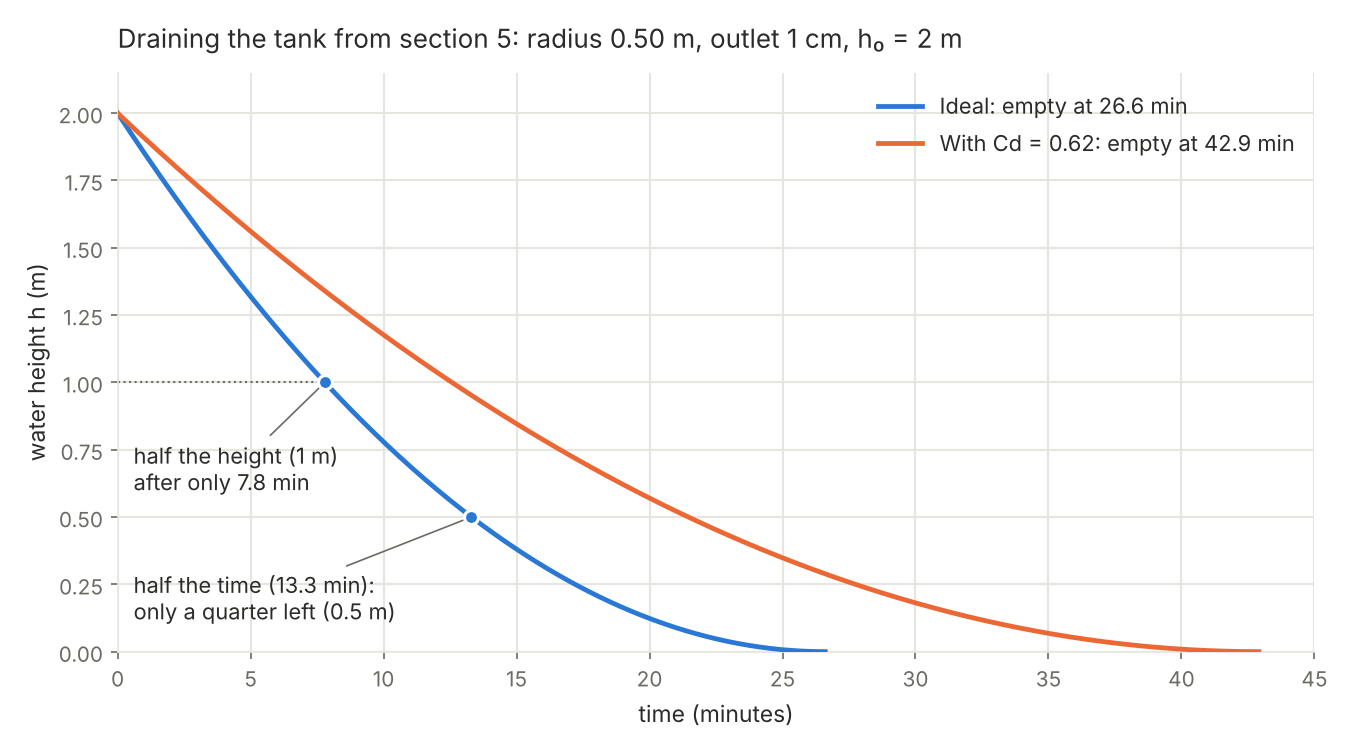
T=2500\sqrt{\frac{4}{9.81}}\approx1596\ \mathrm{s}\approx26.6\ \mathrm{minutes}.
Answer: The ideal model predicts about 26.6 minutes to empty. In a real tank, resistance and outlet contraction usually make the emptying time longer.
6. A surprising result: half the height is not half the time
Let T denote the full emptying time. The height formula simplifies to
\frac{h(t)}{h_0}=\left(1-\frac tT\right)^2.
Halfway through the total draining time, the height is only one quarter of its starting value:
h(T/2)=\frac{h_0}{4}.
To reach half the initial height, solve the same equation:
\frac{t}{T}=1-\frac{1}{\sqrt2}\approx0.293.
So the water reaches half its initial height after only about 29.3% of the total draining time. The final portion takes disproportionately long because the water pressure and exit speed are lower.
7. What about real tanks?
Real outlets lose energy to friction, turbulence, and contraction of the stream. Engineers often introduce a dimensionless discharge coefficient Cd, typically less than 1:
A\frac{dh}{dt}=-C_d a\sqrt{2gh}.
If Cd is approximately constant, the predicted emptying time becomes
T_{\mathrm{real}}\approx\frac{A}{C_d a}\sqrt{\frac{2h_0}{g}}.
For illustration, if Cd = 0.62 in our example, the time would be approximately 42.9 minutes. This is a model-based estimate, not a measured value. Near the end of drainage, effects such as surface tension, vortices, and outlet geometry can also matter.
8. What if the tank is not cylindrical?
For a tank whose horizontal cross-sectional area varies with height, write it as A(h). The equation becomes
A(h)\frac{dh}{dt}=-C_d a\sqrt{2gh}.
With constant Cd, the corresponding idealized emptying time is
T=\frac{1}{C_d a\sqrt{2g}}\int_0^{h_0}\frac{A(h)}{\sqrt h}\,dh.
This explains why a cone, a sphere, and a cylinder of the same initial water volume may have different draining times: the amount of water stored at each height is different.
9. Try it yourself
Use the ideal cylindrical-tank model unless otherwise specified. Open each solution after trying the problem.
- Double the height. If the initial water height doubles while all other parameters stay fixed, by what factor does the emptying time change?
Show solution
Since T\propto\sqrt{h_0}, the factor is \sqrt2\approx1.414.
- Double the outlet radius. By what factor does the emptying time change?
Show solution
The outlet area becomes four times as large, so T becomes one quarter as large, provided the small-outlet approximation remains valid.
- Find the water level. What fraction of the initial height remains after 75% of the emptying time?
Show solution
h/h_0=(1-0.75)^2=1/16, or 6.25%.
- Find the time. At what fraction of the total draining time does the height fall to one ninth of its initial value?
Show solution
1/9=(1-t/T)^2. On the physical interval, 1-t/T=1/3, hence t/T=2/3.
- Challenge: a widening tank. Suppose A(h)=kh, with k a positive constant having units of length. Find the ideal emptying time.
Show solution
Set C_d=1 in the general formula: T=\frac{k}{a\sqrt{2g}}\int_0^{h_0}\sqrt h\,dh=\frac{2k h_0^{3/2}}{3a\sqrt{2g}}.
10. The mathematical takeaway
A familiar physical process becomes predictable once we connect an energy principle to a rate of change. Torricelli’s law tells us how fast water escapes at a given height; conservation of volume turns that speed into a differential equation; integration gives the complete history of the water level.
That is a recurring theme of mathematical physics: start with a physical law, express it as an equation, and let mathematics reveal the time evolution.
Related articles and reference
For other examples of differential equations describing physical change, see Why Does Heat Spread? and Why Do Vibrations Die Out? Damped Oscillations.
Historical note: Torricelli’s law is named after Evangelista Torricelli (1608–1647). The derivation above uses the ideal-flow energy principle commonly associated with Bernoulli’s equation.
Leave a Reply