
Touch one end of a metal spoon to something hot. After a while, the handle becomes warm too. Why does heat spread, and why do temperature differences gradually disappear?
The mathematical explanation begins with a simple idea: heat flows from hotter regions toward colder ones. For a thin, insulated rod, this leads to one of the fundamental equations of mathematical physics: the heat equation.
1. Describing temperature along a rod
Let u(x,t) denote the temperature at position x along a rod at time t. We assume that the rod is made of a uniform material, its sides are insulated, and temperature is approximately constant across each cross-section.
The one-dimensional heat equation is
\frac{\partial u}{\partial t}=\alpha\frac{\partial^2u}{\partial x^2}.Here \alpha>0 is the thermal diffusivity, measured in square meters per second. A larger value of \alpha means that temperature differences tend to even out more quickly.
2. Where does the equation come from?
Fourier’s law says that the heat flow per unit area is proportional to the negative temperature gradient:
q=-k\frac{\partial u}{\partial x},where k is thermal conductivity. The minus sign means heat flows toward lower temperatures.
Consider a short piece of rod from x to x+\Delta x, with cross-sectional area A, density \rho, and specific heat capacity c_p. Its rate of change of thermal energy is approximately
\rho c_p A\Delta x\frac{\partial u}{\partial t}.The net rate at which heat enters is
Aq(x,t)-Aq(x+\Delta x,t).Equating these rates, dividing by A\Delta x, and taking the limit as \Delta x\to0, we obtain
\rho c_p\frac{\partial u}{\partial t}=-\frac{\partial q}{\partial x}=k\frac{\partial^2u}{\partial x^2}.Thus the heat equation follows with
\alpha=\frac{k}{\rho c_p}.3. An exact example: a rod cooling toward a uniform temperature
Suppose a rod has length L, both ends are insulated, and its initial temperature is
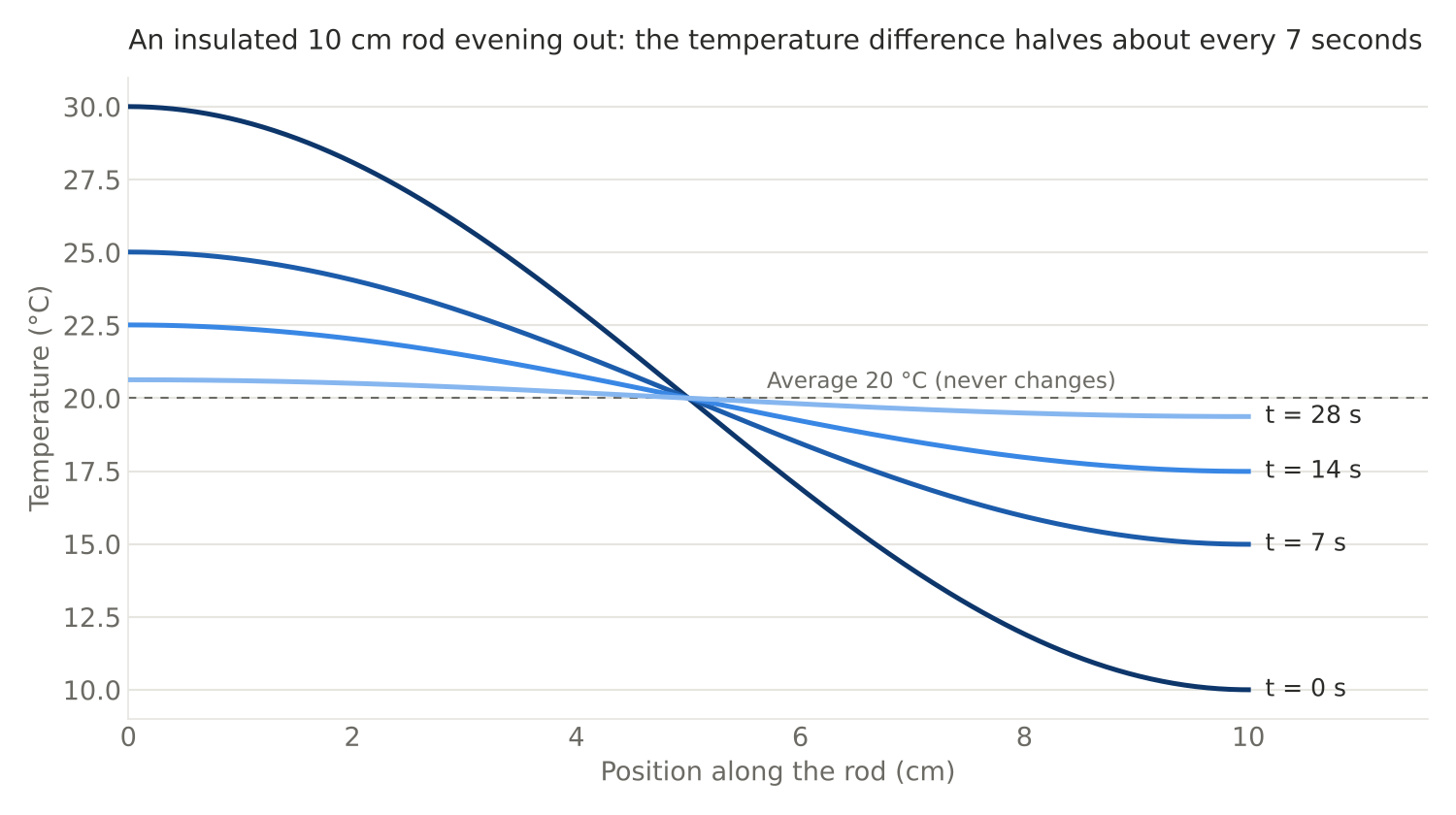
u(x,0)=20+10\cos\left(\frac{\pi x}{L}\right)\quad\text{degrees Celsius}.At first, the left end is at 30^\circ\mathrm{C}, the right end is at 10^\circ\mathrm{C}, and the average temperature is 20^\circ\mathrm{C}.
An exact solution is
u(x,t)=20+10e^{-\alpha\pi^2t/L^2}\cos\left(\frac{\pi x}{L}\right).We can check it directly. Differentiating with respect to time gives
u_t=-\frac{10\alpha\pi^2}{L^2}e^{-\alpha\pi^2t/L^2}\cos\left(\frac{\pi x}{L}\right).Differentiating twice with respect to position gives
u_{xx}=-\frac{10\pi^2}{L^2}e^{-\alpha\pi^2t/L^2}\cos\left(\frac{\pi x}{L}\right).Therefore u_t=\alpha u_{xx}, exactly as required. Also, u_x(0,t)=u_x(L,t)=0, so no heat flows through the ends.
4. How quickly does the difference disappear?
The factor
e^{-\alpha\pi^2t/L^2}controls the size of the temperature variation. For illustration, take L=0.10 m and \alpha=10^{-4} m^2/s. The time at which the variation has fallen to half its initial size satisfies
e^{-\alpha\pi^2t/L^2}=\frac12.Taking logarithms gives
t=\frac{L^2\ln2}{\alpha\pi^2}\approx7.0\ \text{seconds}.After about seven seconds in this idealized example, the end temperatures are approximately 25^\circ\mathrm{C} and 15^\circ\mathrm{C}. The average remains 20^\circ\mathrm{C}.
5. Why do small temperature variations disappear faster?
For a temperature pattern of the form
u(x,t)=T_0+Be^{-\alpha k^2t}\cos(kx),the decay rate is proportional to k^2. A pattern with twice the spatial frequency decays four times as fast. This explains why the heat equation rapidly smooths small-scale temperature fluctuations.
6. Heat versus waves
The heat equation contains a first derivative in time:
u_t=\alpha u_{xx}.The ideal wave equation contains a second derivative in time:
u_{tt}=c^2u_{xx}.These equations describe different behavior. Heat diffusion smooths temperature differences; ideal waves can carry disturbances while retaining their oscillatory character.
7. What does this model leave out?
Real rods can lose heat to surrounding air, and material properties may change with temperature. The simple equation also assumes ordinary Fourier heat conduction and a uniform rod. Nevertheless, it captures a fundamental fact: in an insulated rod, temperature differences decay while the average temperature stays constant.
Final thought
Heat spreads because a temperature gradient produces a flow of thermal energy. Conservation of energy turns this physical observation into a differential equation. Its solutions reveal not only that a rod approaches uniform temperature, but also how quickly different temperature patterns disappear.
For the wave side of this comparison, see
Why Do Waves Travel? The Mathematics of a Vibrating String.
Heat that has stopped changing satisfies Laplace’s equation, the subject of How Does Electricity Know Where to Flow?
Leave a Reply