
Can remembering cards really beat a casino?
Imagine playing blackjack and carefully remembering every card that has appeared. You use no electronic device, mark no cards, and receive no secret information. Nevertheless, a casino may ask you to stop playing blackjack. Why?
The answer is a beautiful application of conditional probability. In blackjack, unlike roulette, the past can change the probabilities of what happens next. Cards already dealt are temporarily removed from the shoe, so the composition of the remaining cards matters.
Why the casino usually has an advantage
The key mathematical concept is expected value. If a wager has possible net outcomes x_1,x_2,\ldots,x_n with probabilities p_1,p_2,\ldots,p_n, its expected net return is
E=\sum_{i=1}^{n}p_i x_i.For example, suppose a hypothetical $10 wager wins $10 with probability 0.49 and loses $10 with probability 0.51. Then
E=0.49(10)+0.51(-10)=-0.20.On average, this wager loses 20 cents per play. That does not mean every play loses 20 cents; individual outcomes are either a $10 win or a $10 loss.
Actual blackjack is more complicated: players may hit, stand, double down, split pairs, or receive a blackjack payout. Under many common rules, correct basic strategy leaves the house with a relatively small edge, but its exact size depends on the table rules. Card counting attempts to exploit the fact that this edge is not constant as the shoe changes.
Why previously dealt cards matter
A standard deck contains 52 cards, including 16 ten-valued cards (tens, jacks, queens, and kings). Before any card is dealt, the probability that the next card is ten-valued is
P(\text{ten-valued})=\frac{16}{52}=\frac4{13}\approx0.3077.Now suppose 20 cards have been dealt, and only three of them were ten-valued. There are 32 cards left, including 13 ten-valued cards. The probability becomes
P(\text{ten-valued}\mid\text{cards seen})=\frac{13}{32}\approx0.4063.That is an increase from about 30.8% to 40.6%. Nothing mysterious happened: we simply updated the probability using the information already available.
High cards can benefit the player in several ways. They increase the chance of a natural blackjack, which commonly pays more than an ordinary win, and they can make the dealer more likely to bust when required to draw. The overall advantage, however, depends on all the remaining cards and the blackjack rules; a higher chance of drawing a ten-valued card alone does not prove that every bet is profitable.
A simple system: Hi-Lo counting
Tracking the exact composition of a multi-deck shoe would be difficult. A widely known approximation is the Hi-Lo system, which assigns each visible card a score:
| Card values | Counting score |
|---|---|
| 2, 3, 4, 5, 6 | +1 |
| 7, 8, 9 | 0 |
| 10, J, Q, K, A | −1 |
Start the running count at zero and add each exposed card’s score. Low cards increase the count because their removal tends to leave a richer concentration of high cards. High cards decrease it.
For example, suppose the exposed cards are
5,\quad K,\quad 3,\quad 8,\quad A,\quad 6,\quad 2.The running count is
C=1-1+1+0-1+1+1=2.A positive running count suggests a more favorable remaining composition than at the start, but its meaning depends on how many decks remain.
Why the true count matters
A running count of +6 means something different with six decks remaining than with one deck remaining. Players therefore use an estimate called the true count:
T=\frac{C}{D},where C is the running count and D is the estimated number of decks remaining.
If C=6 and D=3, then T=2. If only one deck remains, the same running count gives T=6. The second situation signals a much stronger imbalance.
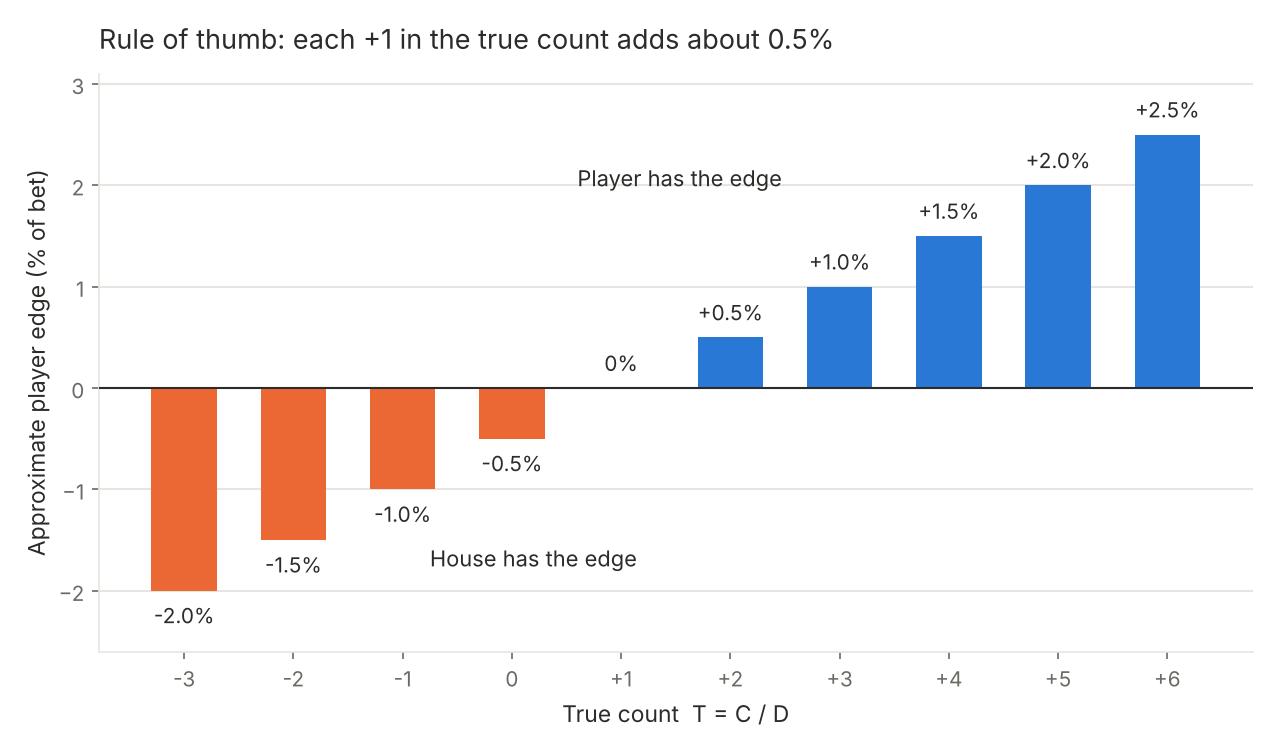
The true count is not itself a probability or a guaranteed profit percentage. It is a compact statistic that helps estimate how the expected return has changed.
When does the player have a positive expectation?
Suppose a simplified wager pays $1 of net profit on a win and loses $1 on a loss, with no ties or special payouts. If the probability of winning is p, then the expected net return per dollar wagered is
E=p-(1-p)=2p-1.The wager is favorable precisely when
E>0\quad\Longleftrightarrow\quad p>\frac12.For instance, if p=0.51, the expected profit is two cents per dollar wagered:
E=2(0.51)-1=0.02.This is an illustrative model, not an exact blackjack calculation. Blackjack includes pushes, blackjacks, doubles, splits, and decisions that depend on the dealer’s upcard. In real blackjack, the player can have a positive expected return at certain sufficiently favorable shoe compositions when using an appropriate strategy, even though no single win-probability threshold describes every hand.
The crucial point is that a small positive expected value becomes important over many repeated wagers. This is why casinos pay attention not merely to whether someone wins, but also to whether their betting patterns respond systematically to the cards already dealt.
Positive expectation does not guarantee a win
Even a favorable game can produce a long losing streak. Consider the simplified game above with a 51% chance of winning each independent wager. The probability of losing five consecutive wagers is
P(\text{five losses})=(0.49)^5\approx0.02825.That is about 2.8%. Losing streaks are therefore entirely compatible with a positive expected value.
To see how volatility can dominate short-term results, suppose we make n independent $1 wagers in this simplified game. Each wager has expected value 0.02 and variance
\operatorname{Var}(X)=1-(0.02)^2=0.9996.For the total net profit S_n,
\mathbb E[S_n]=0.02n,\qquad \operatorname{SD}(S_n)=\sqrt{0.9996n}.After 100 wagers, the expected profit is just $2, while the standard deviation is approximately $10. The mathematical advantage is real in this model, but the actual result remains highly uncertain. Real blackjack hands are not independent in this simple way, so these formulas are illustrations of risk rather than a bankroll forecast.
Why casinos dislike card counting
Casinos generally welcome players who wager under conditions with a house advantage. Card counting challenges that business model by allowing a sufficiently skilled player, under some rules and shoe conditions, to identify moments when the expected advantage may shift.
Casinos respond in several ways. They may use multiple decks, reshuffle with many cards still undealt, restrict bet changes, or use continuous shuffling machines. They may also limit a suspected counter to other games or ask the person to leave, depending on local law.
Is card counting illegal? In general, mentally tracking exposed cards is not itself a crime in the United States. However, using prohibited devices or colluding in unlawful ways is a different matter, and casinos’ rights to exclude skilled players vary by jurisdiction. Thus, “not illegal” does not mean a casino must continue offering someone a blackjack game.
The deeper mathematical lesson
Card counting illustrates an important distinction between independent and dependent random events. In roulette, previous spins do not change the probabilities on a fair wheel. In blackjack, drawing without replacement changes the composition of the deck after every exposed card.
There is also a subtle lesson about information. Card counting does not predict the next card with certainty. It extracts a small statistical advantage from observations that other players may ignore.
The mathematics does not promise riches. It explains how conditional probability, expected value, and the law of large numbers can transform the analysis of a seemingly simple game—and why a casino may prefer that its customers not perform that analysis too well.
For another surprising application of probability, see Why Does an OFDM Signal Have a Rayleigh Distribution? , which explores how randomness in communication signals leads to a predictable mathematical distribution.
For more on expected values, see Two Averages, Two Different Triangles: A Semicircle Probability Puzzle and Jensen’s Inequality: How Curvature Controls Averages.
Leave a Reply