
Can a bank offering a lower nominal annual interest rate actually pay more? Yes—if it compounds interest more frequently. The distinction is between the stated nominal rate and the effective annual yield.
I once tried to make this point to a financial advisor, who insisted it was impossible: a lower rate, he said, can never pay more. The mathematics below shows why it can.
1. Compound Interest
For principal P, nominal annual rate r, n compounding periods per year, and t years, the balance is
A=P\left(1+\frac{r}{n}\right)^{nt}.2. A Lower Rate That Wins
Invest $10,000 for one year. Bank A offers 5.00% compounded monthly; Bank B offers 4.995% compounded weekly.
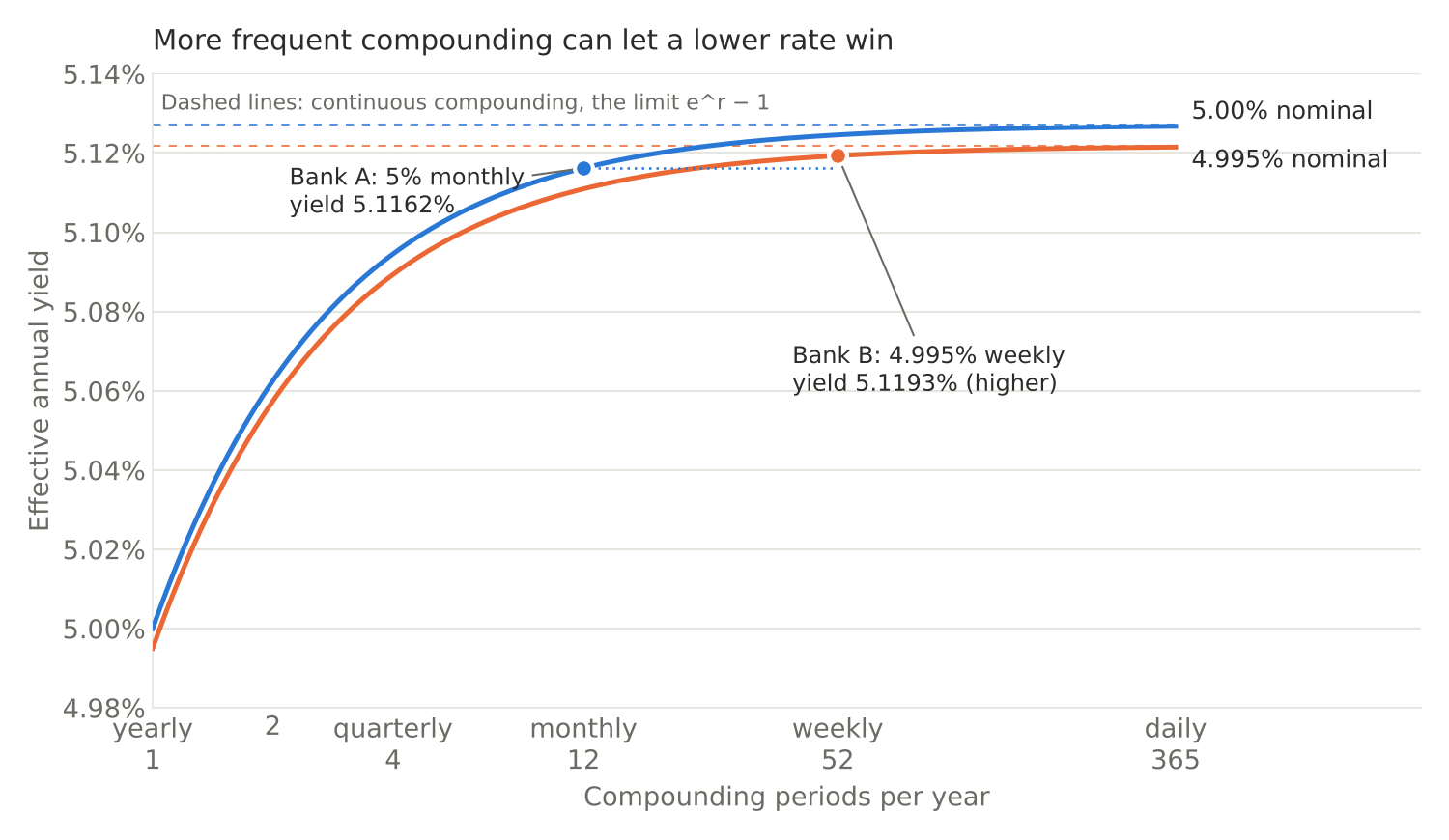
A_A=10000\left(1+\frac{0.05}{12}\right)^{12}. A_B=10000\left(1+\frac{0.04995}{52}\right)^{52}.Working these out gives $10,511.62 for Bank A and $10,511.93 for Bank B. The lower rate pays 31 cents more.
Although Bank B has the lower nominal rate, its more frequent compounding can produce a greater final balance. The next section determines the exact threshold.
3. The Exact Break-Even Rate
Let r be the nominal annual rate compounded monthly, and s the nominal annual rate compounded weekly. Equality after one year means
\left(1+\frac{r}{12}\right)^{12}=\left(1+\frac{s}{52}\right)^{52}.Taking the 52nd root and solving for s yields
\boxed{s=52\left[\left(1+\frac{r}{12}\right)^{3/13}-1\right].}For r = 0.05, the threshold is approximately 4.992007%. Thus 4.995% compounded weekly wins, whereas 4.99% compounded weekly does not.
4. Effective Annual Yield
For a nominal rate r compounded n times annually, the effective annual yield is
\mathrm{APY}=\left(1+\frac{r}{n}\right)^n-1.For a fixed positive nominal rate, more frequent compounding increases APY, but the incremental gain becomes progressively smaller.
5. Why the Number e Appears: A Proof
We will establish, for every fixed real x, that
\boxed{\lim_{n\to\infty}\left(1+\frac{x}{n}\right)^n=e^x.}For all sufficiently large n the base is positive. Taking the logarithm of the expression gives
\ln\left[\left(1+\frac{x}{n}\right)^n\right]=n\ln\left(1+\frac{x}{n}\right).Put t=1/n, so t approaches zero from the right. Then
\lim_{n\to\infty}n\ln\left(1+\frac{x}{n}\right)=\lim_{t\to0^+}\frac{\ln(1+xt)}{t}.By L’Hopital’s rule,
\lim_{t\to0^+}\frac{\ln(1+xt)}{t}=\lim_{t\to0^+}\frac{x}{1+xt}=x.Continuity of the exponential function now gives the claimed limit. In particular, setting x=1 yields the familiar limit defining e.
6. Continuous Compounding
For t years, rewrite the interest formula as
A_n=P\left[\left(1+\frac{r}{n}\right)^n\right]^t.Taking the limit as n tends to infinity gives
\boxed{A=Pe^{rt}.}Thus infinitely frequent compounding does not produce an infinite return: it approaches a finite exponential limit.
7. Can Continuous Compounding Always Make Up for a Lower Rate?
No. To beat a nominal 5% compounded monthly, a continuously compounded nominal rate s must satisfy
e^s>\left(1+\frac{0.05}{12}\right)^{12}.Equivalently,
\boxed{s>12\ln\left(1+\frac{0.05}{12}\right)\approx0.04989612.}So continuous compounding must offer more than approximately 4.989612% nominal interest to outperform 5% compounded monthly. Compounding more frequently cannot compensate for an arbitrarily low rate.
8. A Connection to Differential Equations
With continuous compounding, the balance is A(t)=Pe^{rt}. Differentiation gives
\boxed{\frac{dA}{dt}=rA.}The instantaneous growth rate is proportional to the current balance. This same equation underlies basic models of population growth and other exponential processes.
9. What Should Savers Compare?
For real savings accounts, compare annual percentage yields (APYs), not nominal rates alone. APY incorporates the compounding frequency. Fees, changing rates, minimum balances, and account-specific conventions may also affect actual returns.
Conclusion
A lower nominal interest rate can produce a higher return when interest is compounded more frequently. The precise comparison comes from exponential expressions, and the limit that governs ever-faster compounding leads naturally to the number e. A practical banking question thus reveals one of calculus’s most important ideas.
Further Reading: The exponential function also plays an important role in population growth. Explore this connection in our article The Logistic Population Model, where exponential growth is extended to account for limited resources.
How can present value help determine the price of an investment property? Explore this question in The Time Value of Money: From Infinite Payments to Real Estate Investing.Compound interest also plays a surprising role in deciding whether to take a lottery jackpot as a lump sum or receive payments over time. Explore the mathematics in our article Lottery Winnings and Lifetime Annuities: When Is a Guaranteed Payment Worth More Than Cash? .
Leave a Reply