
Suppose you need 99 cents in change. In the United States, you might use a half-dollar, a quarter, two dimes, and four pennies: eight coins. With European denominations, you can do it with just six: 50 + 20 + 20 + 5 + 2 + 2. Does this mean Europe has a better coin system? And if we could invent our own coins, could we do even better?
These everyday questions lead to an unexpectedly rich problem in discrete mathematics, algorithms, and optimization. We will compare familiar coin systems, discover why the obvious change-making strategy sometimes fails, and identify the mathematically best sets of four, five, and six denominations.
1. What does “best” mean?
We need a precise definition. For each integer amount from 1 through 99, suppose we may use an unlimited supply of each available denomination. We must make the amount exactly, using as few coins as possible. All 99 amounts are treated as equally likely.
For a denomination set D, write m_D(n) for the smallest number of coins making n. We compare two measures:
A(D)=\frac{1}{99}\sum_{n=1}^{99}m_D(n),\qquad W(D)=\max_{1\le n\le99}m_D(n).The first is the average number of coins; the second is the worst case. They measure different aspects of efficiency. We count coins handed out as change, not the net number exchanged if the customer also contributes coins. We also do not allow overpaying and receiving change back as part of a representation.
2. Europe versus the United States
For amounts below one major currency unit, the euro and British pound have the same six denominations: 1, 2, 5, 10, 20, and 50. The traditional U.S. denominations are 1, 5, 10, 25, and 50 cents, although half-dollars are uncommon and penny production policies have changed.
| System | Denominations below 100 | Average coins | Maximum |
|---|---|---|---|
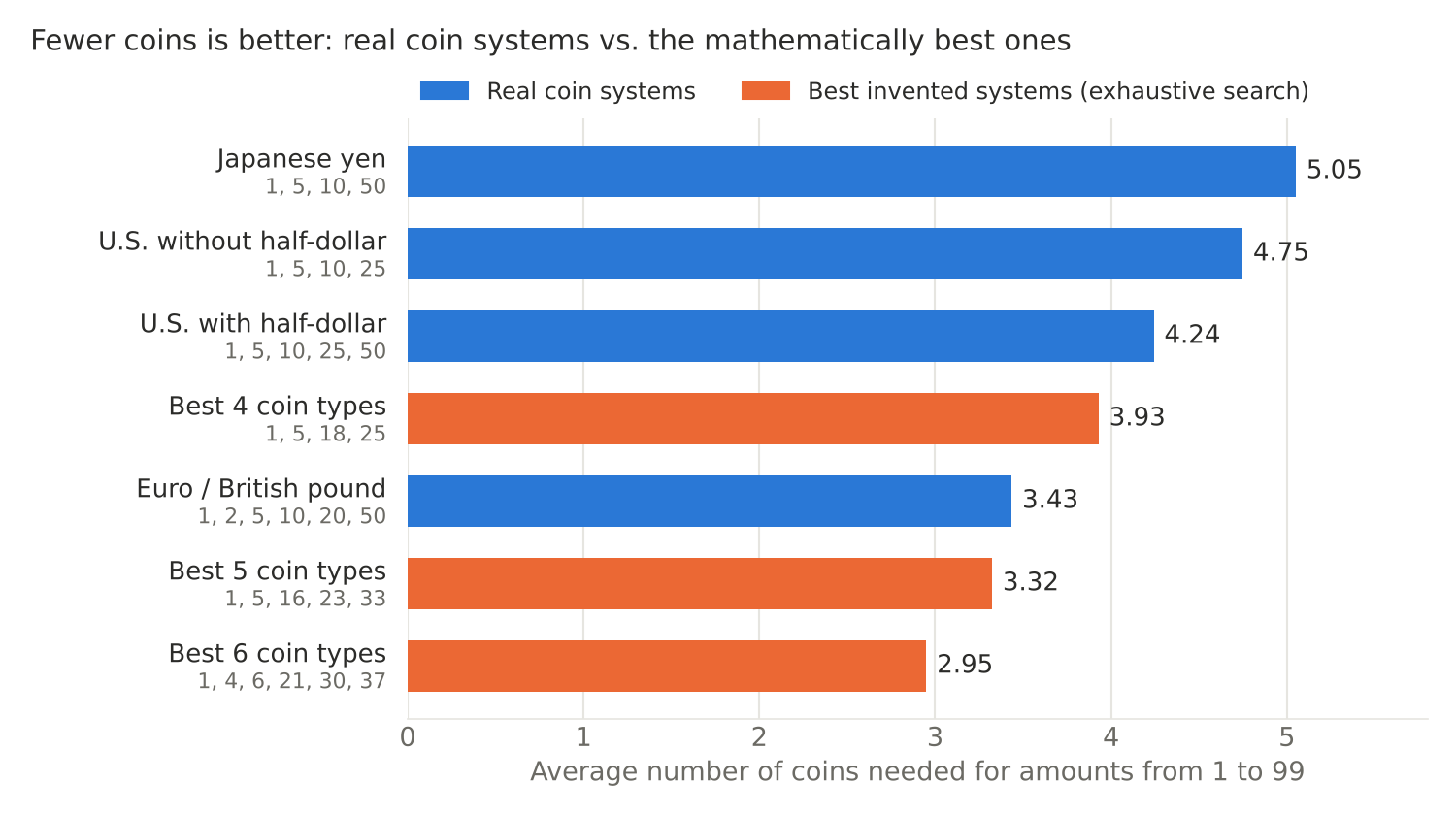
| Euro / British pound | 1, 2, 5, 10, 20, 50 | 340/99 = 3.434 | 6 |
| Traditional U.S., including 50-cent coin | 1, 5, 10, 25, 50 | 420/99 = 4.242 | 8 |
| Traditional U.S., excluding 50-cent coin | 1, 5, 10, 25 | 470/99 = 4.747 | 9 |
| Japanese yen (amounts below 100 yen) | 1, 5, 10, 50 | 500/99 = 5.051 | 10 |
For this particular experiment, the euro-style denominations use (420-340)/420\approx19.05\% fewer coins on average than the five-denomination traditional U.S. set. This is a mathematical statement about the denomination sets, not a judgment about the countries’ economies or everyday payment habits.
Sources: European Commission: euro denominations; Royal Mint: British coin denominations.
3. Why countries that round cash payments require special treatment
Some countries do not routinely make cash change in single-cent increments. Canada, Australia, and Switzerland use five-unit cash rounding; New Zealand uses ten-unit cash rounding. The final cash amount is rounded, not necessarily the price of each item, and electronic payments can follow different rules.
For a simplified comparison, consider only positive attainable amounts below 100:
| Example denomination system | Amounts examined | Average minimum coins |
|---|---|---|
| Canada: 5, 10, 25, 50 | 5, 10, …, 95 | 44/19 = 2.316 |
| Australia: 5, 10, 20, 50 | 5, 10, …, 95 | 44/19 = 2.316 |
| Switzerland: 5, 10, 20, 50 | 5, 10, …, 95 | 44/19 = 2.316 |
| New Zealand: 10, 20, 50 | 10, 20, …, 90 | 17/9 = 1.889 |
These numbers should not be placed in the same ranking as the exact-change results above: rounding removes many possible amounts, including the hardest small ones. The simplified table does not model actual purchase frequencies or the probability that the rounded change is zero.
4. A trap: the largest coin is not always the right choice
Many people make change by repeatedly choosing the largest coin that does not exceed the remaining amount. This is called the greedy algorithm. It works for several familiar denomination systems, but not for arbitrary sets.
Consider coins worth 1, 3, and 4. To make 6, the greedy method chooses 4+1+1, three coins. But 3+3 requires only two. Therefore, to compare invented coin systems rigorously, we cannot rely on greedy change-making.
5. A recurrence that always finds the minimum
The key is a simple observation: the last coin in an optimal representation must have some denomination d. The other coins must optimally represent n-d; otherwise, we could replace them with a shorter representation.
Thus, with m_D(0)=0,
\boxed{m_D(n)=1+\min_{\substack{d\in D\\d\le n}}m_D(n-d).}This is a dynamic programming recurrence. Starting at zero, we compute the exact minimum for 1, then 2, then 3, all the way to 99. It is fast enough to evaluate millions of candidate coin systems.
6. If we could invent our own coins
Now suppose we may choose exactly k different positive integer denominations, including 1, with every denomination at most 99. Which choice minimizes the sum \sum_{n=1}^{99}m_D(n)?
An exhaustive computer search gives the following results:
| Number of denominations | Globally average-optimal sets | Sum over 1–99 | Average |
|---|---|---|---|
| 4 | {1, 5, 18, 25} or {1, 5, 18, 29} |
389 | 3.9293 |
| 5 | {1, 5, 16, 23, 33} | 329 | 3.3232 |
| 6 | {1, 4, 6, 21, 30, 37} or {1, 5, 8, 20, 31, 33} |
292 | 2.9495 |
Notice how unusual the six-denomination winners look! There is no 10, 20, or 50. Nevertheless, both outperform the euro-style set, which averages 340/99 coins. The improvement is (340-292)/340\approx14.12\%.
These are not guesses from a heuristic search. The program evaluated every possible set of the required size:
\binom{98}{3}=152096,\quad\binom{98}{4}=3612280,\quad\binom{98}{5}=67910864.That is 71,675,240 denomination sets in total. The 1-unit coin is fixed, and the remaining denominations are chosen in increasing order from 2 through 99, so each eligible system appears exactly once.
7. An even more surprising result: four coins always suffice
The six-denomination system
\boxed{D=\{1,4,6,21,30,37\}}not only minimizes the average; it can also represent every amount from 1 to 99 using at most four coins. For example, 99=37+37+21+4, exactly four coins.
Why is four the smallest possible worst case? We can prove it without a computer.
With six denominations, a selection of at most three coins is specified by six nonnegative integers x_1,\ldots,x_6 whose sum is at most 3. The number of such selections, including the empty selection, is
\binom{6+3}{3}=\binom{9}{3}=84.Different selections might even give the same value, so they can represent at most 84 different amounts. But we need 100 different amounts: 0 through 99. Consequently, no six-denomination system can cover all these amounts with three or fewer coins.
\boxed{W(D)\ge4\text{ for every six-denomination system.}}Our special set attains four, as verified by the recurrence. Therefore, its worst-case performance is mathematically optimal. This combines an elementary counting proof with an exact finite computation.
The other average-optimal system, \{1,5,8,20,31,33\}, sometimes needs five coins. So two systems tie for best average, but only one of those two also achieves the best possible worst case.
8. Why aren’t real coins designed this way?
There is a catch: our objective is deliberately narrow. A national coin system must also be easy to recognize, count, price with, manufacture, and use in cash registers. Familiar 1–2–5 patterns are easy to learn and extend naturally across powers of ten. A 37-cent coin might be mathematically effective but awkward in daily life.
Our model also assumes all amounts from 1 to 99 occur equally often, which is unlikely in actual commerce. If prices frequently end in 0, 5, or 9, the best denominations under a realistic distribution could differ. Cash rounding, production costs, and the use of banknotes would change the answer again.
9. A question to explore
Suppose your country could introduce exactly one new coin. Would you add a 2-cent coin to the American system, a 20-cent coin, or something unexpected? How would you decide if your goal were to minimize average change rather than the maximum number of coins?
The mathematics suggests a broader lesson: the best design depends on what we choose to optimize. An ordinary pocketful of change turns out to be a small laboratory for algorithm design and combinatorial optimization.
Computational note: The exhaustive results above were independently rerun from a C++ implementation of the dynamic programming recurrence. They are exact for the stated model; they are not claims about real-world transaction frequency or practical currency design.
References
- Jeffrey Shallit, What This Country Needs Is an 18-Cent Piece , The Mathematical Intelligencer, Vol. 25, No. 2 (2003), pp. 20–23.
Related reading: Mathematics can also make multiplication more efficient. Read our article Multiplying Complex Numbers with Only Three Multiplications .
For another interesting problem in discrete optimization, see our article The Courier’s Dilemma: Five Deliveries, Shortest Routes, and Roads You Cannot Repeat , where we explore how to find optimal delivery routes through a network of roads.
Leave a Reply