
1. A Geometric Inequality
Imagine a continuous, strictly increasing function f:[0,\infty)\to[0,\infty) with f(0)=0 and f(t)\to\infty as t\to\infty. Its inverse function is f^{-1}, which is defined on the entire nonnegative real axis. The graphs of these two functions are reflections of one another across the line y=x.
Choose two nonnegative numbers x and y. Consider the rectangle with side lengths x and y, so its area is xy. The area under the graph of f, from 0 to x, is
\int_0^x f(t)\,dt.Similarly, the area under the graph of the inverse function, from 0 to y, is
\int_0^y f^{-1}(s)\,ds.The two regions together cover the rectangle. Depending on the position of the point (x,y) relative to the graph, they may extend beyond it, but their total area cannot be smaller than the rectangle’s area. Therefore,
xy\leq \int_0^x f(t)\,dt+\int_0^y f^{-1}(s)\,ds.This is the geometric form of Young’s inequality.
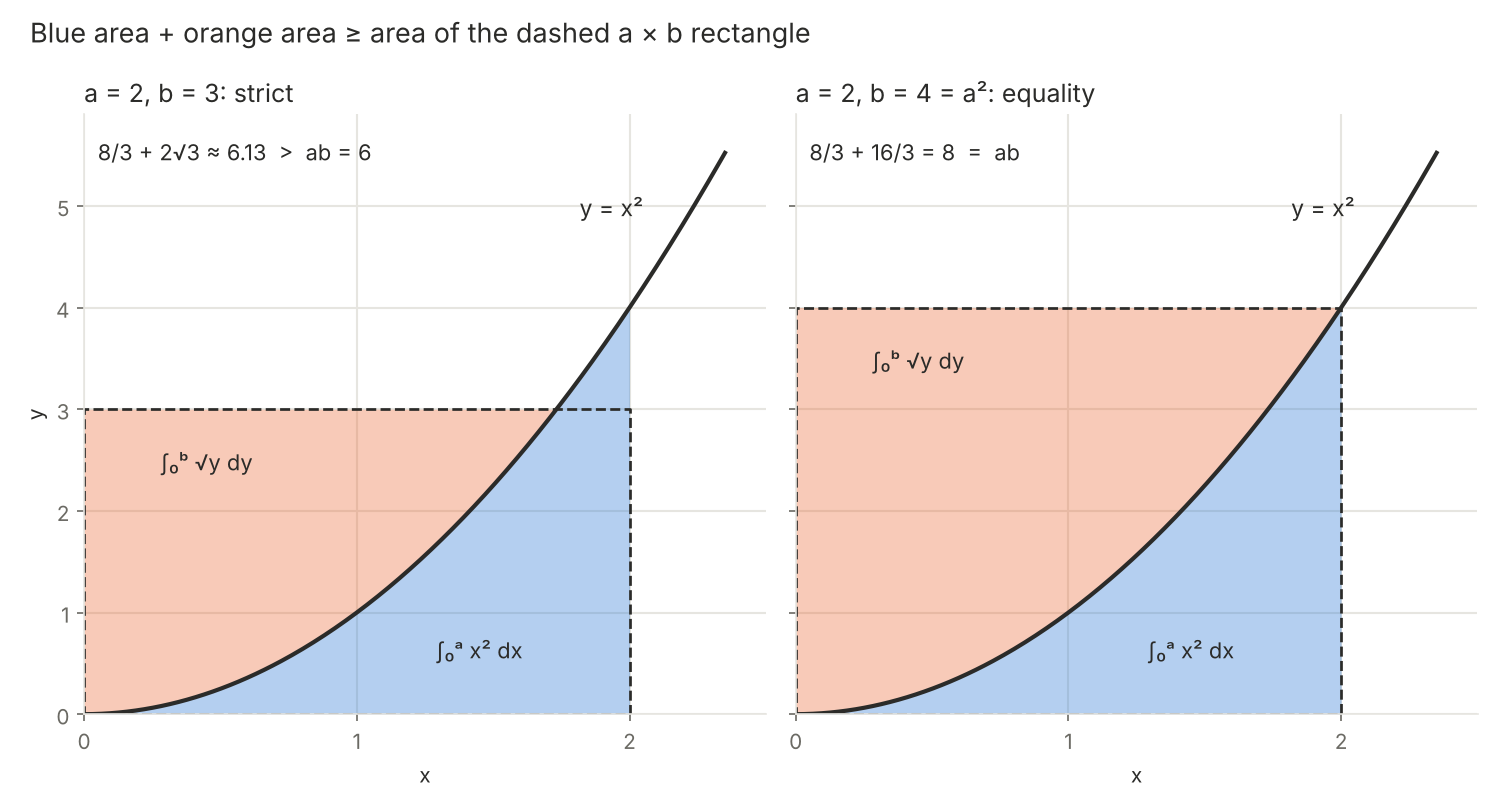
When y=f(x), the point (x,y) lies on the graph. The two regions fit together exactly to form the rectangle, and equality holds:
xy=\int_0^x f(t)\,dt+\int_0^{f(x)} f^{-1}(s)\,ds.This area relationship is the central idea behind the inequality.
2. The Classical Young Inequality
We now choose a particularly useful function:
f(t)=t^{p-1},\qquad p>1.Its inverse is
f^{-1}(s)=s^{1/(p-1)}=s^{q-1},where the exponents p and q satisfy
\frac{1}{p}+\frac{1}{q}=1,\qquad p,q>1.Substituting these functions into the area inequality gives
ab\leq \int_0^a t^{p-1}\,dt+\int_0^b s^{q-1}\,ds.Evaluating the integrals, we obtain the classical result.
Young’s inequality. For a,b\geq0 and conjugate exponents p,q>1,
ab\leq \frac{a^p}{p}+\frac{b^q}{q}.Equality holds precisely when
a^p=b^q.Indeed, equality in the area argument occurs when b=f(a)=a^{p-1}, which is equivalent to a^p=b^q.
A familiar special case
If p=q=2, Young’s inequality becomes
ab\leq \frac{a^2+b^2}{2},or, equivalently,
2ab\leq a^2+b^2.This is simply the nonnegativity of (a-b)^2. Equality occurs when a=b. Thus, the familiar quadratic inequality is one member of a much larger family.
A numerical example
Take p=3, so that q=3/2. For a=2 and b=3, Young’s inequality gives
6\leq \frac{2^3}{3}+\frac{3^{3/2}}{3/2} =\frac{8}{3}+2\sqrt{3}\approx 6.13.The inequality is strict because a^p=8 and b^q=3\sqrt{3} are not equal.
For equality, choose a=2 and b=4. Then a^3=b^{3/2}=8, and
8=\frac{2^3}{3}+\frac{4^{3/2}}{3/2} =\frac{8}{3}+\frac{16}{3}.3. Another Proof: A Calculus Argument
The same inequality can be proved directly using calculus. This proof gives another way to understand why the exponents p and q must be conjugate.
Fix a\geq0, and define
\phi(b)=\frac{a^p}{p}+\frac{b^q}{q}-ab,\qquad b\geq0.For b>0,
\phi'(b)=b^{q-1}-a.The derivative vanishes when
b=a^{1/(q-1)}=a^{p-1}.Since
\phi''(b)=(q-1)b^{q-2}>0,the function is convex, and this critical point is its minimum. At that point, b^q=a^p, so
\phi(b)=\frac{a^p}{p}+\frac{a^p}{q}-a^p=0.Consequently, \phi(b)\geq0 for all b\geq0, which proves Young’s inequality.
The area proof explains the geometry; the calculus proof makes the equality condition transparent.
4. From Young’s Inequality to Hölder’s Inequality
One reason Young’s inequality is so important is that it leads directly to Hölder’s inequality, a fundamental result in analysis.
For finite sequences of nonnegative numbers a_1,\ldots,a_n and b_1,\ldots,b_n, Hölder’s inequality states that
\sum_{i=1}^n a_i b_i\leq \left(\sum_{i=1}^n a_i^p\right)^{1/p} \left(\sum_{i=1}^n b_i^q\right)^{1/q}.Here p and q are again conjugate exponents.
To see how Young’s inequality gives this result, first assume that both sums on the right are positive. Normalize the sequences by setting
x_i=\frac{a_i}{\left(\sum_{j=1}^n a_j^p\right)^{1/p}}, \qquad y_i=\frac{b_i}{\left(\sum_{j=1}^n b_j^q\right)^{1/q}}.Then
\sum_{i=1}^n x_i^p=1,\qquad \sum_{i=1}^n y_i^q=1.Apply Young’s inequality to each pair x_i,y_i:
x_i y_i\leq \frac{x_i^p}{p}+\frac{y_i^q}{q}.Adding these inequalities gives
\sum_{i=1}^n x_i y_i \leq \frac{1}{p}\sum_{i=1}^n x_i^p+ \frac{1}{q}\sum_{i=1}^n y_i^q =\frac1p+\frac1q=1.Undoing the normalization gives Hölder’s inequality. If either of the two sums is zero, the result is immediate.
Thus, a geometric inequality about areas under inverse curves becomes a powerful tool for estimating sums and integrals.
5. Why This Inequality Matters
Young’s inequality is more than an isolated estimate. It is a bridge between several important ideas:
- Inverse functions: The areas under a function and its inverse are linked by a simple geometric relation.
- Convexity: The power functions and the minimum in the calculus proof reveal the role of convexity.
- Conjugate exponents: The relation 1/p+1/q=1 is exactly what makes the two integral terms fit together.
- Hölder’s inequality: Applying Young’s inequality term by term produces a fundamental estimate for sums and, more generally, integrals.
Young’s inequality also connects naturally to the Cauchy–Schwarz inequality, which we explored in another article:
One Inequality, Many Worlds: From Geometry to Calculus
In the next step, these ideas lead to the broader theory of L^p norms and functional inequalities. Young’s inequality is one of the basic building blocks of that theory.
Continue exploring: Section 4 continues in Hölder’s Inequality: Beyond Cauchy–Schwarz. The case p = q = 2 is the simplest instance of AM–GM, and the role of convexity is explored in Jensen’s Inequality: How Curvature Controls Averages.
6. Try It Yourself
Try these problems before opening the solutions.
Problem 1. Use Young’s inequality with p=4 to write an inequality involving a and b.
Solution. The conjugate exponent is q=4/3, since
\frac14+\frac{3}{4}=1.Therefore,
ab\leq \frac{a^4}{4}+\frac{3b^{4/3}}{4}.Equality holds when a^4=b^{4/3}.
Problem 2. For which positive values of a and b does equality hold in Young’s inequality when p=3 and q=3/2?
Solution. Equality requires
a^3=b^{3/2}.Equivalently, b=a^2.
Problem 3. Use Young’s inequality with p=q=2 to prove 3xy\leq \frac{3}{2}x^2+\frac{3}{2}y^2 for all real x,y.
Solution. Apply Young’s inequality to |x| and |y|:
|xy|\leq \frac{x^2+y^2}{2}.Multiplying by 3 gives
3xy\leq 3|xy|\leq \frac32x^2+\frac32y^2.Problem 4. Use Young’s inequality to prove u v\leq \frac{u^3}{3}+\frac{2v^{3/2}}{3} for nonnegative u,v.
Solution. Choose p=3 and q=3/2. These exponents are conjugate, so Young’s inequality gives exactly
uv\leq \frac{u^3}{3}+\frac{v^{3/2}}{3/2} =\frac{u^3}{3}+\frac{2v^{3/2}}{3}.References
- G. H. Hardy, J. E. Littlewood, and G. Pólya, Inequalities, 2nd edition, Cambridge University Press, 1952.
Young’s inequality is a small geometric observation with far-reaching consequences. The next time you encounter a product that is difficult to estimate, it may be useful to remember that it can often be bounded by a sum of two powers.
Leave a Reply