
How far does a crosswind push a projectile, and does air resistance really matter? In this post we put real numbers into the three-dimensional projectile model and follow the calculation step by step, from launch to landing.
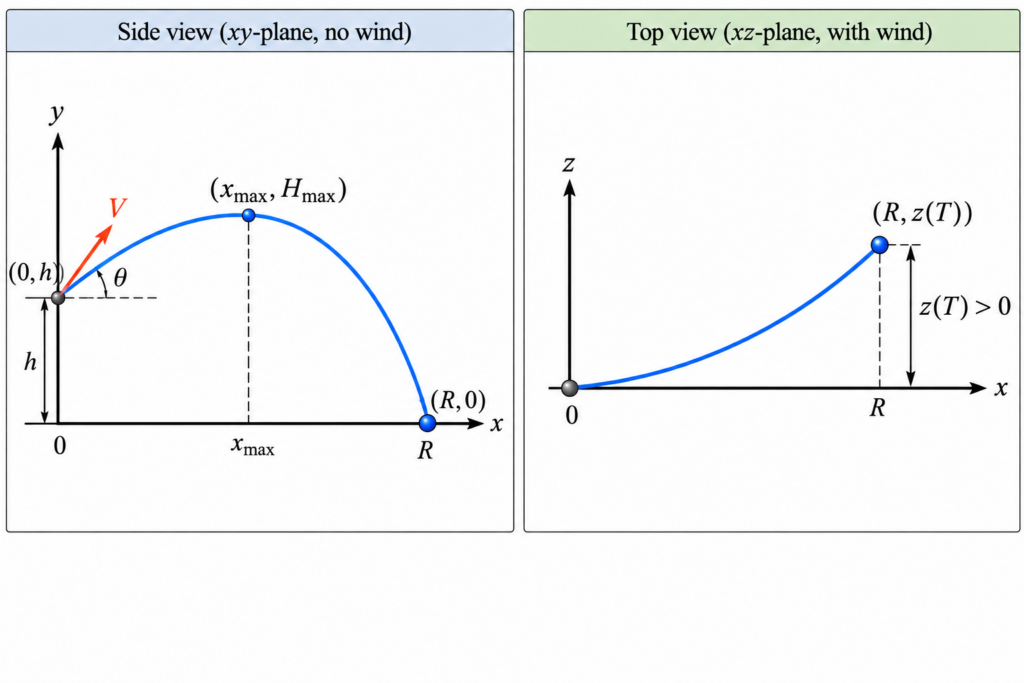
The formulas come from Projectile Motion in 3D: Adding Wind and Air Resistance, where they are derived. Briefly: x is the original firing direction, y is vertical and z is sideways. The wind blows horizontally, and air resistance is proportional to the projectile’s velocity relative to the moving air, with drag constant k per unit mass.
The Setup
Suppose a projectile is launched from a height of 10 meters with an initial speed of 40 m/s at an angle of 45° above the horizontal.
A horizontal wind blows at 10 m/s at an angle of 60° from the original firing direction. Assume a linear drag constant k = 0.10 s−1 and take g = 9.81 m/s2.
Thus our data are
Step 1: When Does It Reach Maximum Height?
The time at which the projectile reaches its maximum height is
Substituting the numerical values gives
Therefore,
The projectile reaches its highest point about 2.53 seconds after launch.
Step 2: What Is the Maximum Height?
The maximum height is
Substitution gives
Thus
The projectile rises to approximately 44.32 meters above the ground.
Step 3: When Does It Hit the Ground?
The projectile hits the ground when . For our values, this means solving
Unlike the standard projectile problem, this is not a quadratic equation. The unknown T appears both by itself and in an exponential. Solving the equation numerically gives
So the projectile is in the air for approximately 5.70 seconds.
Step 4: How Far Downrange Does It Travel?
The horizontal x-coordinate at landing is
Substituting gives
Thus the projectile travels approximately 129.62 meters downrange.
Step 5: How Far Sideways Does the Wind Push It?
The sideways coordinate at landing is
Substituting the numerical values gives
Therefore,
The wind has pushed the projectile approximately 11.73 meters sideways from the original vertical firing plane.
Step 6: Where Does It Land?
We now know both horizontal coordinates. Therefore the landing point is approximately
In other words, the projectile lands approximately 129.62 meters downrange and 11.73 meters sideways from the original vertical firing plane.
Step 7: Total Horizontal Displacement
The straight-line horizontal distance from the point directly below the launch position to the landing point is
Therefore,
The Answer
For this example, the projectile reaches a maximum height of approximately 44.32 m and stays in the air for approximately 5.70 s.
It lands approximately 129.62 m downrange and 11.73 m sideways from the original vertical firing plane. Thus its landing point is
The total horizontal displacement from the point directly below the launch position is approximately 130.15 m. The sideways displacement shows exactly how the wind changes the familiar two-dimensional projectile problem into a three-dimensional one.
Continue exploring: see how these formulas are derived in Projectile Motion in 3D: Adding Wind and Air Resistance. For another motion problem with a surprising answer, read A Sliding Ladder: Is It Better to Slide or Jump?
Leave a Reply