
Can a Taller Can Contain Exactly the Same Amount?
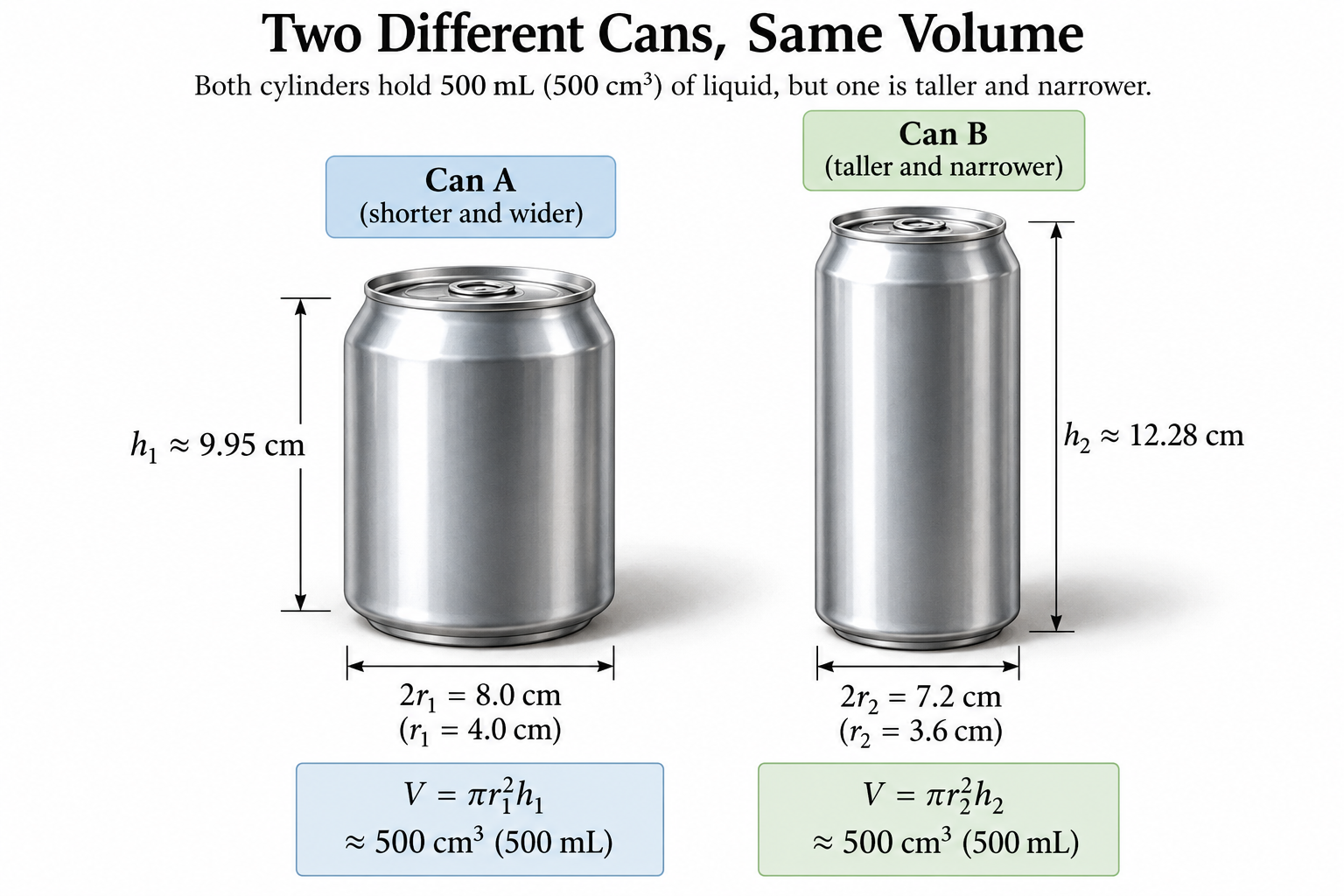
Imagine two cylindrical cans on a store shelf. One is short and wide; the other is noticeably taller and narrower. Both labels say 500 mL. Could both labels be correct?
Yes. A change in radius can be compensated by a change in height. Calculus tells us how sensitive the height is to that change, and an exact formula tells us what happens when the change is not particularly small.
1. The Volume of a Cylinder
For a cylinder of radius r and height h,
V=\pi r^2h.Suppose the volume is fixed. If we reduce the radius, we must increase the height. But by how much?
2. What Differentials Tell Us
Differentiate the volume formula:
dV=2\pi rh\,dr+\pi r^2\,dh.Because the volume remains constant, dV = 0. Therefore,
0=2\pi rh\,dr+\pi r^2\,dh.Dividing by \pi r^2h gives
\boxed{\frac{dh}{h}=-2\frac{dr}{r}.}This is a useful sensitivity rule: for a small percentage decrease in radius, the required percentage increase in height is approximately twice as large. For example, reducing the radius by 1% requires roughly a 2% increase in height.
The word approximately matters. Differentials give a first-order estimate; a finite change requires an exact calculation.
3. The Exact Formula
Let the original can have dimensions r_1,h_1 and the redesigned can have dimensions r_2,h_2. Equal volumes imply
\pi r_1^2h_1=\pi r_2^2h_2.Solving for the ratio of heights,
\boxed{\frac{h_2}{h_1}=\left(\frac{r_1}{r_2}\right)^2.}If the radius is reduced by 10%, then r_2=0.90r_1, and
\frac{h_2}{h_1}=\frac{1}{(0.90)^2}=\frac{100}{81}\approx1.23457.Thus the new can must be approximately 23.46% taller. The differential estimate would have predicted only 20%, illustrating the error introduced by treating a 10% change as infinitesimal.
4. Two Different Cans, Both Holding 500 mL
Since 1 mL equals 1 cubic centimeter, each can must have volume 500\,\mathrm{cm}^3. Consider the following dimensions:
| Dimension | Original can | Taller can |
|---|---|---|
| Radius | 4.00 cm | 3.60 cm |
| Diameter | 8.00 cm | 7.20 cm |
| Height | 9.95 cm | 12.28 cm |
| Volume | 500 mL | 500 mL |
The heights come from
h_1=\frac{500}{\pi(4)^2}\approx9.95\,\mathrm{cm},\qquad h_2=\frac{500}{\pi(3.6)^2}\approx12.28\,\mathrm{cm}.The second can is more than 2.3 cm taller, even though both hold exactly the same amount. (The displayed dimensions are rounded.)
5. Can Shape Fool the Eye?
A taller package can look more substantial at first glance. That observation suggests an interesting question: might someone judge a tall, narrow can to contain more than a short, wide can, even when both have identical labeled volumes?
That is a hypothesis about visual perception, not a consequence of the volume formula. Demonstrating such an effect would require consumer-perception evidence. Our mathematical conclusion is narrower and certain: height alone does not determine capacity.
6. A General Formula for Any Percentage Reduction
Suppose the radius is reduced by a fraction p, where 0<p<1. Then
r_2=(1-p)r_1,\qquad \frac{h_2}{h_1}=\frac{1}{(1-p)^2}.The exact fractional increase in height is therefore
\boxed{\frac{h_2-h_1}{h_1}=\frac{1}{(1-p)^2}-1.}For small p, calculus gives the approximation 2p. In fact, the binomial series makes the correction explicit:
\frac{1}{(1-p)^2}-1=2p+3p^2+4p^3+\cdots,\qquad |p|<1.All the additional terms are positive when the radius is reduced, so the differential estimate underestimates the required increase in height.
7. Try It Yourself
Challenge: A manufacturer reduces the radius of a cylindrical can by 5% while keeping its volume unchanged. What is the exact percentage increase in height? Compare it with the differential estimate.
Show solution
Here p=0.05, so
100\left(\frac{1}{0.95^2}-1\right)\%\approx10.8033\%.The differential estimate is 10%, which underestimates the exact result by about 0.80 percentage points.
Final Thought
Reducing a cylinder’s radius has a surprisingly strong effect on the height needed to preserve its volume. A small change in one dimension can produce a much more noticeable change in another. This simple packaging problem is a practical illustration of differentials, percentage change, and the difference between linear approximation and an exact formula.
Another Surprising Application of Calculus: The shape of a container can lead to unexpected mathematical results. For another fascinating example, explore Gabriel’s Horn: A Shape with Finite Volume and Infinite Surface Area .
Leave a Reply