
I came across this integral while working on Gelfand widths. It’s a classical result, but the way symmetry reduces it to a one-line formula is worth seeing.
Consider the integral
where is the unit sphere in and is a fixed vector. At first glance, this looks like a difficult high-dimensional integral. The absolute value creates a nonsmooth integrand, but the symmetry of the sphere makes the calculation surprisingly simple.
The key observation
If , the integral is zero, so the formula holds trivially. We may therefore assume that . Write
where is a unit vector. Then
Therefore,
The remaining integral does not depend on the direction of . The sphere is rotationally symmetric, so we may rotate the coordinate system and assume that
Then
and therefore
A geometric interpretation
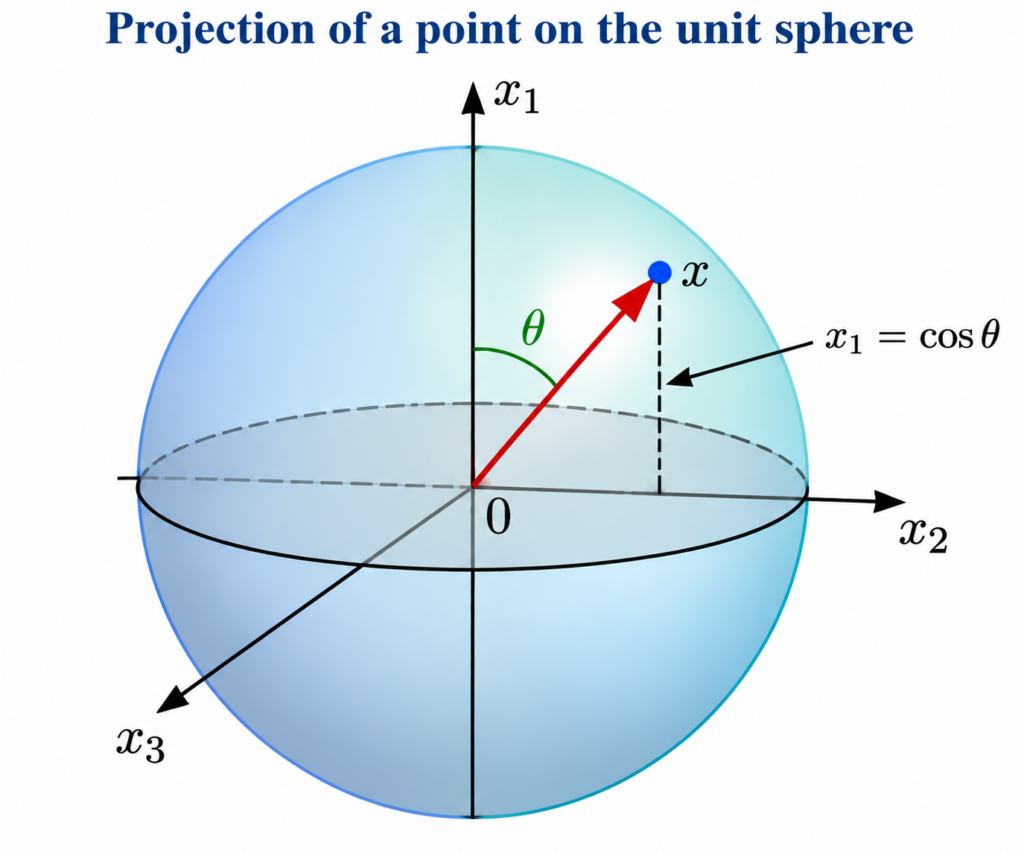
For a point on the sphere, let be the angle between and the chosen direction . Then the projection of onto this direction is
so
The integral is therefore the total absolute projection of all points on the sphere onto a fixed direction.
Measuring spheres
The notation means the surface area of the unit sphere .
For example,
- consists of two points, so .
- is the unit circle, so .
- is the ordinary unit sphere, so .
Now consider the sphere . Fix the angle between a point on this sphere and a fixed direction .
All points making the same angle with the fixed direction form a lower-dimensional sphere of radius . Its surface measure is , where denotes the surface area of the corresponding unit sphere.
This explains why the factor appears in the spherical-coordinate calculation.
The lower-dimensional sphere
To compute the integral, we slice the sphere by fixing the angle . Each slice is itself a sphere of one lower dimension.
The notation
means the surface area of the unit sphere one dimension lower. For example,
- , because it consists of two points;
- , because it is the unit circle;
- , because it is the usual sphere.
Using spherical coordinates, the surface element becomes
Therefore,
Finishing the computation
The remaining one-dimensional integral is elementary. Let
so that
Therefore,
Substituting this result gives
Finally,
Examples
The formula becomes especially simple in low dimensions.
The circle
For the unit circle we have . The lower-dimensional sphere is
which consists of two points, so
Therefore,
The sphere
For the ordinary unit sphere in we have
and the lower-dimensional sphere is the unit circle:
Hence,
In both examples, the direction of does not matter. Only its length remains. This is a direct consequence of the rotational symmetry of the sphere.
The main idea
The calculation is simple because the sphere has no preferred direction. A rotation can move any vector to a coordinate axis without changing the geometry of the sphere.
Therefore, the integral depends only on the length of the vector:
where is a constant that depends only on the dimension.
The important lesson is not the integration itself, but the symmetry behind it: whenever a problem on a sphere involves a single fixed vector, the first question should be whether a rotation can remove the direction completely.
Related Reading
Why does differentiating the volume of a sphere with respect to its radius give its surface area? Does this relationship hold in higher dimensions?
Explore the geometric explanation, the general formula for hyperspheres, and the surprising behavior of volume in higher dimensions in Why Does Differentiating a Sphere’s Volume Give Its Surface Area?
The same dot product also measures distance on the sphere itself. See how in Two Points on a Sphere: Why the Dot Product Measures Distance.
Leave a Reply