
Can a shape stretch forever, hold a finite amount of liquid, and still have an infinite surface to paint? Gabriel’s horn does exactly that. The more interesting question is what can happen for other horns. Can we classify every possibility?
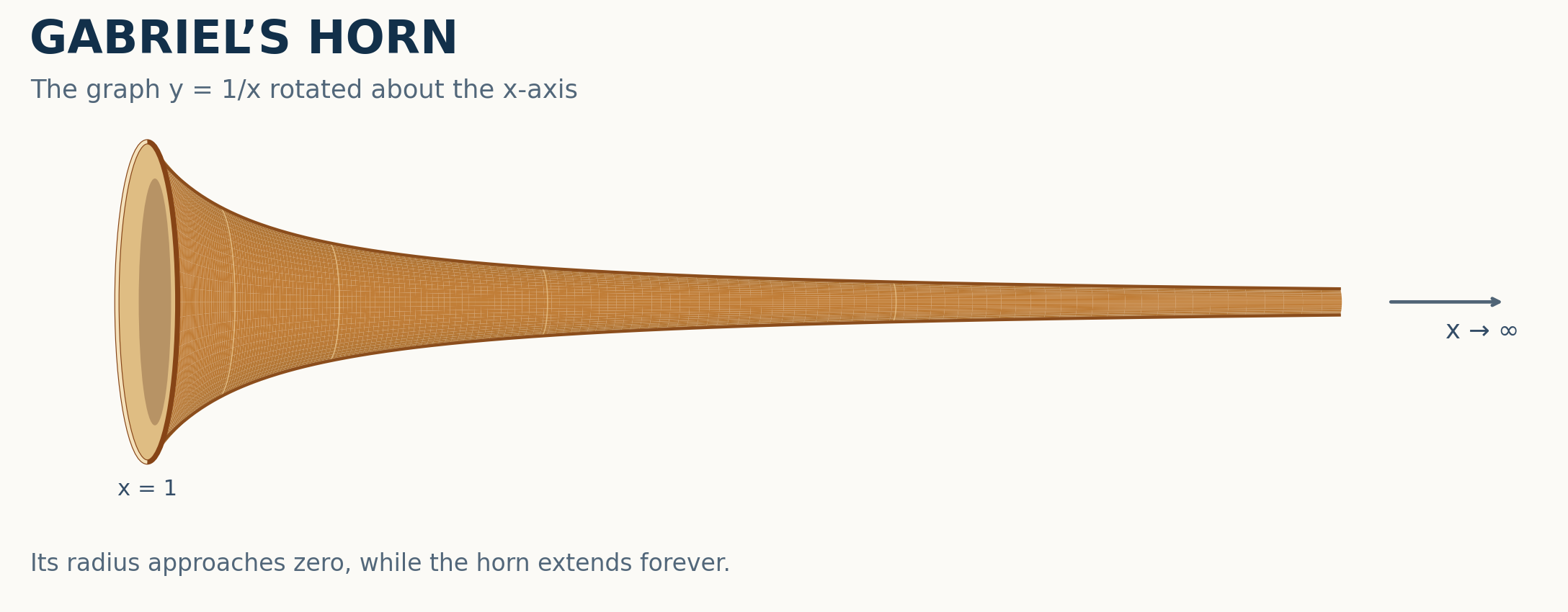
The familiar paradox
At position x, the horn has radius 1/x. The disk method gives its volume:
But the lateral surface area satisfies
So the horn can be filled with π cubic units, although painting its entire outside would require infinite area. This is the usual painter’s paradox. [1, 2]
A general horn
Now let f be a nonnegative continuously differentiable function on [a, ∞), and rotate the region under its graph about the x-axis. “Painting” means covering the curved lateral surface; including the single disk at x = a changes no finite-versus-infinite result. The familiar formulas are [1]
To determine whether the second integral converges, use the elementary inequality
Apply it with v = f′(x), multiply by f(x) ≥ 0, and integrate. We obtain a useful if and only if statement:
The first integral measures the radii accumulated along the axis. The second detects rapid changes in the radius. Both must be finite to paint the horn.
The four possibilities
| Volume | Lateral area | Condition |
|---|---|---|
| Finite | Finite | Both integrals in the painting test converge. |
| Finite | Infinite | The integral of f² converges, but at least one integral in the painting test diverges. |
| Infinite | Finite | Impossible. |
| Infinite | Infinite | The integral of f² diverges. |
Why is the third row impossible? Since the derivative of f² is 2ff′, the painting test gives the bound
Thus a paintable horn has a bounded radius. If M is an upper bound for f, then f² ≤ Mf. The painting test also says the integral of f is finite, so the integral of f² is finite. In short: every paintable horn is fillable. The converse fails, as Gabriel’s horn shows. The implication is also noted in a Calculus II laboratory abstract by Royer. [3]
An entire family of examples
Consider
Here f(x) = x−p decreases from f(1) = 1 toward 0. Its derivative is negative, so |f′(x)| = −f′(x). Thus the second integral in the painting test is
Now (f(x)²)′ = 2f(x)f′(x). Integrating the expression on the right gives
Therefore the second painting integral is finite for every p > 0. The volume is finite when 2p > 1, while the surface area is finite when p > 1.
| Exponent | What happens? |
|---|---|
| p > 1 | Both fillable and paintable. |
| 1/2 < p ≤ 1 | Fillable but not paintable; p = 1 is Gabriel’s horn. |
| 0 < p ≤ 1/2 | Neither fillable nor paintable. |
What if the horn wiggles?
For a decreasing graph, the integral involving |f′| needs no separate test. For an oscillating graph, it really matters. Consider the smooth positive function
The function is bounded above by 3/(1+x)², so both the integral of f and the volume integral of f² converge. Yet the oscillations become increasingly rapid. Differentiating gives
Since 1 ≤ 2 + sin(x⁴) ≤ 3, the reverse triangle inequality gives, for x ≥ 1,
The second term has a convergent integral. For the first term, substitute t = x⁴:
The last integral diverges because |cos(t)| has a positive average over each period, while 1/t decreases too slowly to make the integral finite. Consequently, the integral of f|f′| diverges. This horn is therefore fillable but not paintable, even though the integral of its radii is finite.
Gabriel’s horn fails the painting test because it shrinks too slowly. The oscillating horn fails because its surface becomes too corrugated. The two-integral criterion catches both.
References
- Gilbert Strang and Edwin “Jed” Herman, Calculus Volume 1, OpenStax (2016), §6.2, “Determining Volumes by Slicing” and §6.4, “Arc Length of a Curve and Surface Area.”
- APEX Calculus, §7.4, “Arc Length and Surface Area,” Example 7.4.18 (Gabriel’s horn).
- Melvin G. Royer, “Gabriel’s Other Equipment,” abstract, Joint Mathematics Meetings (2010).
Related problem: volume and surface area
Gabriel’s horn separates volume from surface area. For a sphere, the two are tightly linked: differentiate the volume and you get the surface area. Why Does Differentiating a Sphere’s Volume Give Its Surface Area?
Another Surprise from an Improper Integral
Gabriel’s horn shows how an improper integral can be finite in one sense and infinite in another. Another famous improper integral involves an oscillating function that never settles down, yet its value is remarkably simple.
Continue exploring: Why Is the Integral of sin(ax)/x Always π/2?
Leave a Reply