
For a function that rises to a single peak and then falls, the equation f(x) = f(y) has the obvious solutions x = y and a second, nontrivial family of partner pairs. In When Two Inputs Give the Same Output: A Hidden Symmetry of Unimodal Functions we found every such pair for fn(x) = xne−x. Writing y = kx with k > 0 and k ≠ 1, the nontrivial solutions are
Here we look at what these formulas reveal: a single curve shared by the whole family, a solution in closed form using the Lambert W function, and why partner pairs matter.
1. A surprising universal curve
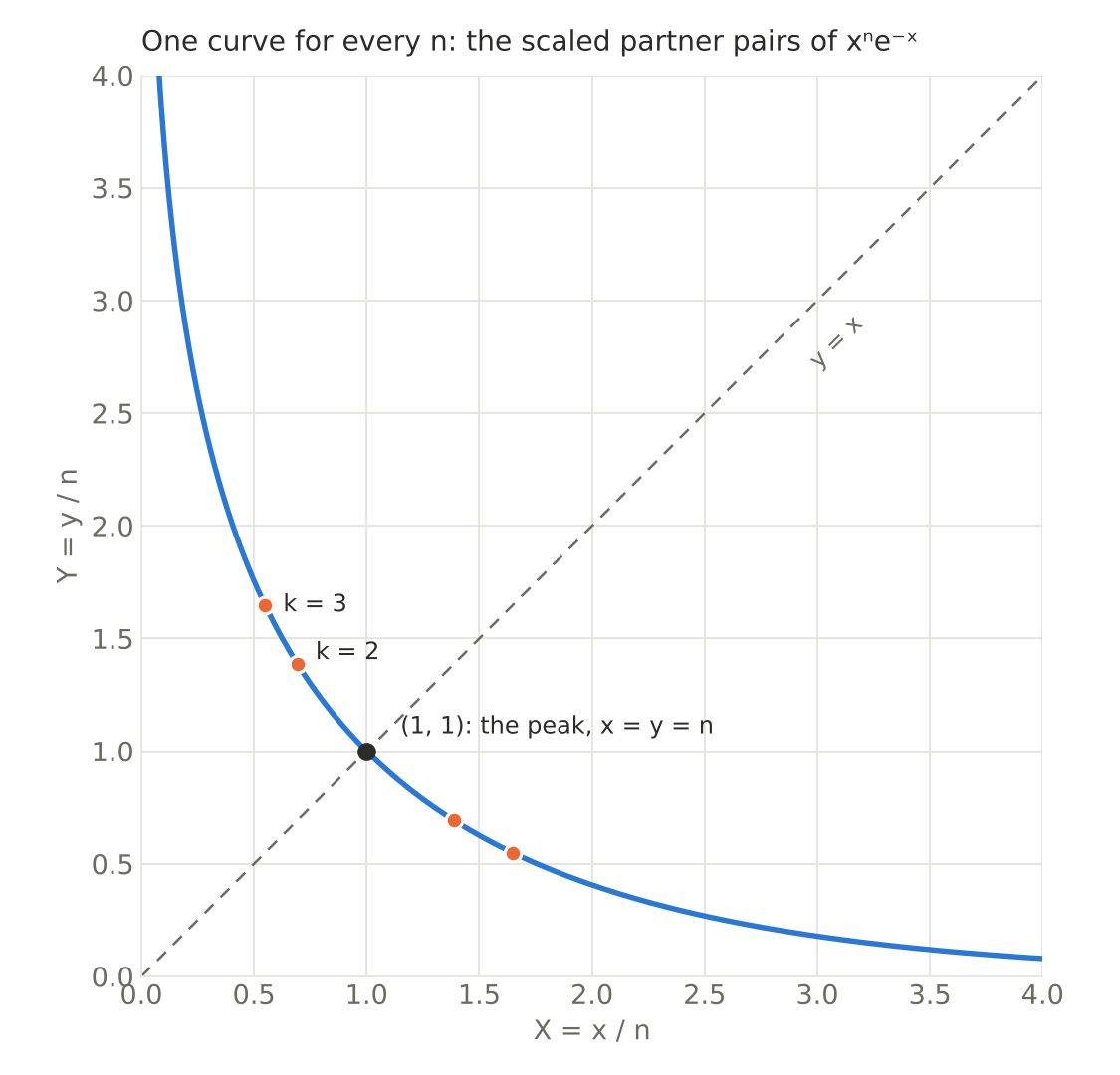
Set X = x/n and Y = y/n. Dividing the parameterization by n removes the exponent entirely:
All the nontrivial solution curves have exactly the same shape after scaling both axes by n. The exponent changes only the size of the picture, not its geometry.
2. A further generalization
For a > 0, consider f(x) = xne−ax. The maximum is at x = n/a. The same substitution y = kx gives
Thus the universal shape persists even when the exponential decay rate changes.
3. A connection to the Lambert W function
Our parameterization gives exact pairs of numbers with the same value of . But can we find the matching value y explicitly when x is given? The answer involves the Lambert W function.
What is Lambert W?
The Lambert W function reverses the operation . In other words,
For real inputs between and 0, there are two real branches: , with values between −1 and 0, and , with values at most −1. The branches meet at .
Solving the equal-value equation
Suppose n > 0 and x, y > 0. Starting from
take the positive nth root and divide by n:
Multiplying by −1 puts the equation in Lambert W form. Therefore both possible values of y are obtained from
One branch returns the trivial solution y = x; the other returns the nontrivial partner:
- If 0 < x < n, then y = x comes from W0, and the larger partner comes from W−1.
- If x > n, then y = x comes from W−1, and the smaller partner comes from W0.
- At x = n, both branches give y = n, the maximum point.
An exact example
Take n = 2 and x = 2 ln 2. The parameterization with k = 2 gives y = 4 ln 2. Lambert W confirms this result because
and the two real Lambert W values are −ln 2 and −2 ln 2. Thus the corresponding inputs are 2 ln 2 and 4 ln 2.
Why this is interesting. The elementary parameterization describes the entire curve using a parameter k, while Lambert W describes its two branches directly as functions of x. These are two complementary ways to understand the same geometric symmetry.
Endpoint note: when x = 0 and n > 0, the only finite nonnegative solution is y = 0. The nontrivial branch approaches infinity as x approaches zero from the right.
4. Why this matters
The partner map describes precisely which different inputs become indistinguishable after one application of a unimodal function. If a sequence is generated by xm+1 = f(xm), any two starting values with f(x) = f(y) have identical trajectories from the first step onward. This is a useful first observation in the study of iterative maps, although more advanced dynamical phenomena require additional analysis.
What began as the simple equation f(x) = f(y) has revealed a decreasing involution, an orthogonal crossing at a smooth peak, infinitely many exact logarithmic solutions, and a universal curve shared by an entire family of functions.
Try it yourself
- Show that for xne−ax, the partner curve has slope −1 at its crossing with the diagonal.
Solution
Try the problem yourself before opening the solution.
Problem 1. Prove the partner curve has slope −1 for xⁿe⁻ᵃˣ.
Let f(x) = xne−ax, where n,a > 0. Then
f′(x) = xn−1e−ax(n − ax).
The unique maximum occurs at c = n/a. Differentiating once more and evaluating at c gives
f″(c) = −a cn−1e−ac < 0.
Write x = c + h and y = c + u, with h and u on opposite sides of zero. Taylor’s theorem gives
f(c+h) = f(c) + ½f″(c)h² + o(h²), and f(c+u) = f(c) + ½f″(c)u² + o(u²).
Equality of these values implies u²/h² → 1. Since u and h have opposite signs, u/h → −1.
Therefore the nontrivial partner curve has tangent slope −1 at (n/a,n/a), perpendicular to the diagonal y = x.
Continue exploring: for the partner map, the right-angle crossing at the peak and the exact points for n = 1, 2, 3, see When Two Inputs Give the Same Output. Two concrete unimodal examples are When Does x^(1/x) Take the Same Value Twice? and When Does x cos(x) Take the Same Value Twice?
Leave a Reply