Consider the function
on the interval
At both ends of the interval the function is zero:
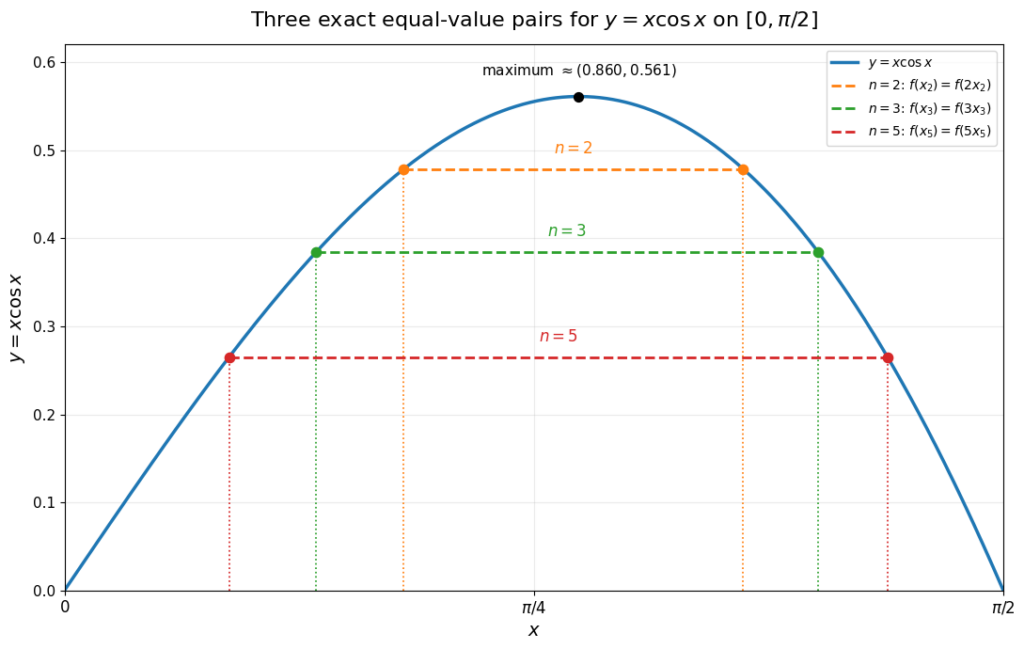
Between these endpoints, the function rises to a single maximum and then falls back to zero. This means that every value strictly between zero and the maximum is attained at exactly two points.
Why is there only one maximum?
Differentiate:
At an interior critical point,
or equivalently,
The function x tan(x) is strictly increasing on because
Therefore the equation has exactly one solution. Numerically,
and the maximum value is approximately
The main idea
Usually, finding the two points at which has the same value leads to a transcendental equation. But something interesting happens if the second point is an integer multiple of the first.
Suppose the two points are and , where is an integer. To keep both points inside the interval, we require
We want
Thus
Since , we can divide by x:
This is where Chebyshev polynomials enter the problem.
What is a Chebyshev polynomial?
The Chebyshev polynomial of the first kind, denoted by , is defined by the identity
For example,
and
Now set
Then
so our transcendental equation becomes the algebraic equation
This is the key observation: a question about two equal values of a transcendental function has turned into a polynomial equation.
Case 1: n = 2
We have
Therefore
The root satisfying the required interval condition is
Hence
The two different inputs and therefore give exactly the same value of .
Case 2: n = 3
Now
Since c is positive, division by c gives
Thus
and therefore
So x and give another exact pair with the same value of the function.
Case 3: n = 5
Using
the equation becomes, after dividing by c,
Setting gives
Therefore
However, not both algebraic roots correspond to our original problem. We need
so Only the larger root satisfies this condition. Hence
and
Thus x and form a third exact pair.
What makes this interesting?
The graph tells us immediately that takes most of its values twice. But the locations of those two points are usually not available in closed form.
Requiring the two inputs to have the special form x and nx changes the problem completely. The multiple-angle identity
turns the transcendental equation into a polynomial equation. For , that polynomial equation gives particularly clean exact answers.
A Related Same-Value Problem
The function leads to one kind of same-value problem. A surprisingly different example appears when we ask the same question about .
Continue exploring: When Does x^(1/x) Take the Same Value Twice?