Consider the integral
where is the unit sphere in and is a fixed vector. At first glance, this looks like a difficult high-dimensional integral. The absolute value creates a nonsmooth integrand, but the symmetry of the sphere makes the calculation surprisingly simple.
The key observation
Write
where is a unit vector. Then
Therefore,
The remaining integral does not depend on the direction of . The sphere is rotationally symmetric, so we may rotate the coordinate system and assume that
Then
and therefore
A geometric interpretation
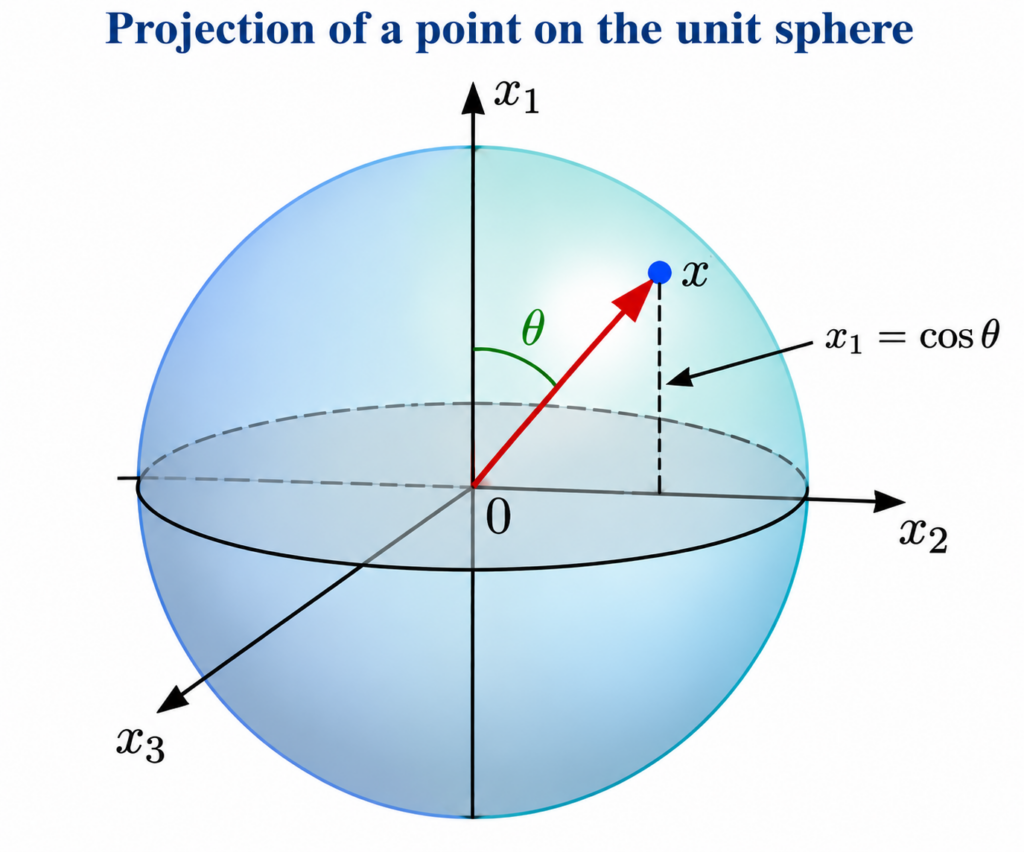
For a point on the sphere, let be the angle between and the chosen direction . Then the projection of onto this direction is
so
The integral is therefore the total absolute projection of all points on the sphere onto a fixed direction.
Measuring spheres
The notation means the surface area of the unit sphere .
For example,
- consists of two points, so .
- is the unit circle, so .
- is the ordinary unit sphere, so .
Now consider the sphere . Fix the angle between a point on this sphere and a fixed direction .
All points with the same angle form a lower-dimensional sphere . Therefore, is the surface area of this slice of the sphere.
This is the geometric reason that appears when we compute the integral using spherical coordinates.
The lower-dimensional sphere
To compute the integral, we slice the sphere by fixing the angle . Each slice is itself a sphere of one lower dimension.
The notation
means the surface area of the unit sphere one dimension lower. For example,
- , because it consists of two points;
- , because it is the unit circle;
- , because it is the usual sphere.
Using spherical coordinates, the surface element becomes
Therefore,
Finishing the computation
The remaining one-dimensional integral is elementary. Let
so that
Therefore,
Substituting this result gives
Finally,
Examples
The formula becomes especially simple in low dimensions.
The circle
For the unit circle we have . The lower-dimensional sphere is
which consists of two points, so
Therefore,
The sphere
For the ordinary unit sphere in we have
and the lower-dimensional sphere is the unit circle:
Hence,
In both examples, the direction of does not matter. Only its length remains. This is a direct consequence of the rotational symmetry of the sphere.
The main idea
The calculation is simple because the sphere has no preferred direction. A rotation can move any vector to a coordinate axis without changing the geometry of the sphere.
Therefore, the integral depends only on the length of the vector:
where is a constant that depends only on the dimension.
The important lesson is not the integration itself, but the symmetry behind it: whenever a problem on a sphere involves a single fixed vector, the first question should be whether a rotation can remove the direction completely.