Choose any point outside a circle. Can we draw a second circle, centered at that point, that covers exactly half the area of the original circle?
Surprisingly, the answer is always yes. Even better, there is exactly one such circle.
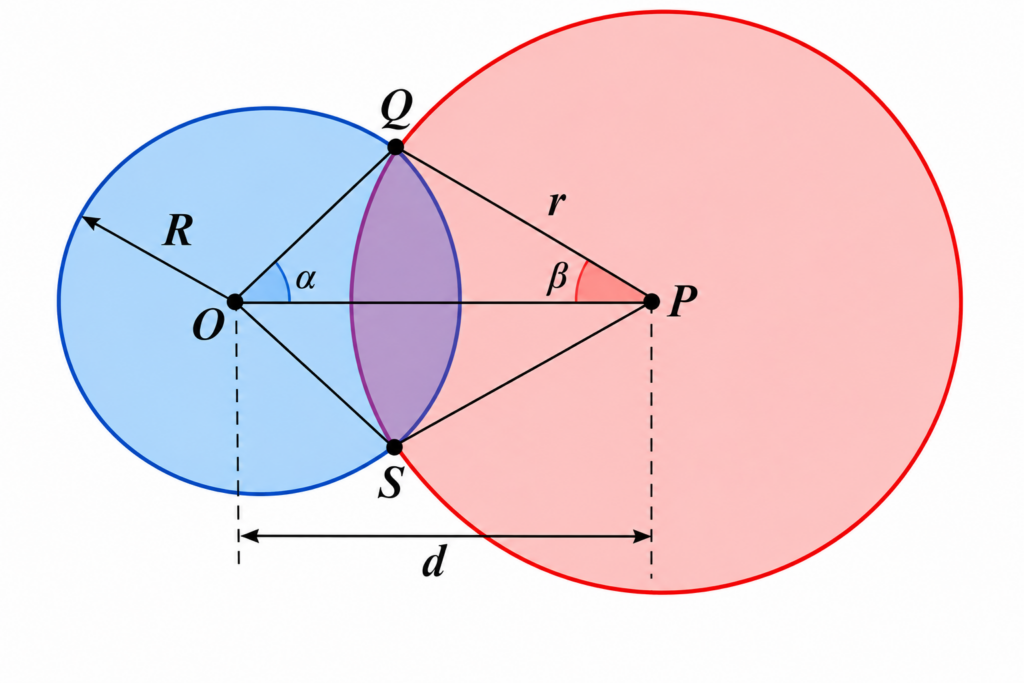
Let the original circle have center O and radius R. Choose a fixed point P outside the circle, and let
We want to find the radius r of a circle centered at P that covers exactly half of the original disk.
Why must such a circle exist?
Before calculating anything, we can prove that the desired circle must exist.
Let A(r) denote the area of the part of the original disk covered by the circle centered at P with radius r.
Since P is outside the original circle, the distance from P to the nearest point of the original circle is
Therefore, when
the two circles are externally tangent. They meet at only one point, so their common area is zero:
Now continue increasing r. Eventually,
At this point the circle centered at P contains the entire original disk. Hence
As r increases, the circle centered at P grows continuously. Consequently, the area A(r) that it covers inside the original circle also changes continuously.
It starts at
and eventually reaches
Therefore, by the Intermediate Value Theorem, at some intermediate radius it must equal
Thus there is at least one radius satisfying
for which the second circle covers exactly half of the original disk.
Why is the radius unique?
Suppose
The disk centered at P with the smaller radius is strictly contained in the disk with the larger radius. While the two circles intersect, increasing the radius captures an additional region of positive area inside the original disk.
Therefore A(r) is strictly increasing for
So the value
can occur only once. The required circle is therefore unique.
Now let us calculate its radius
Let the two circles intersect at points Q and S. Consider the triangle formed by O, P, and Q.
Its side lengths are
Let α be the angle at O between OP and OQ, and let β be the angle at P between PO and PQ.
By the Law of Cosines,
Hence
Applying the Law of Cosines at P gives
so
The area of the overlap
The common lens consists of two circular segments.
At O, the full central angle subtending the common chord is 2α. The area of the corresponding sector is
The triangle inside this sector has area
Thus the first circular segment has area
Similarly, the second circular segment has area
Therefore the total overlap area is
The equation for the radius
We want the overlap to be exactly half the area of the original circle. Therefore r must satisfy
where
and
This is a transcendental equation, so in general the radius is found numerically. But our geometric argument has already established something important: for every d > R, this equation has exactly one solution in
A scale-free version
The problem really depends only on the ratio d/R. Define
Then D > 1, and the required value of ρ depends only on D. Once ρ is found, the actual radius is simply
For example, if the outside point happens to satisfy
the numerical solution is
But this is only one example. The construction works for every point outside the original circle.
The geometric conclusion
We have proved the following result:
Given any point outside a circle, there exists a unique circle centered at that point whose intersection with the original disk has exactly half the area of the original disk.
The calculation of its radius requires solving a transcendental equation, but its existence does not. It follows from a simple geometric idea: start with a circle that barely touches the original circle and continuously increase its radius. The covered area grows continuously from zero to the entire area of the original disk, and therefore it must pass through exactly one-half.
Some numerical examples
Because the problem is unchanged by scaling, we may take
For several choices of the distance d from the center of the original circle to the outside point, the table below gives the unique radius r that covers exactly half of the original disk.
| Distance d | Required radius r |
|---|---|
| 1.10 | 1.24543 |
| 1.25 | 1.37910 |
| 1.50 | 1.60860 |
| 2.00 | 2.08225 |
| 2.50 | 2.56611 |
| 3.00 | 3.05523 |
| 5.00 | 5.03326 |
For a circle of arbitrary radius R, these numbers should be interpreted as ratios. For example,
gives
or equivalently,
The table also reveals an interesting pattern: as the outside point moves farther from the original circle, the required radius becomes increasingly close to the distance d itself.
Another Equal-Area Problem
Dividing the area of a circle exactly in half with another circle raises a natural geometric question: can a circle do the same thing to a triangle?
Continue exploring: Can a Circle Cut a Triangle in Half?