Tag: geometric series

  • How the Ancient Greeks Summed Infinite Series Without Calculus

    Can infinitely many pieces have a finite total area? The Greeks approached this question through geometric exhaustion. Archimedes proved that a parabolic segment has four-thirds the area of its largest inscribed triangle. Here we explain the geometry with modern notation, clearly distinguishing ancient arguments from modern illustrations.

    1. Zeno and infinitely many steps

    Travel half a unit, then a quarter, then an eighth, and so on. The infinite subdivision raises Zeno’s famous question: can infinitely many stages have a finite total?

    12+14+18+⋯=1
    Zeno’s successive halfway distancesA segment from zero to one marked at one half, three quarters, seven eighths, and fifteen sixteenths, with arrows indicating successive travel distances.01/23/47/811/21/41/8The successive distances shrink, while their total approaches 1.
    Figure 1. Zeno’s successive halfway distances. This is a modern diagram of the ancient philosophical problem.

    After n steps the distance left is 1/2n. It tends to zero, although no finite step reaches the endpoint.

    2. A square proves a geometric series

    Partition a unit square into vertical strips of widths 1/2, 1/4, 1/8, … . The strip areas have exactly these values.

    Geometric series filling a squareA square divided into vertical strips of widths one half, one quarter, one eighth, one sixteenth and progressively narrower widths. The remaining unfilled strip tends to zero.1/21/41/8The entire square has area 1.Each new strip occupieshalf the remaining area.No finite step fillsthe entire square.The uncovered areatends to zero.
    Figure 2. Successive strips fill the unit square in the limit. Each new strip is half the remaining width.
    Sn=1−12n

    Since the unfilled strip has area 1/2n, its area approaches zero. The same argument gives the general geometric sum when 0 < q < 1:

    1+q+q2+⋯=11−q

    The colored-square construction and modern series notation are teaching devices, not a reconstruction of a particular surviving ancient proof.

    3. Archimedes’ quadrature of the parabola

    Consider the region between y = 1 − x² and the chord from (−1,0) to (1,0). Its largest inscribed triangle has vertices (−1,0), (0,1), (1,0), and area T = 1.

    Archimedes’ parabolic segment with generations of trianglesThe parabolic arc from minus one to one above its horizontal chord. A large blue inscribed triangle is followed by two orange triangles and four smaller green triangles filling the remaining curved regions.(0, 1)(-1, 0)(1, 0)Area TTotal T/4Total T/16Successive triangle generations fill the parabolic segment.
    Figure 3. The blue triangle has area T. The orange pair totals T/4, and the green group totals T/16. Later generations continue the same pattern.

    Why does every generation shrink by a factor of four?

    The next triangle on the left has vertices (−1,0), (0,1), and (−1/2,3/4). The determinant formula gives area 1/8. The symmetric right triangle also has area 1/8, so their combined area is T/4.

    For any two points of the parabola with x-coordinates a and b, the tangent parallel to their chord occurs at x = (a+b)/2. A determinant calculation gives the inscribed triangle area:

    T(a,b)=b−a38

    Halving the interval [a,b] produces two child triangles, each with 1/8 of its parent’s area. Thus their combined area is 1/4 of the parent’s area. This repeats at every stage.

    A=T(1+14+116+⋯)=4T3

    Since T = 1 in our example, the curved segment has area 4/3. Modern integration confirms that the integral of 1 − x² from −1 to 1 equals 4/3.

    4. Why exhaustion proves the result

    Archimedes needed more than an attractive pattern: he had to show that the remaining curved slivers could have arbitrarily small total area. Let Sn denote the first n+1 generations. The finite geometric sum is

    Sn=4T3(1−14n+1)

    Each remaining parabolic segment fits inside a parallelogram of twice the area of its largest inscribed triangle. Thus, after n generations, the total leftover area Rn obeys:

    0≤Rn≤2T4n+1

    The right side tends to zero, proving that the triangles exhaust the parabolic segment. This is a modern remainder-bound presentation of the geometric reasoning.

    Method of exhaustion boundsA number line with the partial sums S n below four thirds, and shrinking remainders, illustrating that the sum approaches four thirds.S₀ = 1S₁ = 5/44/3Remainder decreases to zero0Illustration is schematic; marks are not to scale.
    Figure 4. The finite areas approach 4T/3 while the leftover area becomes arbitrarily small. Schematic, not to scale.

    5. Another area series: thirds

    A rectangle of area 1/2 can be partitioned into strips with areas 1/3, 1/9, 1/27, … by taking two-thirds of what remains at each step. Hence

    13+19+127+⋯=12

    6. Why the harmonic series behaves differently

    Not every infinite collection of positive areas has a finite sum. Group the harmonic series as 1; 1/2; (1/3 + 1/4); (1/5 + ⋯ + 1/8); and so on. Every group after the first totals at least 1/2. Thus the partial sums grow without bound. Rectangles of width 1 and heights 1, 1/2, 1/3, … have unbounded combined area.

    7. From Greek geometry to calculus

    The method of exhaustion anticipates integration: approximate a curved region with simple shapes, then control the error. The Greeks did not write modern limit or integral notation, but their finite geometric comparisons could establish exact areas.

    Discovery problems

    1. Give a geometric proof that 1/3 + 1/9 + 1/27 + ⋯ = 1/2.

    2. For a starting triangle of area T, find the sum of the first n+1 Archimedean generations and bound the remainder.

    3. For the segment under y = 9 − x² above the x-axis, find the largest inscribed triangle area and then the curved area. Check by integration.

    4. Show geometrically by grouping that the harmonic series diverges, and explain why this does not contradict the square partition.

    Solutions (click to reveal)

    Solution 1

    Begin with a rectangle of area 1/2. Take two-thirds of its area, then two-thirds of the remainder, repeatedly. The removed areas are 1/3, 1/9, 1/27, … . The remainder after n steps is (1/2)(1/3)n, which tends to zero.

    Solution 2

    Sn = (4T/3)(1 − 4−(n+1)). The unfilled area is at most 2T/4n+1, by the enclosing-parallelogram bound. It tends to zero.

    Solution 3

    The endpoints are (−3,0), (3,0) and the apex is (0,9). The triangle area is T = (1/2)(6)(9) = 27. Archimedes gives 4T/3 = 36. Integrating 9 − x² from −3 to 3 also gives 36.

    Solution 4

    Group 1/2; (1/3+1/4); (1/5+⋯+1/8); and so on. Every group contains twice as many terms as the previous, each at least half the preceding minimum, so each group totals at least 1/2. The area grows without bound, unlike the square partition whose total is at most 1.

    Historical sources

    • Archimedes, Quadrature of the Parabola, especially Propositions 21–24.
    • Euclid, Elements, Book XII.
    • Thomas L. Heath, The Works of Archimedes (1897 translation and commentary).

    Historical note: The modern algebra, colored diagrams, and integration checks are explanatory additions, not verbatim ancient arguments.

    Archimedes used geometry to evaluate infinite sums long before the development of calculus. Centuries later, mathematicians discovered remarkable geometric and analytic methods for evaluating more complicated series. Explore one such example in our article on the Basel problem and its solution using a double integral .

    The relationship between infinity and geometry continues to produce surprising results. For example, a surface can have infinite area while enclosing a finite volume. Discover this phenomenon in Gabriel’s Horn .
  • A Sum of Cosines Is a Geometric Series—Could You Believe It?

    Consider the innocent-looking sum

    S = cosx + cos2x + cos3x + ⋯ + cosnx.

    At first glance, there is nothing geometric about it. The terms are cosines, not powers of a common ratio.

    But there is a geometric series hiding inside.

    The Key Idea

    Euler’s formula says

    eix = cosx + isinx.

    Therefore, the real part of eikx is coskx. Hence

    S = Re ( eix + e2ix + e3ix + ⋯ + enix ) .

    Now look carefully at the expression inside the parentheses. It is a geometric series!

    Its first term is eix, and its common ratio is also eix.

    Sum the Geometric Series

    Using the finite geometric-series formula,

    eix + e2ix + ⋯ + enix = eix 1 − enix 1 − eix .

    This already proves that our trigonometric sum comes from a geometric series. But we can simplify it further.

    A Useful Identity

    For any real number t,

    1 − eit = −2i eit/2 sin ( t2 ) .

    Apply this identity to both the numerator and denominator. After cancellation, we obtain

    eix + e2ix + ⋯ + enix = sin ( nx2 ) sin ( x2 ) e i (n+1)x 2 .

    Now take the real part. Since the real part of eiθ is cosθ, we arrive at

    cosx + cos2x + ⋯ + cosnx = sin ( nx2 ) cos ( (n+1)x 2 ) sin ( x2 ) .

    So the final formula is

    cosx + cos2x + ⋯ + cosnx = sin ( nx2 ) cos ( (n+1)x 2 ) sin ( x2 ) .

    This formula applies whenever sin(x/2)≠0. If x is a multiple of 2π, every cosine equals 1, so the original sum is simply n.

    There Is Geometry Behind the Geometric Series

    The connection is even more interesting than the algebra suggests.

    Each complex number

    eikx = coskx + isinkx

    can be viewed as a vector of length 1 making an angle kx with the positive horizontal axis.

    Thus the vectors

    eix , e2ix , e3ix , … , enix

    all have the same length, and each successive vector is obtained by rotating the previous one through exactly the same angle x.

    Place these vectors head-to-tail. They form a turning polygonal chain. Their vector sum is

    eix + e2ix + ⋯ + enix.

    And what is the horizontal component of this vector?

    Exactly

    cosx + cos2x + ⋯ + cosnx.

    So our sum of cosines really does have a geometric meaning.

    And the Sines Come for Free

    The imaginary part of exactly the same geometric series gives another classical identity:

    sinx + sin2x + ⋯ + sinnx = sin ( nx2 ) sin ( (n+1)x 2 ) sin ( x2 ) .

    One geometric series has given us two trigonometric identities.

    The Takeaway

    A sum such as

    cosx + cos2x + ⋯ + cosnx

    does not look remotely like a geometric series.

    But complex numbers reveal what is hidden:

    trigonometric sum → complex exponentials → geometric series → closed formula.

    Sometimes the hardest part of a problem is not doing the calculation. It is recognizing what the calculation really is.


    Another Unexpected Side of Trigonometry

    Writing a sum of cosines as part of a geometric series reveals algebra hidden inside trigonometry. There is another beautiful example of this idea in the historical problem of actually computing sines and cosines.

    Long before electronic calculators, Newton developed infinite series that turned sin ⁡ (x) and cos ⁡ (x) into expressions that could be evaluated using arithmetic.

    Continue exploring: How Newton Computed Sines and Cosines Without a Calculator

  • Proving 1 + 1/4 + 1/9 + ⋯ = π²/6 with a Double Integral

    One of the most famous identities in mathematics is

    1 + 14 + 19 + 116 + ⋯ = π2 6 .

    In summation notation,

    ∑ n=1 ∞ 1 n2 = π2 6 .

    This is known as the Basel problem. Euler famously solved it in the eighteenth century. There are many proofs, but one particularly beautiful approach uses a double integral and an unexpected change of variables.

    Start with the odd terms

    Instead of attacking the entire series immediately, consider only the reciprocals of the odd squares:

    S = 1 + 132 + 152 + 172 + ⋯ .

    We will first prove that

    S = π2 8 .

    The full Basel sum will then follow almost immediately.

    Turn the series into a double integral

    Consider

    I = ∫01 ∫01 1 1 − x2 y2 dx dy .

    For points inside the unit square, the geometric-series identity gives

    1 1 − x2 y2 = ∑ n=0 ∞ xy 2n .

    Therefore,

    I = ∑ n=0 ∞ ( ∫01 x2n dx ) ( ∫01 y2n dy ) .

    Each one-dimensional integral is

    ∫01 x2n dx = 1 2n+1 .

    Hence

    I = ∑ n=0 ∞ 1 (2n+1) 2 .

    Thus the double integral is exactly the sum of the reciprocals of the odd squares:

    I = 1 + 132 + 152 + ⋯ .

    The key change of variables

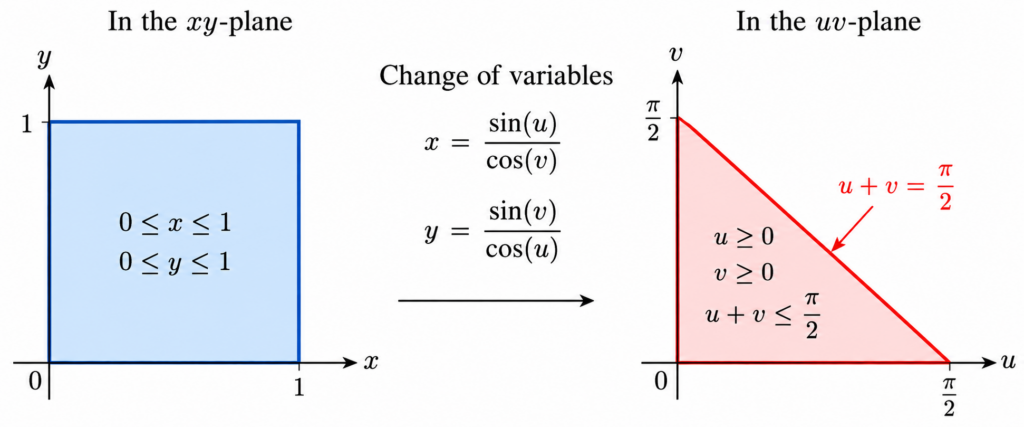
    Now comes the surprising part. Introduce new variables u and v by

    x = sin(u) cos(v) , y = sin(v) cos(u) .

    The square

    0≤x≤1 , 0≤y≤1

    corresponds to the triangular region

    u≥0 , v≥0 , u+v ≤ π2 .

    To see where the last boundary comes from, notice that

    x≤1 ⇔ sin(u) ≤ cos(v) ⇔ u+v ≤ π2 ,

    and the condition on y gives the same inequality.

    The Jacobian

    We compute

    ∂x∂u = cos(u) cos(v) , ∂x∂v = sin(u) sin(v) cos(v) 2 .

    Similarly,

    ∂y∂u = sin(u) sin(v) cos(u) 2 , ∂y∂v = cos(v) cos(u) .

    After simplifying the determinant, the Jacobian is

    ∂(x,y) ∂(u,v) = 1 − x2 y2 .

    This is exactly the expression that appears in the denominator of our original integral. Therefore,

    dxdy 1 − x2 y2 = dudv .

    The complicated-looking integrand has completely disappeared.

    The integral becomes an area

    Our double integral is now simply

    I = ∫ 0 π2 ∫ 0 π2 − u dv du .

    Geometrically, this is the area of a right triangle whose two perpendicular sides both have length

    π2

    Therefore,

    I = 12 · π2 · π2 = π2 8 .

    We have proved that

    1 + 132 + 152 + 172 + ⋯ = π2 8 .

    Recovering the full series

    Let

    T = ∑ n=1 ∞ 1 n2 .

    Split the series into its odd and even terms. The odd terms have sum

    π2 8

    while the even terms have sum

    122 + 142 + 162 + ⋯ = 14 T .

    Consequently,

    T = π2 8 + 14 T .

    Thus,

    34 T = π2 8 ,

    and finally,

    T = π2 6 .

    Why this proof is remarkable

    We started with an infinite series involving nothing but reciprocals of squares. We then represented part of that series by a double integral over a square. A carefully chosen trigonometric change of variables transformed the square into a triangle and, at the same time, made the integrand disappear.

    The infinite series was therefore reduced to the area of a triangle:

    12 · π2 · π2 = π2 8 .

    From there, separating the odd and even terms gives the celebrated result

    ∑ n=1 1 n2 = π2 6 .

    It is a striking example of how an infinite series, a double integral, a trigonometric substitution, and a simple geometric area can all describe the same number.


    Another Problem Where Two Dimensions Help

    The double-integral proof of the Basel sum illustrates a powerful mathematical idea: sometimes a problem becomes easier when we move to a higher dimension.

    One of the most beautiful examples is the Gaussian integral. A one-dimensional integral that resists ordinary antiderivative methods becomes accessible after it is squared and transformed into a two-dimensional integral.

    Continue exploring: The Gaussian Integral and Beyond: From e^(-x²) to a Family of Integrals

    Long before Euler solved the Basel problem, ancient Greek mathematicians had developed ingenious geometric methods for evaluating infinite sums. In particular, Archimedes used areas of triangles to establish a remarkable infinite series identity. Discover his method in How the Ancient Greeks Summed Infinite Series Without Calculus .