One of the most famous identities in mathematics is
In summation notation,
This is known as the Basel problem. Euler famously solved it in the eighteenth century. There are many proofs, but one particularly beautiful approach uses a double integral and an unexpected change of variables.
Start with the odd terms
Instead of attacking the entire series immediately, consider only the reciprocals of the odd squares:
We will first prove that
The full Basel sum will then follow almost immediately.
Turn the series into a double integral
Consider
For points inside the unit square, the geometric-series identity gives
Therefore,
Each one-dimensional integral is
Hence
Thus the double integral is exactly the sum of the reciprocals of the odd squares:
The key change of variables
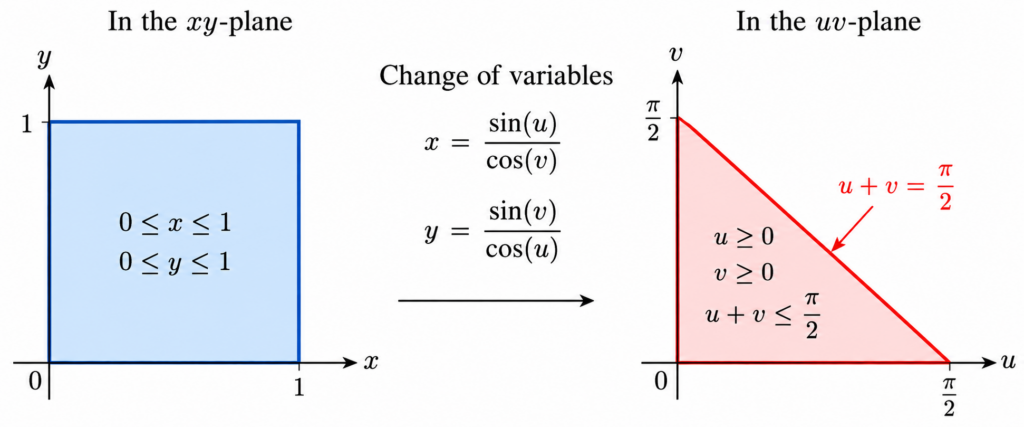
Now comes the surprising part. Introduce new variables u and v by
The square
corresponds to the triangular region
To see where the last boundary comes from, notice that
and the condition on y gives the same inequality.
The Jacobian
We compute
Similarly,
After simplifying the determinant, the Jacobian is
This is exactly the expression that appears in the denominator of our original integral. Therefore,
The complicated-looking integrand has completely disappeared.
The integral becomes an area
Our double integral is now simply
Geometrically, this is the area of a right triangle whose two perpendicular sides both have length
Therefore,
We have proved that
Recovering the full series
Let
Split the series into its odd and even terms. The odd terms have sum
while the even terms have sum
Consequently,
Thus,
and finally,
Why this proof is remarkable
We started with an infinite series involving nothing but reciprocals of squares. We then represented part of that series by a double integral over a square. A carefully chosen trigonometric change of variables transformed the square into a triangle and, at the same time, made the integrand disappear.
The infinite series was therefore reduced to the area of a triangle:
From there, separating the odd and even terms gives the celebrated result
It is a striking example of how an infinite series, a double integral, a trigonometric substitution, and a simple geometric area can all describe the same number.
Another Problem Where Two Dimensions Help
The double-integral proof of the Basel sum illustrates a powerful mathematical idea: sometimes a problem becomes easier when we move to a higher dimension.
One of the most beautiful examples is the Gaussian integral. A one-dimensional integral that resists ordinary antiderivative methods becomes accessible after it is squared and transformed into a two-dimensional integral.
Continue exploring: The Gaussian Integral and Beyond: From e^(-x²) to a Family of Integrals
Long before Euler solved the Basel problem, ancient Greek mathematicians had developed ingenious geometric methods for evaluating infinite sums. In particular, Archimedes used areas of triangles to establish a remarkable infinite series identity. Discover his method in How the Ancient Greeks Summed Infinite Series Without Calculus .