What can the derivative of a polynomial tell us about geometry?
For a cubic polynomial with three complex roots, the answer is
surprisingly precise: the derivative locates the two foci of a
particular ellipse.
Let
where
are three distinct, noncollinear complex numbers.
Every complex number can be represented as a point in the complex
plane. Therefore the three roots of p become three points,
and those three points form a triangle.
Now differentiate. Since p is cubic,
is quadratic and has two roots, counted with multiplicity. Call them
and
Where are these two critical points located, and what do they have
to do with the triangle formed by the original three roots?
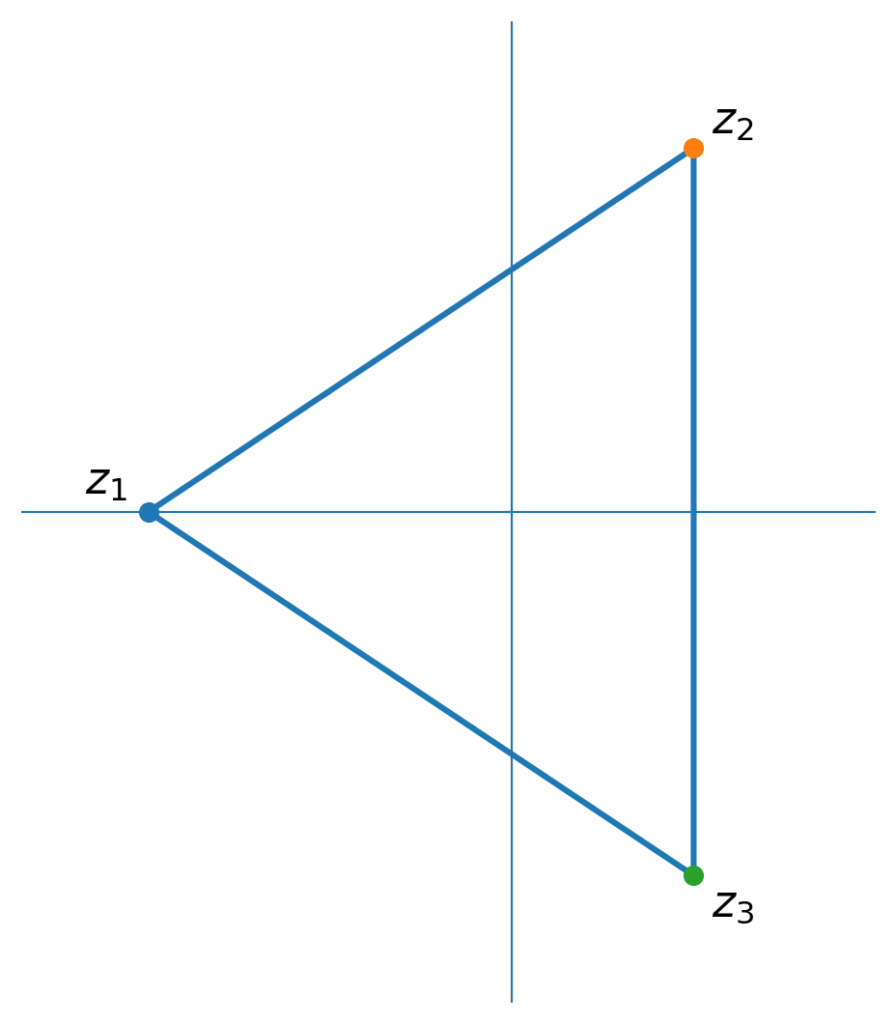
Figure 1. Three noncollinear roots z₁, z₂, and z₃ of a cubic polynomial determine a triangle in the complex plane.
What does the derivative know about the triangle?
There is already a classical theorem that gives us some information.
The Gauss–Lucas theorem states that the zeros of the
derivative of a polynomial lie in the convex hull of the zeros of the
polynomial.
For our cubic, the convex hull of the three roots is simply the triangle
with vertices
Therefore the two zeros of
must lie inside this triangle.
That is already an interesting connection between differentiation and
geometry. But for a cubic, something much stronger is true.
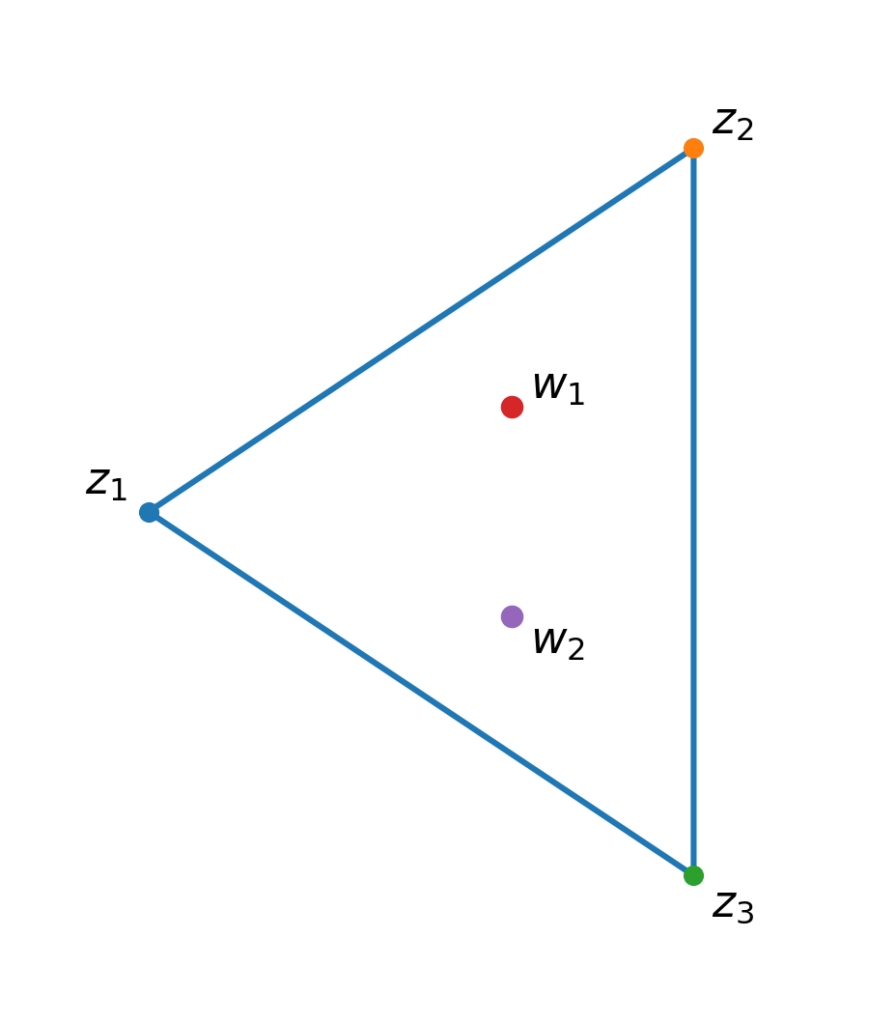
Figure 2. By the Gauss–Lucas theorem, the two zeros w₁ and w₂ of the derivative lie inside the triangle determined by the three roots of the cubic.
Marden’s theorem
Recall the Steiner inellipse of a triangle: the unique
ellipse tangent to the three sides at their midpoints.
Marden’s theorem reveals a completely different way in which the same
ellipse appears.
Marden’s Theorem.
Let
where the three roots are noncollinear. Then the two zeros of
are exactly the two foci of the Steiner inellipse of
the triangle whose vertices are
This is much stronger than Gauss–Lucas. Gauss–Lucas tells us that the
critical points are somewhere inside the triangle. Marden’s theorem
identifies their exact geometric meaning.
The derivative of the cubic has found the foci of an ellipse determined
by the roots of the original polynomial.
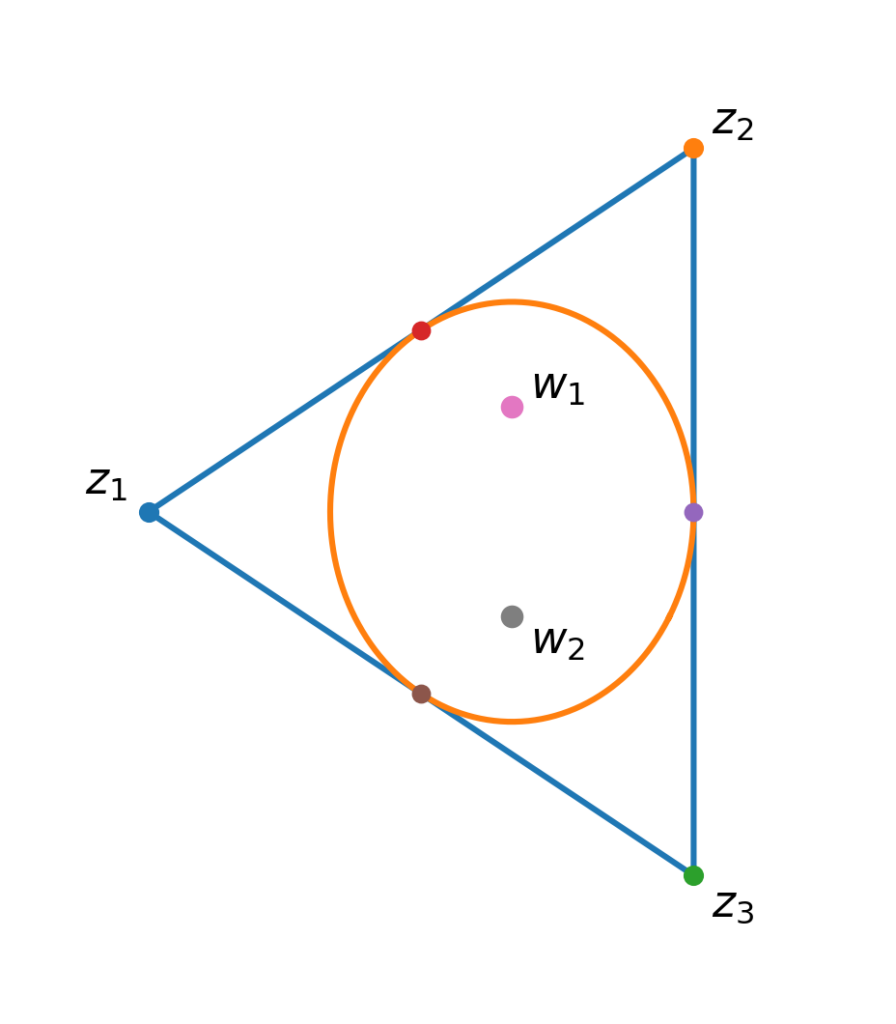
Figure 3. Marden’s theorem: the two zeros w₁ and w₂ of the derivative are exactly the foci of the Steiner inellipse of the triangle formed by z₁, z₂, and z₃.
A concrete example
Let us see the theorem in action. Choose the three roots
The corresponding cubic is
Multiplying the conjugate factors first gives
Hence
Now differentiate:
The critical points satisfy
so
Marden’s theorem now tells us something geometric that would be very
difficult to guess merely by looking at the polynomial:
The two foci of the Steiner inellipse are
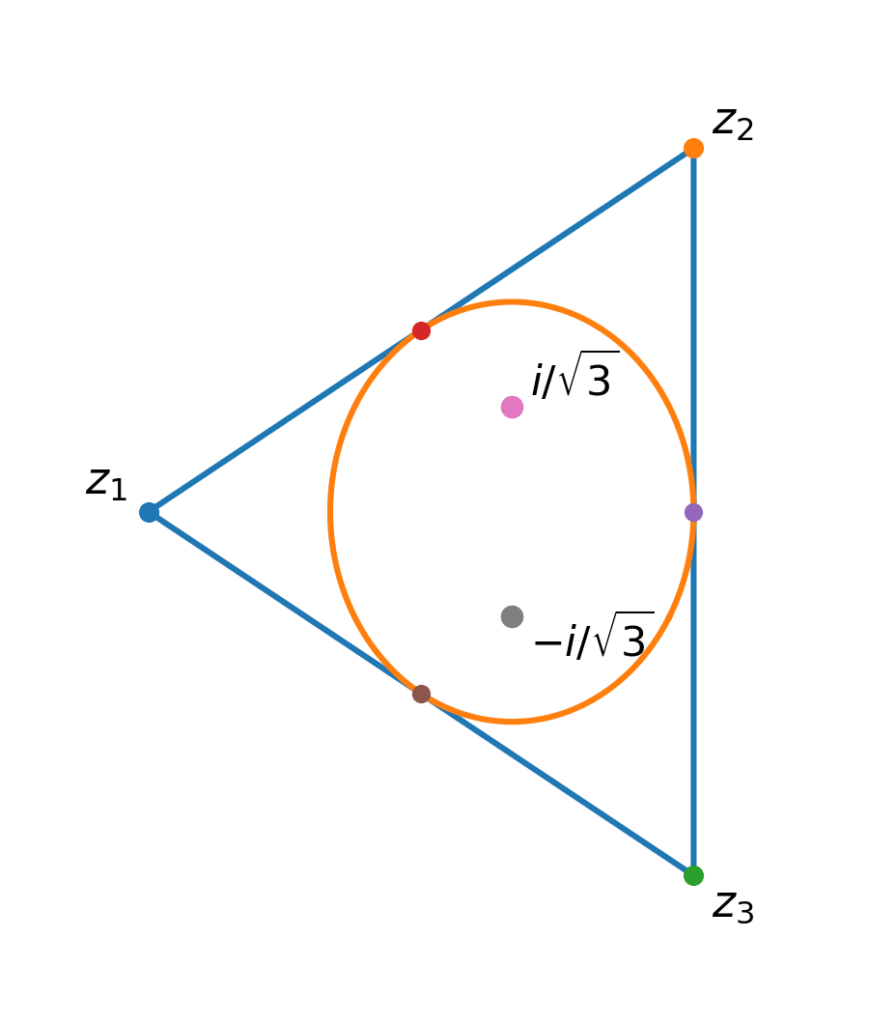
Figure 4. For p(z) = z³ + z + 10, the roots form the displayed triangle, while the zeros ±i/√3 of p′(z) are exactly the foci of its Steiner inellipse.
Why is this so surprising?
The derivative is usually introduced as an analytic object: it measures
instantaneous rate of change, gives the slope of a tangent line, and
locates critical points.
Here it is doing something that looks completely different.
Start with three complex numbers. Use them as the roots of a cubic.
Differentiate the polynomial. Solve one quadratic equation. The two
answers are not merely points somewhere inside the triangle—they are
the two foci of a distinguished ellipse.
In symbols, the chain of ideas is
The same Steiner inellipse therefore admits two very different
descriptions.
In our earlier article, it appeared from an area condition:
a point lies on the ellipse precisely when three corner triangles have
total area equal to half the area of the original triangle.
Here the ellipse appears from differentiation: its two
foci are the zeros of the derivative of the cubic whose roots are the
vertices of the triangle.
This is a beautiful example of a recurring theme in mathematics:
algebra, calculus, and geometry can encode the same object in completely
different ways.
Given a triangle, there are many ellipses that can be drawn inside it.
Among them, one has a particularly beautiful and distinguished place
in geometry: the Steiner inellipse.
What is the Steiner inellipse?
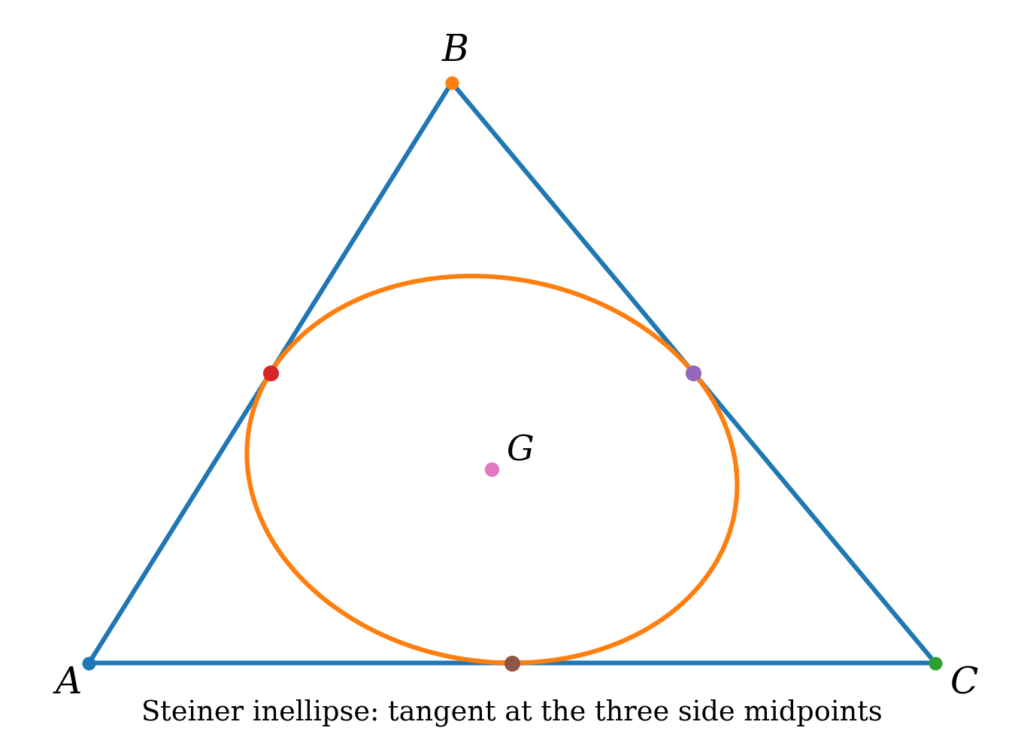
Let ABC be any triangle. The Steiner inellipse
is the unique ellipse contained in the triangle that is tangent to the
three sides at their midpoints.
Thus, if D, E, and F are the midpoints of
BC, CA, and AB, respectively, the Steiner
inellipse passes through all three points and is tangent to the
corresponding sides there.
Its center is the centroid G of the triangle—the point where
the three medians intersect.
The Steiner inellipse also has an extremal property: among all ellipses
contained in a given triangle, it has the largest possible
area.
Why does the Steiner inellipse naturally appear?
One way to understand the Steiner inellipse is through affine geometry.
Every triangle can be obtained from an equilateral triangle by an
invertible affine transformation.
For an equilateral triangle, the Steiner inellipse is simply its
incircle. The incircle touches the three sides at their midpoints and
is centered at the common centroid, incenter, and circumcenter.
Under an affine transformation, a circle generally becomes an ellipse,
midpoints remain midpoints, and tangency is preserved. Therefore the
incircle of an equilateral triangle is transformed into an ellipse
tangent to the three sides of the new triangle at their midpoints.
That ellipse is precisely the Steiner inellipse.
So the Steiner inellipse may be viewed as the affine image of
the incircle of an equilateral triangle.
Figure 1. The Steiner inellipse of triangle ABC. It is the unique ellipse tangent to the three sides at their midpoints, and its center is the centroid G.
A different way to recognize the same ellipse
The definition above characterizes the Steiner inellipse by
tangency: it touches the sides of the triangle at three
special points.
But there is another, rather unexpected way to detect whether a point
lies on this ellipse—one that does not initially mention an ellipse,
tangency, or even distances.
It uses only parallel lines and areas.
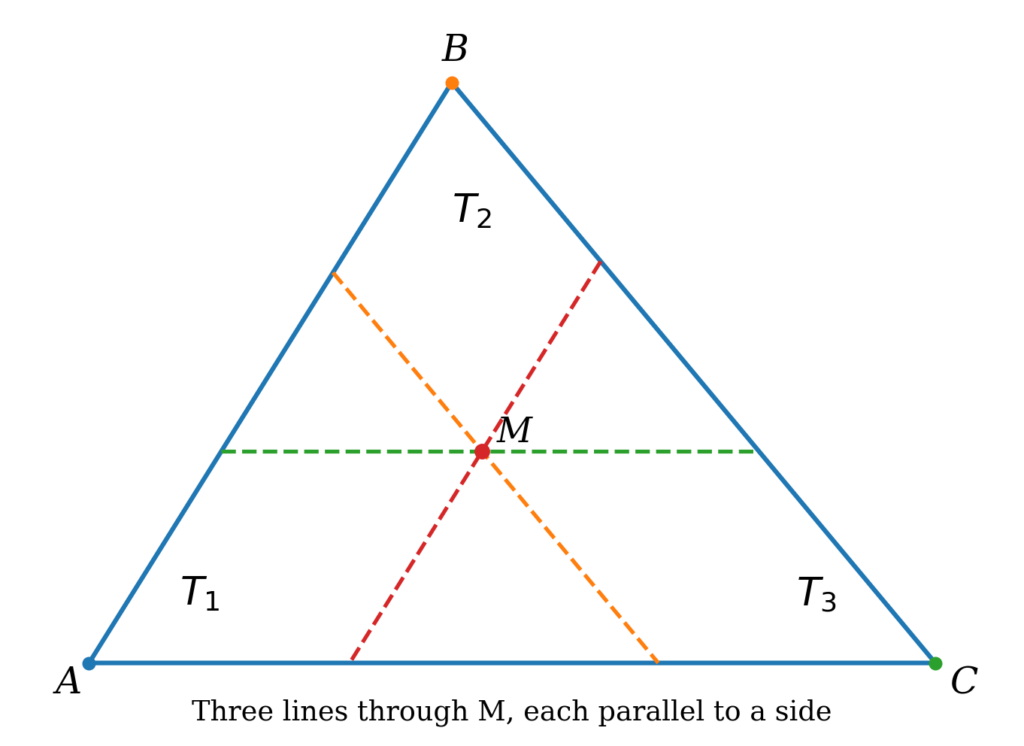
Choose an arbitrary point M inside triangle ABC.
Through M, draw three lines, each parallel to one side of the
triangle.
These three lines cut off three smaller triangles at the vertices
A, B, and C. Let their areas be
Let
denote the area of the original triangle.
Now ask a simple question:
For which points M is the sum of the three corner
areas exactly one-half of the area of the original triangle?
At first glance, there is no obvious reason that the answer should
involve an ellipse at all.
Figure 2. Through an arbitrary interior point M, draw three lines parallel to the sides of triangle ABC. The three corner triangles have areas T₁, T₂, and T₃.
The surprising answer
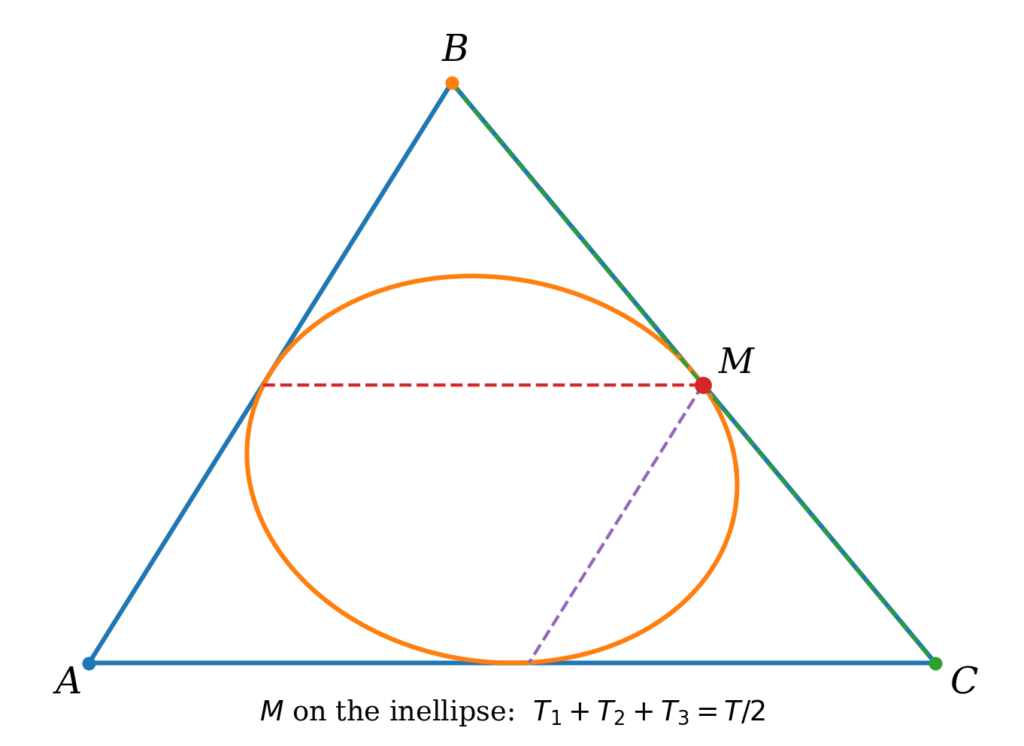
The answer is remarkably simple: the points satisfying this area condition
are exactly the points on the Steiner inellipse.
Theorem.
Let ABC be a triangle with area
,
and let M be a point in its interior. Through M, draw
three lines parallel to the sides of the triangle, cutting off three
corner triangles with areas
,
,
and
.
Then
In other words, a point M lies on the Steiner inellipse
if and only if the three corner triangles together have exactly
half the area of the original triangle.
This is unexpected because the construction itself contains no ellipse.
We choose a point, draw three parallel lines, and measure three areas.
Yet the condition that their sum equals one-half of the total area
traces out precisely the Steiner inellipse.
Why should this be an ellipse?
The key is affine geometry. An invertible affine transformation sends
triangles to triangles, preserves parallelism and ratios of areas, and
sends ellipses to ellipses.
We can therefore transform our original triangle into an equilateral
triangle without changing the essential area condition. In an
equilateral triangle, the Steiner inellipse becomes something much
more familiar: the incircle.
So it is enough to determine which points satisfy the area condition
in the equilateral case.
Figure 3. A point M on the Steiner inellipse. For this point, the three corner areas satisfy T₁ + T₂ + T₃ = T/2.
The equilateral case
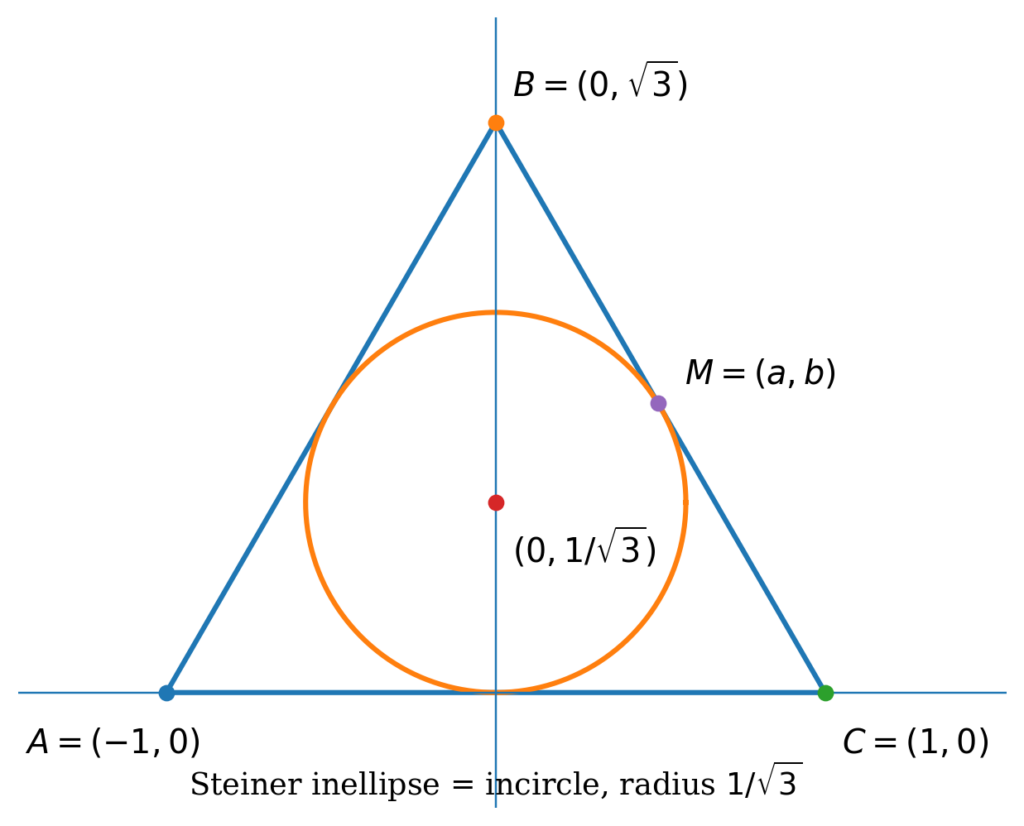
Consider the equilateral triangle with vertices
The base has length 2 and the height is
,
so the area of the triangle is
Let
be an interior point. The three lines through M parallel to the
sides cut off three smaller triangles. Because each corner triangle is
similar to the original equilateral triangle, their areas can be written
in terms of a and b.
A direct calculation gives
and
Now impose our area condition:
Substituting the three expressions above and simplifying gives
Completing the square transforms this into
But this is the equation of the circle centered at
with radius
This is precisely the incircle of our equilateral triangle.
Therefore, in the equilateral case, the points satisfying
are exactly the points on the incircle.
Equilateral triangles often turn geometric questions into especially
elegant problems. For another example, see
Equilateral Triangle Maximum Area
.
Figure 4. In the equilateral case, the Steiner inellipse is the incircle. The area condition produces a circle centered at (0, 1/√3) with radius 1/√3.
Returning to the original triangle
We have proved that, for an equilateral triangle, the condition
describes exactly the incircle.
Now apply the inverse affine transformation that carries the
equilateral triangle back to the original triangle. Parallel lines
remain parallel, and all areas are multiplied by the same factor, so
the area condition is preserved. The incircle is transformed into the
Steiner inellipse.
Therefore, for any triangle, a point M satisfies the area
condition if and only if M lies on the Steiner inellipse.
A related area identity
There is another elegant relation involving the same three corner
triangles. Unlike the characterization above, this identity holds for
every interior point M, not only for points
on the Steiner inellipse.
Since each corner triangle is similar to the original triangle, the
ratio of corresponding side lengths is the square root of the ratio
of the corresponding areas. The three relevant length ratios add to 1,
which gives
The contrast between the two identities is worth noticing.
For every interior point M,
But without the square roots,
holds precisely when M lies on the Steiner inellipse.
Thus the same three corner areas give both a universal identity and
a geometric characterization of a special ellipse.
There is another remarkable way in which the Steiner inellipse appears.
If the vertices of the triangle are regarded as the three complex roots
of a cubic polynomial, the zeros of its derivative are exactly the two
foci of the Steiner inellipse. See
Marden’s Theorem: How the Derivative of a Cubic Finds an Ellipse
.
The first reference contains the area characterization of the Steiner
inellipse discussed in this article. The second gives an earlier
appearance of the classical square-root area problem. The third provides
additional background on the Steiner inellipse and its connection with
Marden’s theorem.