What can the derivative of a polynomial tell us about geometry? For a cubic polynomial with three complex roots, the answer is surprisingly precise: the derivative locates the two foci of a particular ellipse.
Let
where are three distinct, noncollinear complex numbers.
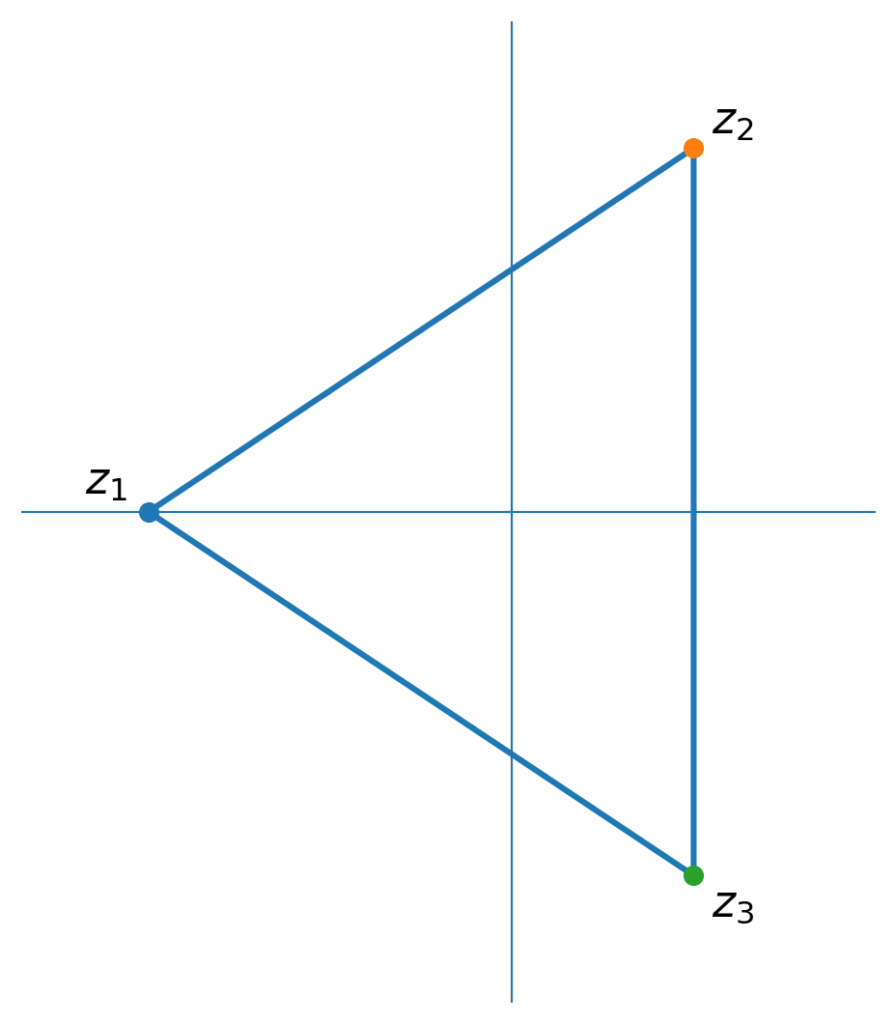
Every complex number can be represented as a point in the complex plane. Therefore the three roots of p become three points, and those three points form a triangle.
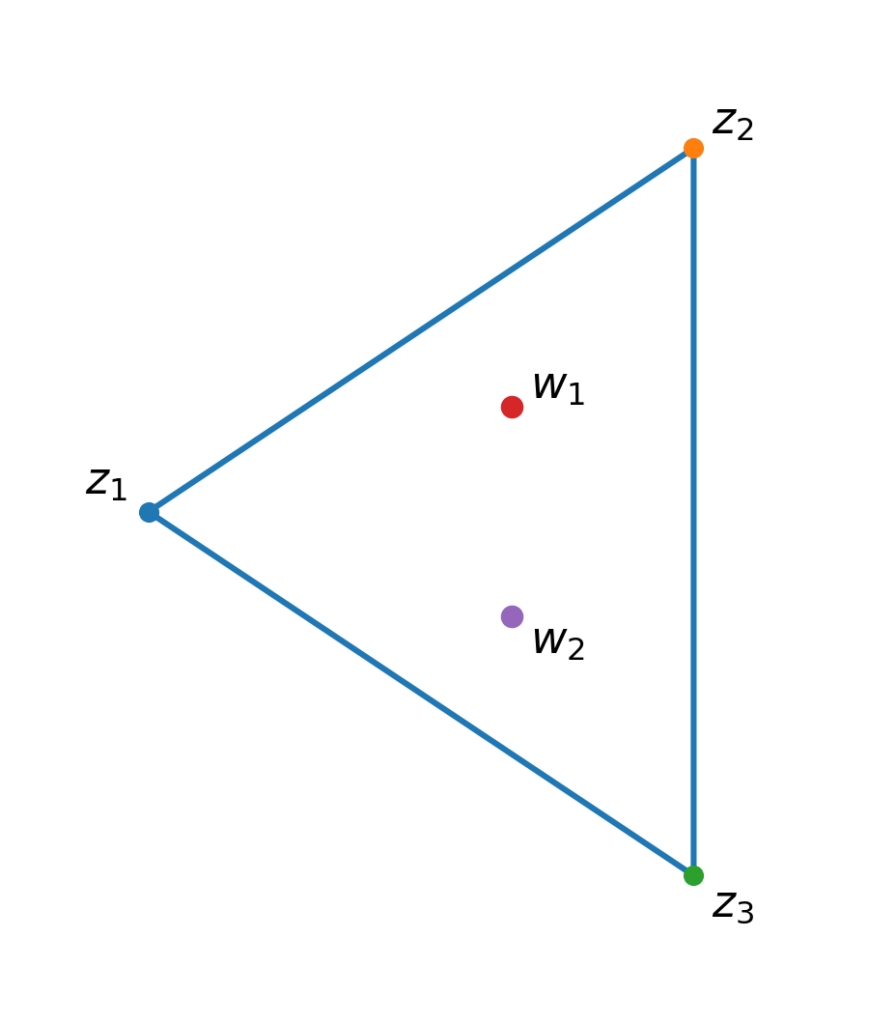
Now differentiate. Since p is cubic, is quadratic and has two roots, counted with multiplicity. Call them and
Where are these two critical points located, and what do they have to do with the triangle formed by the original three roots?
What does the derivative know about the triangle?
There is already a classical theorem that gives us some information. The Gauss–Lucas theorem states that the zeros of the derivative of a polynomial lie in the convex hull of the zeros of the polynomial.
For our cubic, the convex hull of the three roots is simply the triangle with vertices Therefore the two zeros of must lie inside this triangle.
That is already an interesting connection between differentiation and geometry. But for a cubic, something much stronger is true.
Marden’s theorem
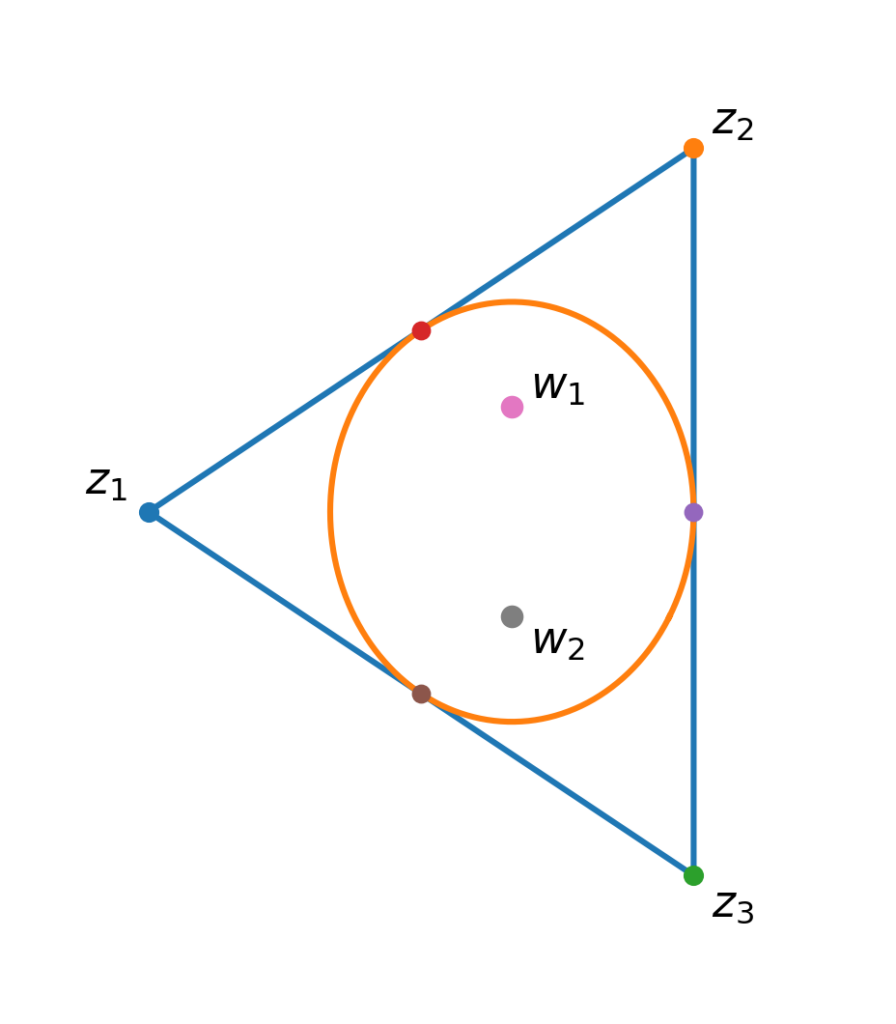
Recall the Steiner inellipse of a triangle: the unique ellipse tangent to the three sides at their midpoints.
We discussed this ellipse and an area characterization of it in The Steiner Inellipse and a Surprising Area Characterization .
Marden’s theorem reveals a completely different way in which the same ellipse appears.
Marden’s Theorem. Let
where the three roots are noncollinear. Then the two zeros of are exactly the two foci of the Steiner inellipse of the triangle whose vertices are
This is much stronger than Gauss–Lucas. Gauss–Lucas tells us that the critical points are somewhere inside the triangle. Marden’s theorem identifies their exact geometric meaning.
The derivative of the cubic has found the foci of an ellipse determined by the roots of the original polynomial.
A concrete example
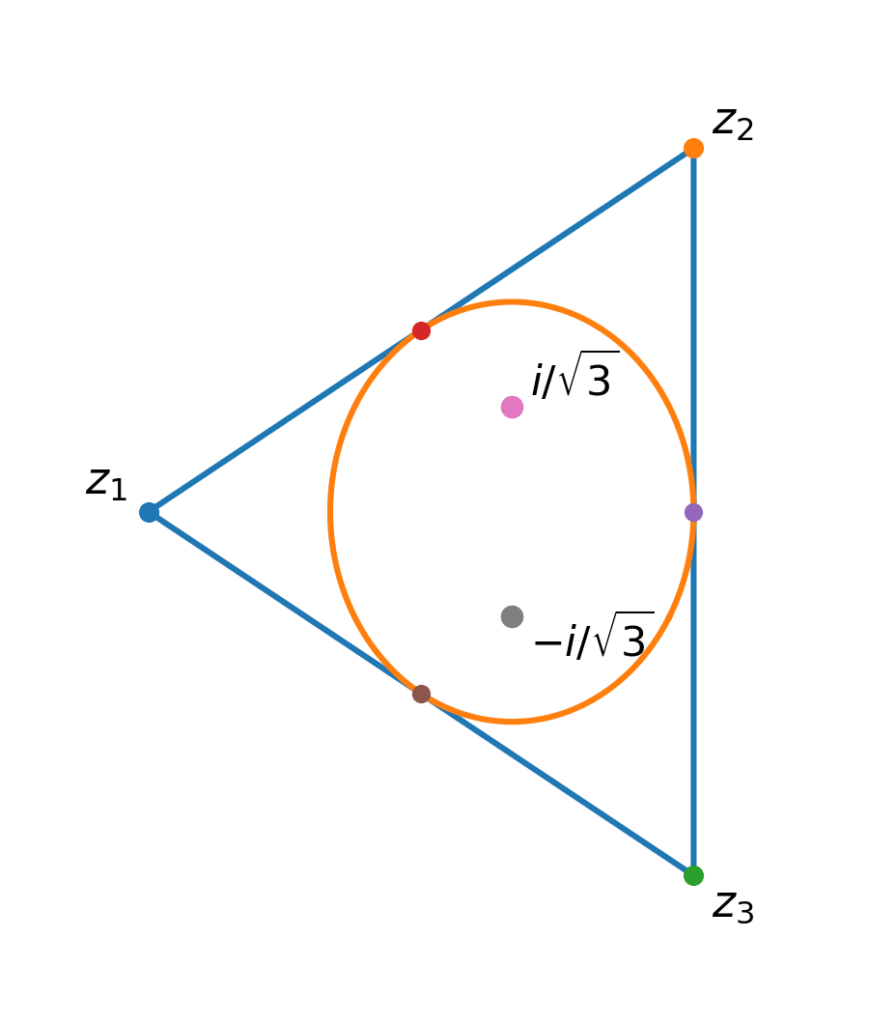
Let us see the theorem in action. Choose the three roots
The corresponding cubic is
Multiplying the conjugate factors first gives
Hence
Now differentiate:
The critical points satisfy
so
Marden’s theorem now tells us something geometric that would be very difficult to guess merely by looking at the polynomial:
The two foci of the Steiner inellipse are
Why is this so surprising?
The derivative is usually introduced as an analytic object: it measures instantaneous rate of change, gives the slope of a tangent line, and locates critical points.
Here it is doing something that looks completely different.
Start with three complex numbers. Use them as the roots of a cubic. Differentiate the polynomial. Solve one quadratic equation. The two answers are not merely points somewhere inside the triangle—they are the two foci of a distinguished ellipse.
In symbols, the chain of ideas is
The same Steiner inellipse therefore admits two very different descriptions.
In our earlier article, it appeared from an area condition: a point lies on the ellipse precisely when three corner triangles have total area equal to half the area of the original triangle.
Here the ellipse appears from differentiation: its two foci are the zeros of the derivative of the cubic whose roots are the vertices of the triangle.
This is a beautiful example of a recurring theme in mathematics: algebra, calculus, and geometry can encode the same object in completely different ways.
References and further reading
- D. Kalman, “An Elementary Proof of Marden’s Theorem” , The American Mathematical Monthly, Vol. 115, No. 4 (2008), pp. 330–338.
- A. Eydelzon, “On a New Property of the Steiner Inellipse” , The American Mathematical Monthly, Vol. 127, No. 10 (2020), pp. 933–935.